The ubiquitous magnetic fields present in the Universe are key factors influencing the interstellar medium across the full dynamic range relevant to massive star formation, from large galactic-scale gas flows down to the small dense clumps where stars are born. Characterizing these rather elusive fields in the highly turbulent Galactic mid-plane is therefore essential for understanding the evolution of galaxies.
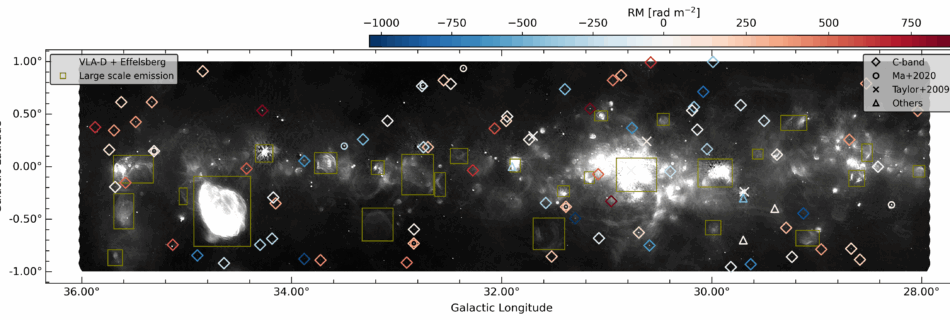
We present the first C-band (4-8 GHz) rotation measure (RM) grid of the Galactic plane, constructed using data from the Global view on Star formation (GLOSTAR) survey. Using the Karl G. Jansky Very Large Array and the Effelsberg 100 m telescope, GLOSTAR achieves 1.5″ angular resolution and a sensitivity of ~60–150 μJy beam⁻¹. By probing Faraday rotation of background extragalactic sources, we map the magnetized, turbulent foreground of the inner Galaxy toward the first Galactic quadrant. The reduced wavelength-dependent depolarization and fine frequency resolution at C-band enable us to penetrate the dense, turbulent interstellar medium and to be sensitive to extreme RMs up to 10^5 rad m⁻².
We have employed a two-pronged approach to quantify the instrumental polarization leakage off-axis. First, we have compared the polarization properties of the bright sources in the survey footprint in the multiple individual pointings in which they are present, as well as in the mosaic. This allows us to quantify how the instrumental polarization varies across the primary beam. Second, we made use of HII regions, which are known to be dominated by unpolarized free-free emission, to estimate the residual instrumental leakage. Together, these two approaches provide a conservative upper limit on the off-axis instrumental polarization of 1.4%.
Within the GLOSTAR pilot region, we detected 79 polarized sources, with a total of 84 components, which corresponds to an areal denisty of ~5 RMs per square degrees. The maximum |RM| is 1661 rad m⁻², with a standard deviation of 474 rad m⁻² and a typical uncertainty of ~48 rad m⁻². The GLOSTAR RM spread is more than twice that of previous low-frequency surveys. A Kolmogorov-Smirnov test confirms that the distributions differ at >3σ significance. We have ruled out higher C-band uncertainties, bandwidth depolarization, and nπ ambiguity in L-band RMs as the main reasons for the enhanced spread. This points towards C band polarized sightlines uniquely probing through strong fluctuations in densities and magnetic fields in the Galactic mid-plane, producing this spread. C-band thus provides us with an unbiased view of the Galactic magnetic field, complementary to lower frequency observations.
Preliminary analysis of the full GLOSTAR footprint has shown that we reach a source density similar to the pilot region, resulting in ~600 polarized sources with peak polarized fractions > 2% above 7 sigma in polarization. This surpasses the ~70 sources detected by the recently published SPICE-RACS catalog at 1.4 GHz in the same region, providing unique probes of the magneto-ionic medium through the plane. These new RMs will unlock the full picture of the Galactic magnetic field in the first Galactic quadrant.
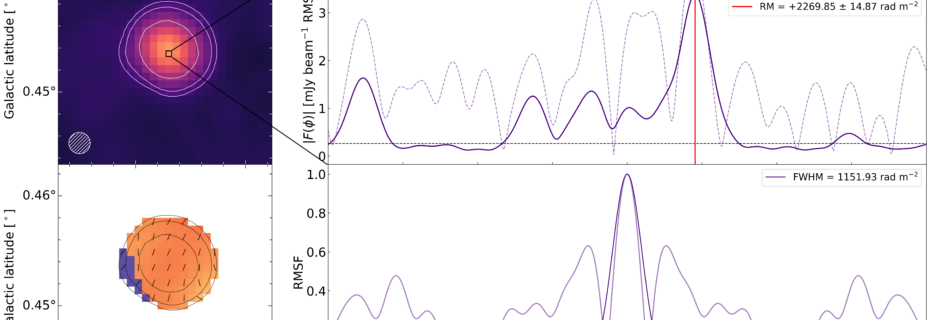
Figure shows an example of polarized source. The left panels shows the polarized intensity and the RM. The right panels show the Faraday dispersion function and the RM spread function.