August 17-21, 2026
at the University of Cologne
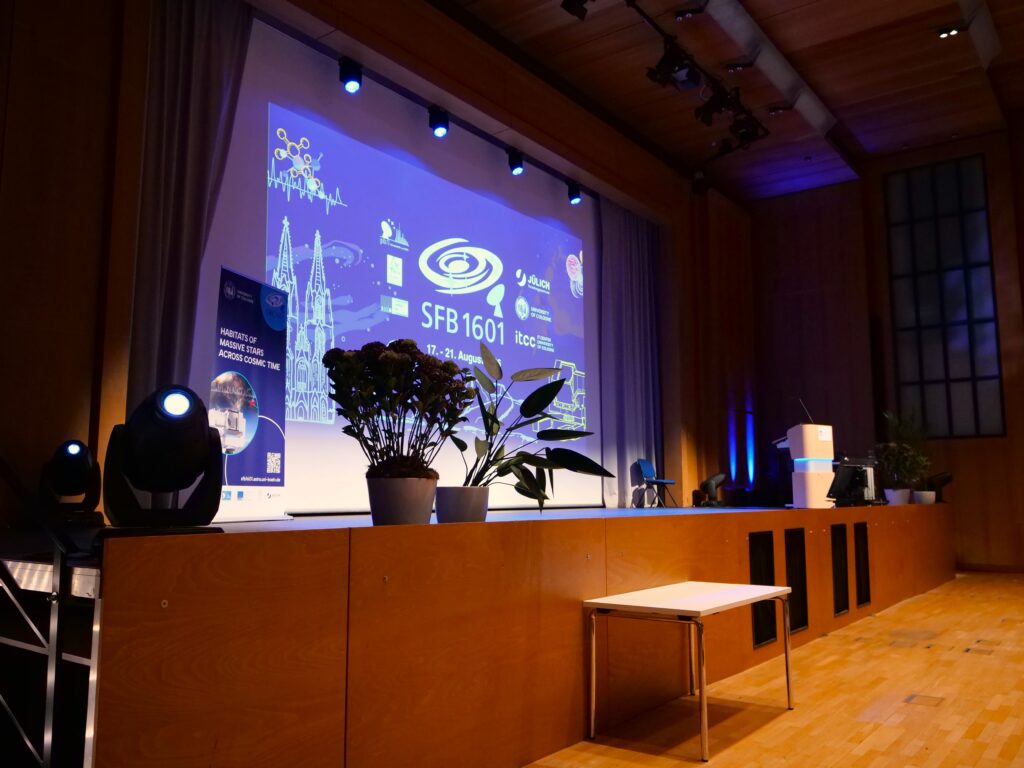
We are excited to announce a conference that will bring together the world’s top researchers in the field of massive star formation and evolution, with a focus on the latest advances in simulations and observations. This meeting will provide a unique opportunity to explore the latest discoveries and advancements in our understanding of the habitats of massive stars across cosmic time.
Massive stars shape the evolution of galaxies through their intense radiation, feedback and ultimate deaths, yet their habitats and impact vary widely across cosmic time. Understanding the life cycle of baryonic matter, the chemical enrichment of the Universe and the regulation of star formation requires two major steps: first, bridging the large dynamic range in scale from sub-parsec dense clumps where stars are born up to hundreds of kiloparsecs in the circumgalactic medium that is affected by their feedback, and second, comparing environments that range from quiescent, nearby spiral galaxies to turbulent, high-redshift starbusts. This symposium aims to unite experts in observations, theory, simulations, laboratory astrophysics and instrumentation to identify the key physical and chemical processes governing the formation and impact of massive stars in their diverse cosmic habitats. The main questions to be addressed will focus on how universal the massive star formation process is across these diverse environments, how efficient stellar feedback is in dispersing different media, and whether the processes and structures observed locally are universal across the Universe.
Conference Highlights:
- Plenary talks by leading experts in the field
- Contributed talks and posters by early-career researchers
- Science Slam
- Interactive discussions and debates on the latest research findings
- Opportunities for networking and collaboration with colleagues from around the world
Invited Speakers:
- Giuliana Cosentino (IRAM, France)
- Robin Garrod (University of Virginia, USA)
- Jacqueline Hodge (Leiden Observatory, The Netherlands)
- Ralf Klessen (University of Heidelberg, Germany)
- Janice Lee (Space Telescope Science Institute, USA)
- Anna McLeod (Durham University, UK)
- Peter Schilke (University of Cologne)
- Kei Tanaka (Institute of Science Tokyo, Japan)
Local Organising Committee
- Emma Bordier
- Francesca Borg
- Isabelle Breloy
- Petra Fackendahl
- Constantina Fotopoulou-Rathjen
- Ying-Chi Hu
- Volker Ossenkopf-Okada
- Tatiana Rodriguez
- Daniel Seifried
- Robert Simon
- Sven Thorwirth
- Stefanie Walch-Gassner
Scientific Organising Committee
- Frank Bigiel (University Bonn)
- Pierre Cox (Institut d’Astrophysique de Paris)
- Arshia Jacob (University of Cologne)
- René Oudmaijer (University of Leeds)
- Elena Redaelli (ESO)
- Anna Rosen (University of California)
- Marta Sewilo (University of Maryland)
- Stefanie Walch-Gassner (University of Cologne)
View the talks and posters presented at the msf2026 (only for participants, password-protected)
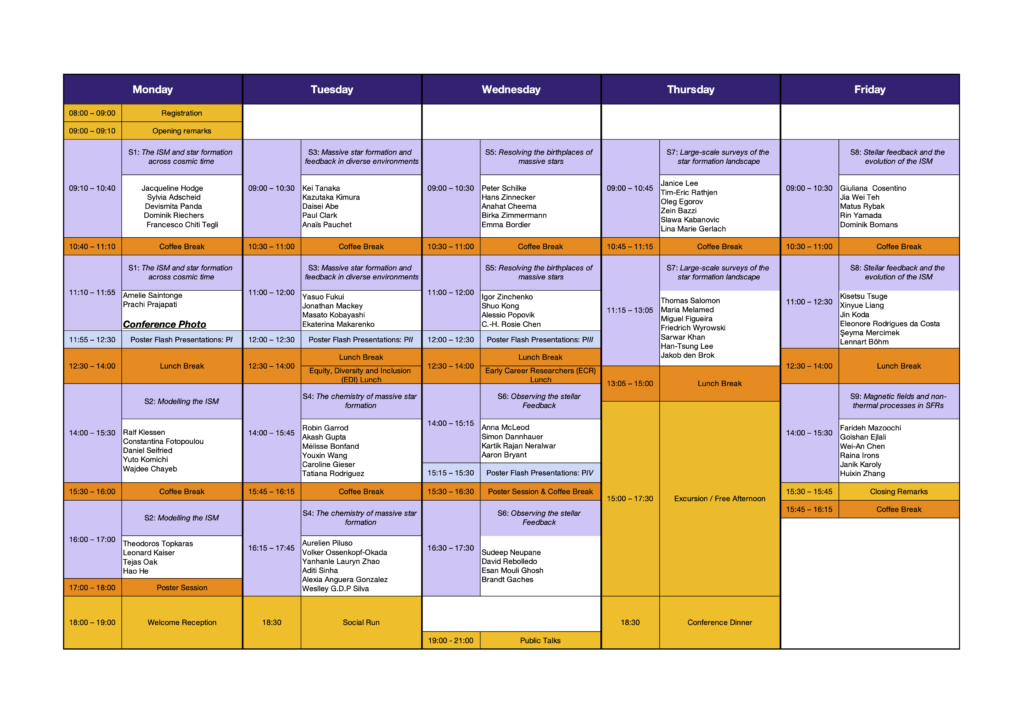
A detailed program and the book of abstract can be downloaded on the right!
A detailed program and the book of abstract can be downloaded below!
Welcome Evening (17.8.26)
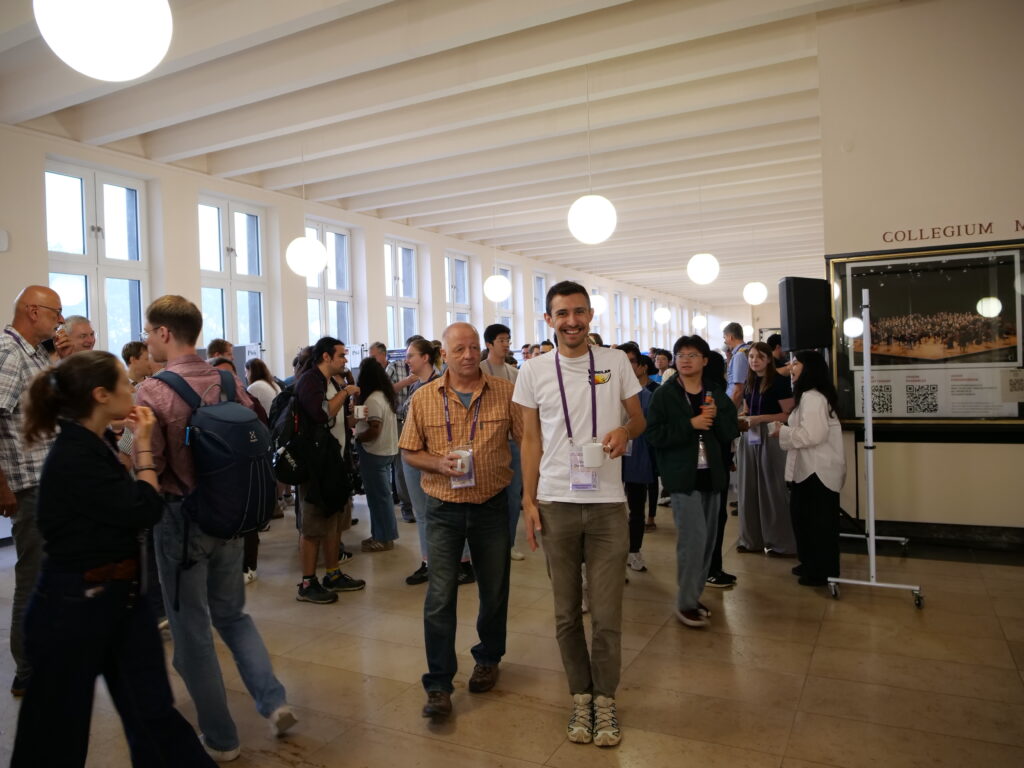
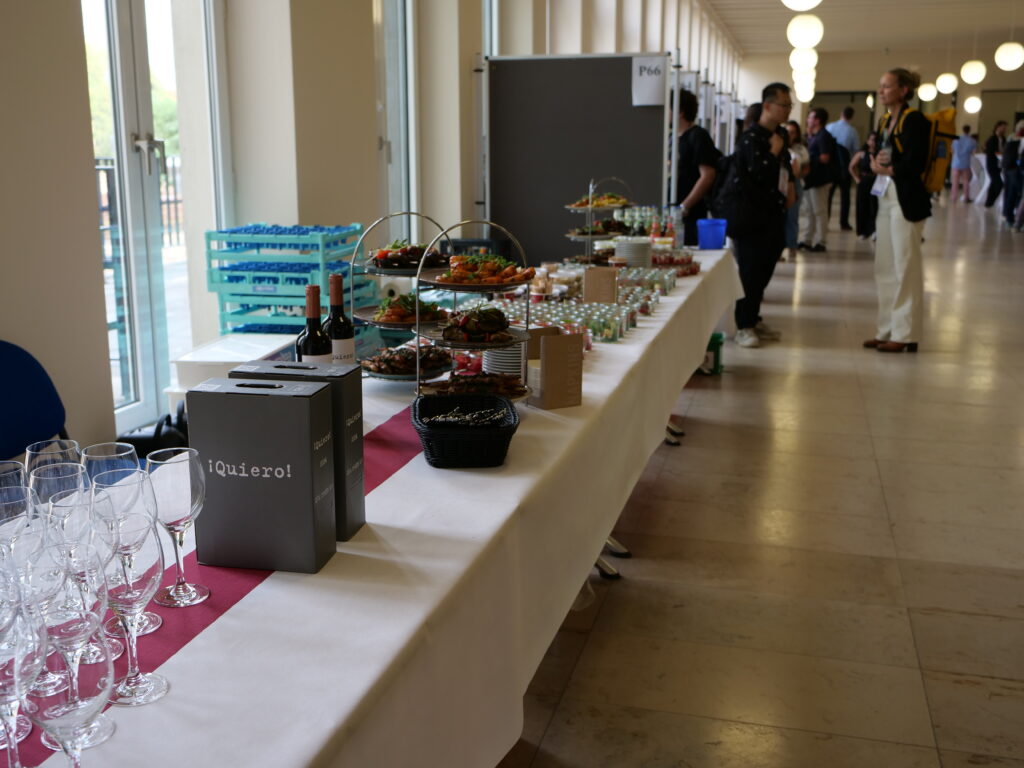
The conference will start with a welcome event combined with a first poster session. There will be snacks and wine.
Equity, Diversity & Inclusion lunch session (18.8.26)
A dedicated lunch session focusing on diversity and inclusion will be held during the symposium. Registration is required (Tab: Events)
Social run (18.8.26)
Early career researchers lunch session (19.8.26)
A dedicated lunch session for ECRs focusing on career paths in Astronomy will be held during the symposium. Registration is required (Tab: Events)
Public talk (19.8.26)
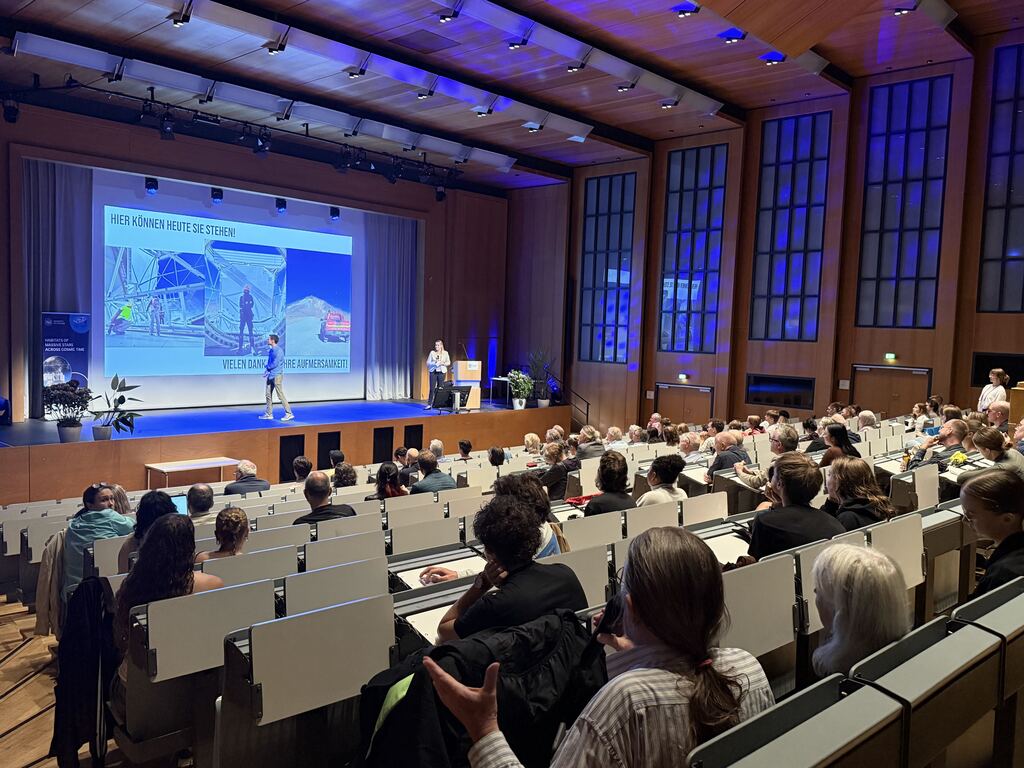
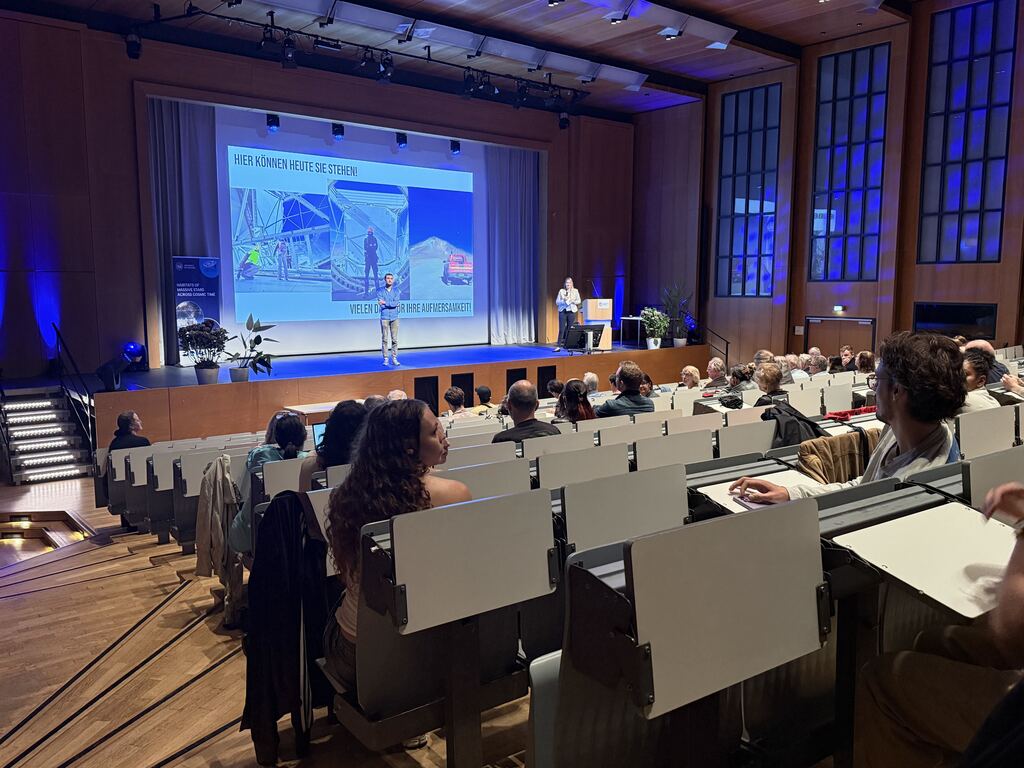
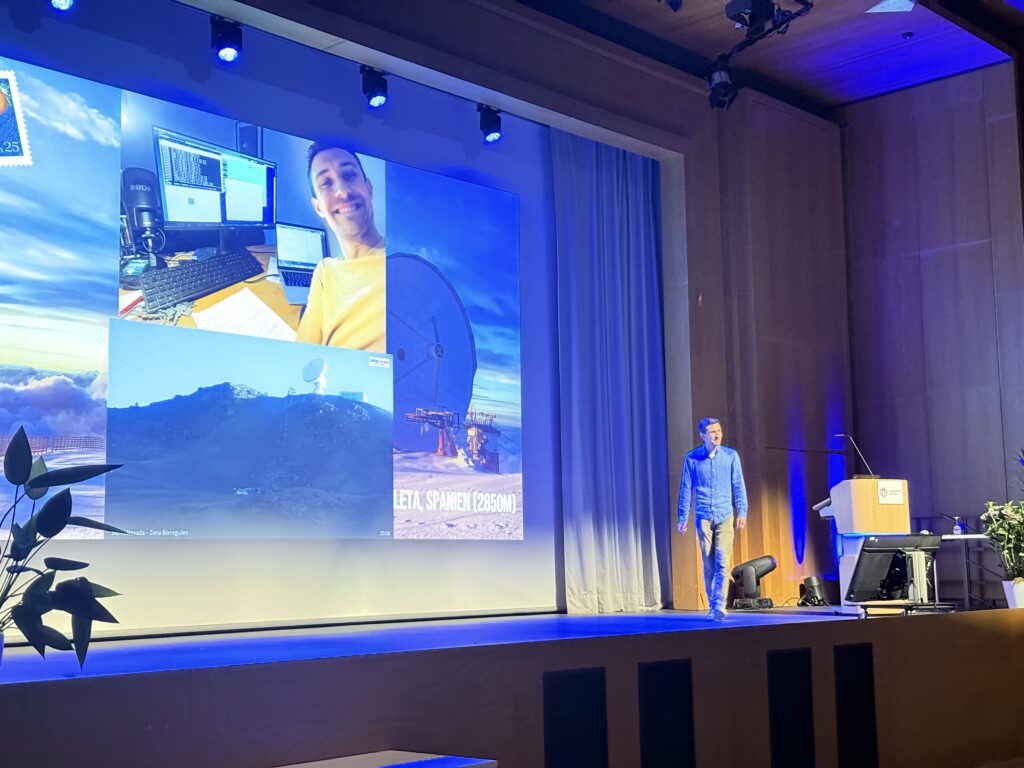
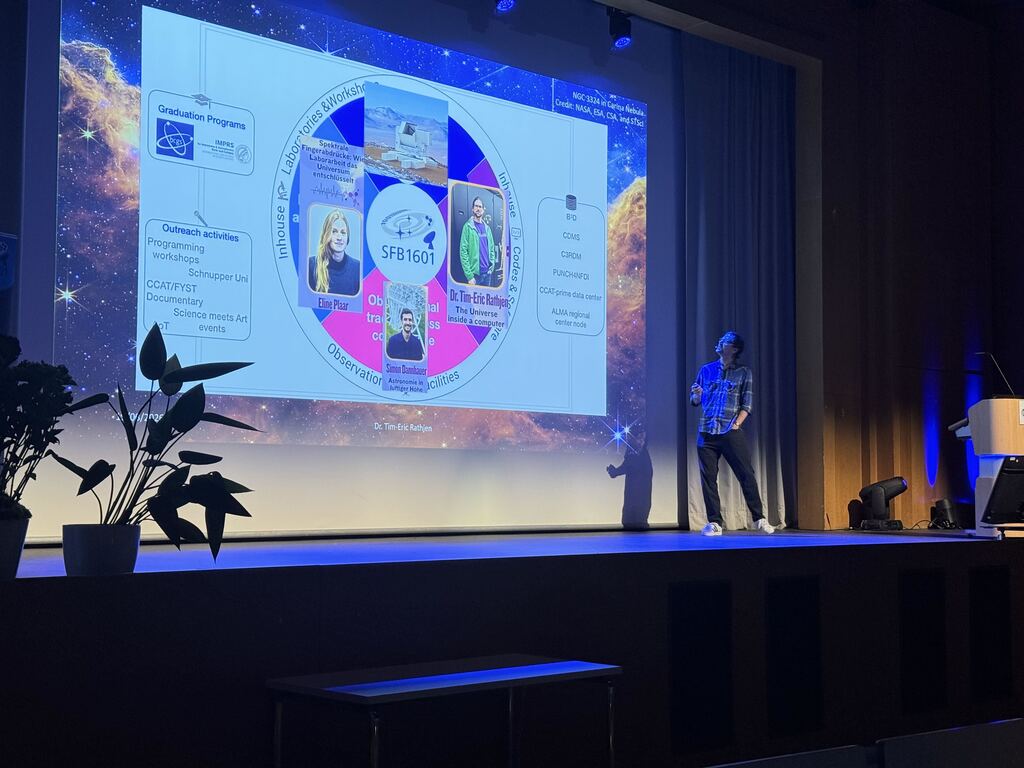
We welcome you to a public talk during our conference. 3 Scientists from the CRC 1601 will contribute to the conference with an easily understandable and fun lecture about Astronomy.
Social Event (20.8.26)
We have booked English tours of the Old town in Cologne. In small groups you will ! be taken on a journey through time: from Roman Colonia to medieval Cologne with its churches, guilds and merchants, through the times of war destruction and reconstruction to modern urban development and today’s Cologne.
Conference Dinner (20.8.26)
We are pleased to announce that during the conference dinner taking place at Herbrand’s (Ehrenfeld) on Thursday evening, Jürgen Stutzki will deliver a talk detailing the developments and history of the CCAT project.
Welcome reception: Monday evening
Equity, Diversity & Inclusion Lunch: Tuesday lunchtime
Social run: Tuesday evening
Early career researchers Lunch: Wednesday lunchtime
Public talk & Public Observatory: Wednesday evening
Social event: Thursday afternoon
Conference dinner: Thursday 7pm
Equity, Diversity & Inclusion lunch event
Tuesday, 18.08.2025
12:30 pm – 2:00 pm
What comes to mind when you hear the word “diversity”? It is not an exclusive club but rather the collective story of everyone in the room. After all, diversity is the spice of life, it’s about culture, background, language, gender, disability, identity, beliefs, life experiences: all the things that shape how we see the world and how the world sees us.
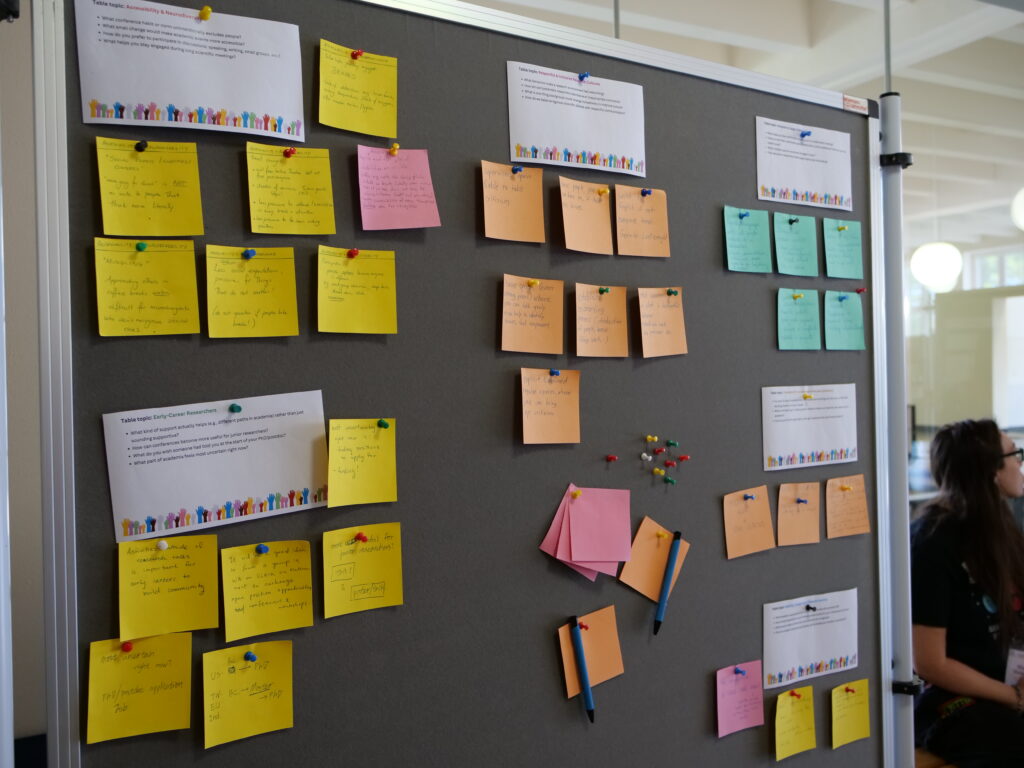
We would like to invite all SFB Symposium participants to join us for an informal Diversity and Inclusion Lunch. Taking place around a shared lunch (provided by the organization), this event is designed as a relaxed and interactive space to meet other participants, exchange experiences, and discuss how we can build a more inclusive, accessible, and supportive astrophysics community.
Participants will join themed discussion tables covering topics such as:
- Inclusion in large collaborations
- Early-career researchers
- Accessibility and neurodiversity in academia
- Mobility, caregiving, and work-life balance
- Respectful and inclusive research cultures
We hope you will join us for an open, thoughtful, and friendly conversation alongside the scientific programme. No preparation or prior expertise is needed, everyone is welcome, from students to senior researchers. You don’t need to be an expert. You don’t need to have the “right” opinions. You don’t even need to talk if you don’t feel like it: some people like to share, some prefer to just listen. If it sounds like something you’d like to try, come join us!
To help us plan the room setup and catering, we kindly ask participants to register in advance if they would like to attend the lunch discussion. – Registration has closed –
Pack your running shoes! We will organize an informal, easy-paced evening social run on Tuesday evening. We meet at 18.30pm in front of the registration desk. Your luggage can be stored securely.
Early career researchers lunch event
Wednesday, 19.08.2025
12:30 pm – 2:00 pm
We invite early career researchers to attend our ECR Lunch, which will take place on Wednesday 16th August during the lunch break between 12:30 and 14:00. This will be an informal Q&A panel format event where lunch will be provided by the organizers, and we have invited four panelists who are currently pursuing different careers in astrophysics. We will have panelists from academia, industry, and the Deutsches Zentrum für Luft- und Raumfahrt (DLR):
- Dr Aleena Baby – machine learning engineer at ACCESS e.V. & founder of Academia to Industry (check out her LinkedIn: https://www.linkedin.com/in/aleena-baby and website: https://academiatoindustry.com)
- Dr Divita Gupta – a Marie Skłodowska-Curie fellow at the University of Cologne (learn about her current research and academic journey through her website: https://decodingastrochemysteries-divitagupta.com/)
- Dr Maude Charmetant – a scientific advisor at the German Aerospace Center (DLR) (learn about her experience on her LinkedIn: http://www.linkedin.com/in/maude-charmetant-05259010a).
- Dr Alexander Wojtczak – a scientific project coordinator at the German Aerospace Center (DLR)
The students and postdocs will have the opportunity to ask the speakers questions about their current positions, their previous experience, the process of job hunting in Germany and the opportunities available to them during and after pursuing academic careers in astrophysics research.
The capacity of the event is limited to 30 participants, so please register in advance via the form below if you wish to attend. – Registration has closed –
Public Talks
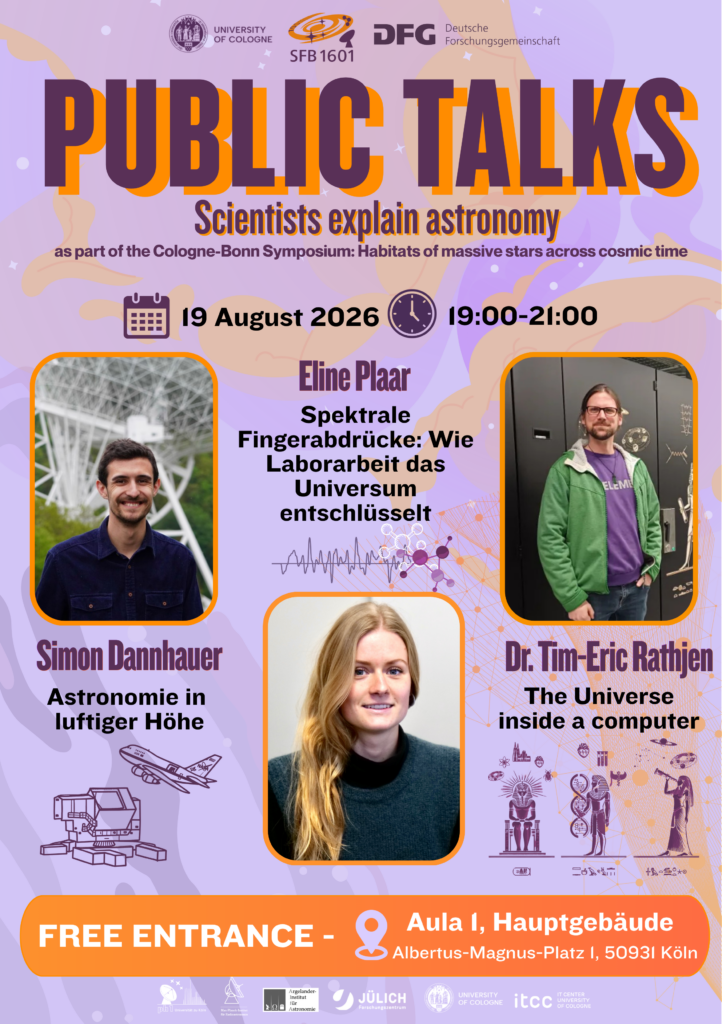
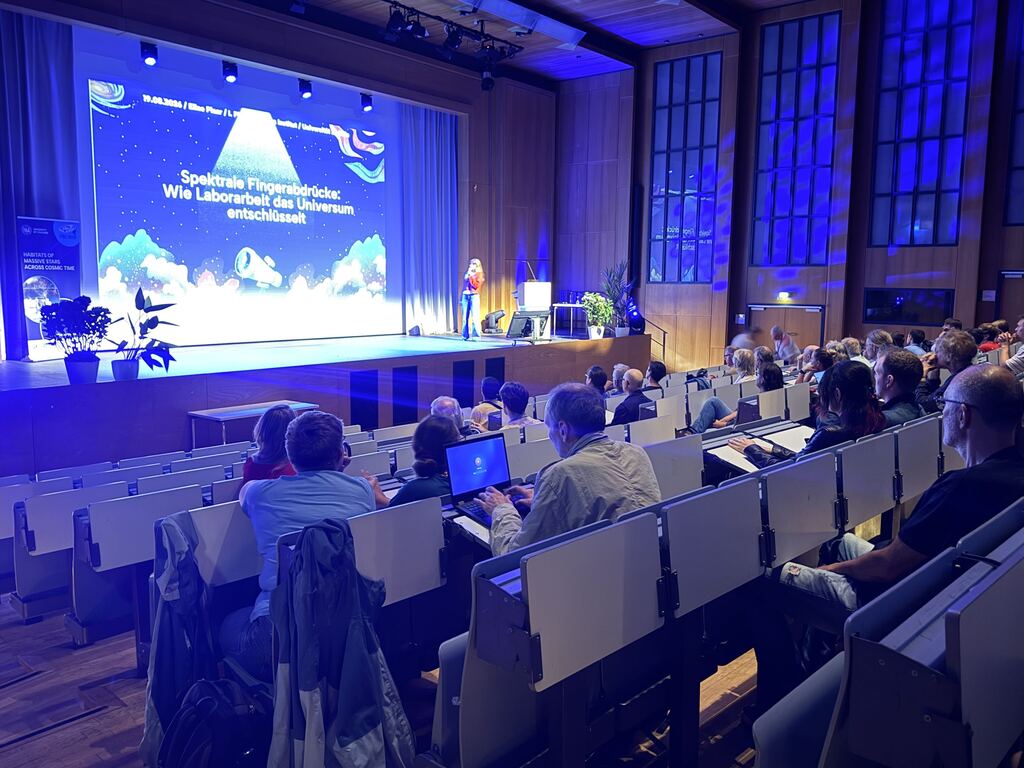
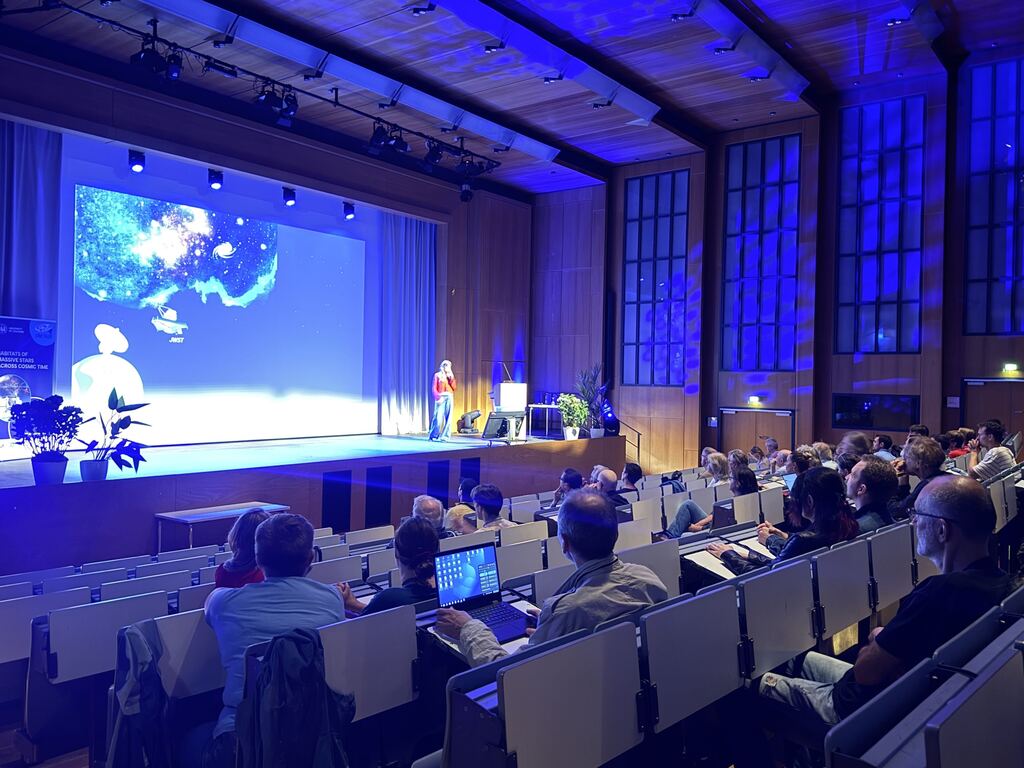
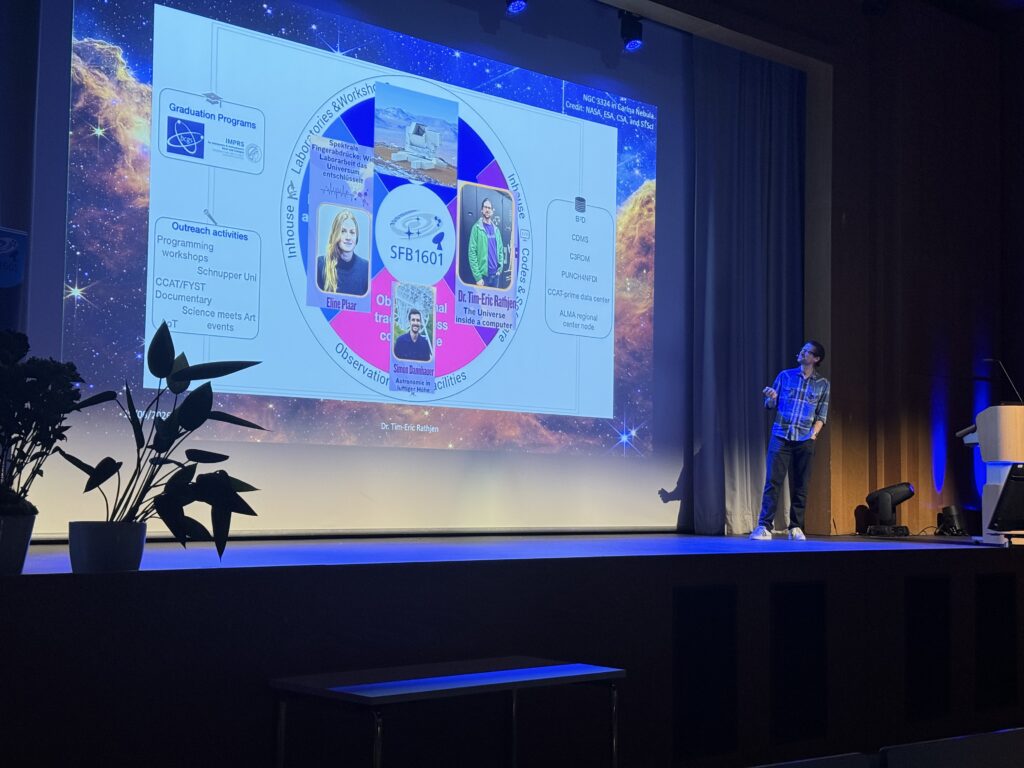
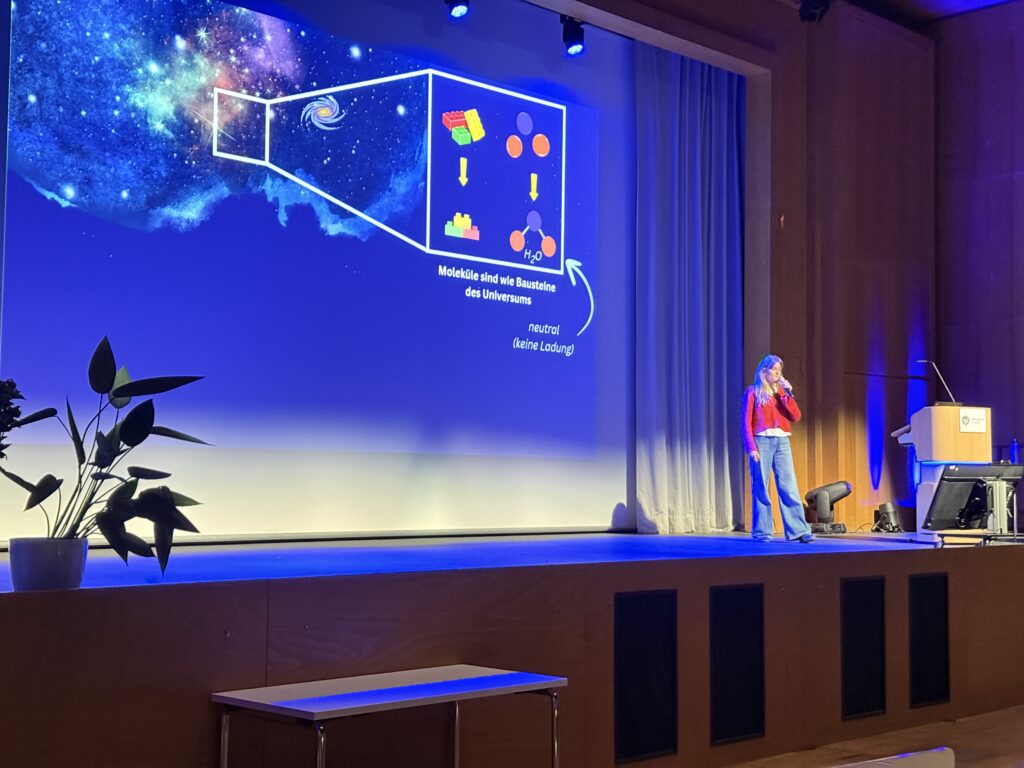
Eline Plaar:
‚Spektrale Fingerabdrücke: Wie Laborarbeit das Universum entschlüsselt‘
Wie erkennen wir die chemische Zusammensetzung entfernter Sterne, Wolken oder Exoplanetenatmosphären? Der Schlüssel liegt in der Molekülspektroskopie: Jedes Molekül absorbiert und emittiert Licht auf charakteristische Weise und hinterlässt damit einen unverwechselbaren spektralen Fingerabdruck. Der Vortrag erklärt, wie diese Fingerabdrücke entstehen und wie Astronomen sie nutzen, um das Universum chemisch zu kartieren – denn ohne präzise Labordaten bleiben selbst die hochauflösendsten Spektren moderner Teleskope wie des James Webb Space Telescopes stumm. Mit besonderem Blick auf geladene Moleküle, die im Rahmen der Forschung mit Ionenfallen untersucht werden, wird deutlich, wie Laborspektroskopie und astronomische Beobachtung Hand in Hand gehen.
Simon Dannhauer:
Astronomie in luftiger Höhe
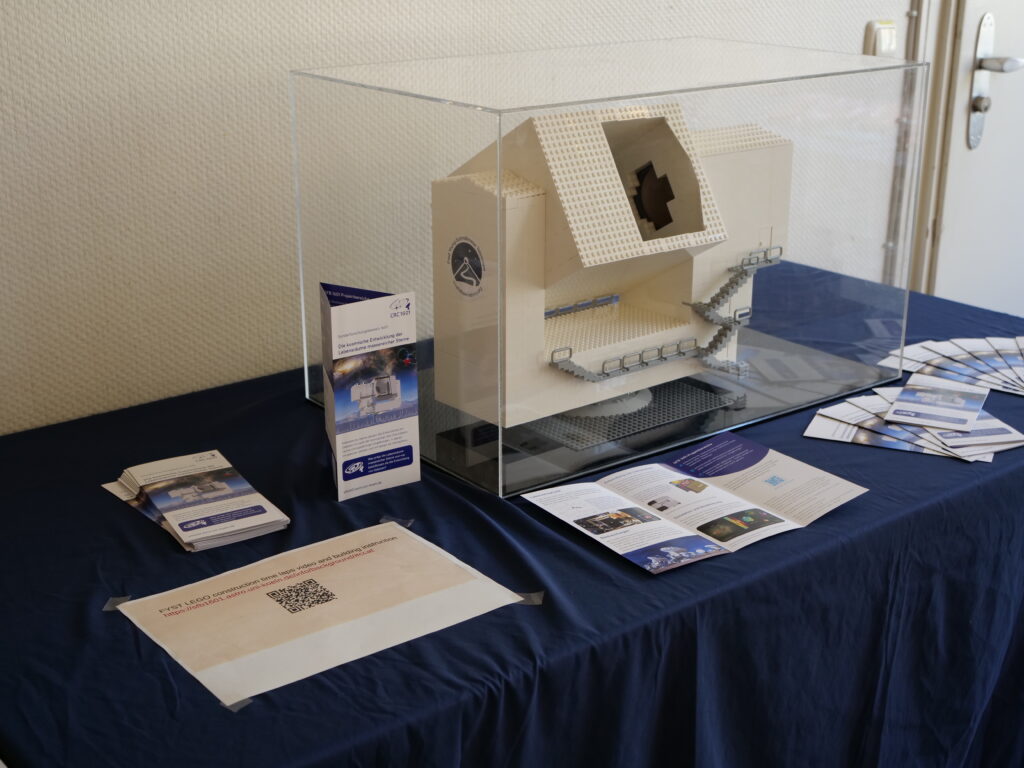
Ob die fliegende Sternwarte SOFIA oder das neue, 5600 m hohe FYST in Chile. Astronominnen und Astronomen sind im Höhenrausch und bauen Teleskope für immer extreme Orte. Doch warum eigentlich? Die Antwort versteckt sich wortwörtlich zwischen den Sternen: in kaltem Gas und Staub, das nur im Ferninfraroten Licht sichtbar wird – Licht, das unsere Atmosphäre verschluckt. Anhand aktueller Forschung zur Sternentstehung in unserer Milchstraße beleuchtet dieser Vortrag, warum manche Fragen sich nur mit extremen Instrumenten an extremen Orten beantworten lassen – und dass einem dabei zwar manchmal die Luft wegbleibt, aber nie die Erkenntnis.
Tim-Eric Rathjen:
The Universe inside a computer
What does it take to create planets, stars, galaxies, and indeed the entire Universe inside a supercomputer? What does a theoretical astrophysicist actually do, and why do we need such powerful computing machines for this work? This talk offers fascinating insights into the world of numerical astrophysics and showcases impressive images and videos from a “universe inside a computer.”
Public Observatory
A visit of the Public Observatory Cologne, a 60cm refractor “Cologne Large Telescope” (CLT) installed in 2012, will be offered right after the public talk. The space is limited to 20 people, sign up for this special tour at the registration desk.
Tour of the Cologne Old Town and View of the Cathedral
Thursday, 20.08.2025
3:00 pm – 5:30 pm
Meeting Point: Kreuzblume in front of the main entrance of the Dom
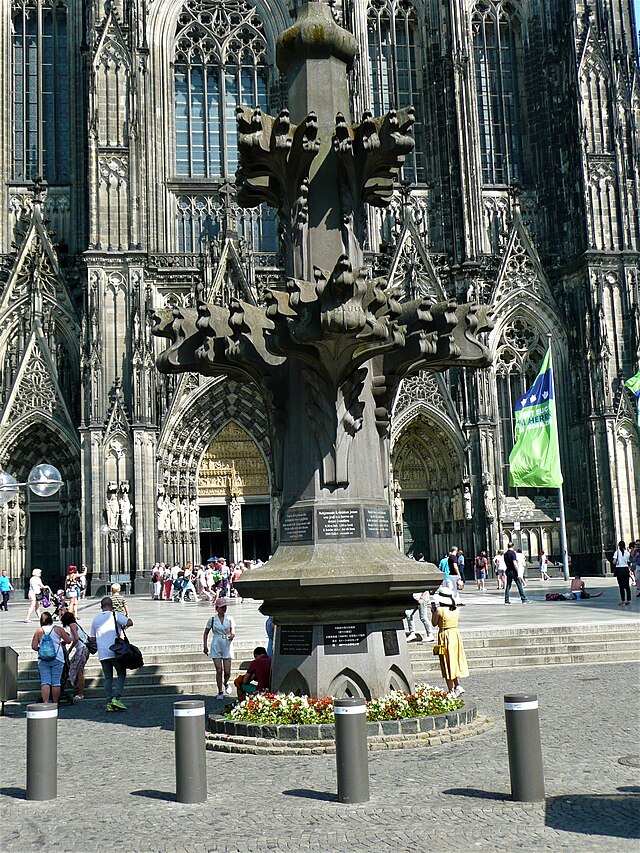
Rainerhaufe
This tour will be a guided walk in smaller groups (15 persons each) through the city of Cologne starting in front of the cathedral, the big square in front of the main entrance. Take tram #18 from the conference venue and get off at Cologne Central Station (“Hauptbahnhof/Dom”). Please make sure you are at the meeting place by 3 pm.
Duration of the tour: 120 minutes
After the tour there will be free time before the conference dinner at 7 pm to further explore the city and the cathedral before you may take a train RE1, RE8, RE9, RB27, RB38, S12, or S19 from Cologne Main Station to Cologne Ehrenfeld to get to the venue of the conference dinner.
A walking tour revolving around highlights, facts and stories
Discover the most exciting facets of Cologne’s past and present! This inspiring walk will take you on a journey through time: from Roman Colonia to medieval Cologne with its churches, guilds and merchants, through the times of war destruction and reconstruction to modern urban development and today’s Cologne – full of the unique Cologne lifestyle. A real highlight is Cologne Cathedral, a UNESCO World Heritage Site. Its impressive dimensions, fascinating architectural history, famous works of art and charming details make the outside tour a very special experience – and provide the perfect complement or preparation for your individual visit inside this magnificent building (Text taken from Köln Tourismus).

Thomas Robbin
Conference Dinner at Herbrand’s Ehrenfeld
Thursday, 20.08.2026
starting 6:30 pm
Herbrandstr. 21
50825 Köln
https://herbrands.de
Parking is available!
Public Transport:
Subway # 3/4/13 to stop „Venloer Str./Gürtel“
Bus # 141/142/143 to stop „Venloer Str./Gürtel“
train S12/13/19 or RE RE1, RE8, RE9, RB27, RB38 to station „Bahnhof Ehrenfeld“
Best connection from the conference venue:
Bus #142 from stop “Sülz Universität” to stop „Venloer Str./Gürtel“
The Herbrand’s is a restaurant, club & beer garden in the hip area of Ehrenfeld in a former industrial building.
The venue combines the traditional Kölsch beergarden with a modern urban-style atmosphere.
The conference dinner will be a “summer buffet”, music and a surprise. Every participant will get vouchers for 2 drinks, more are available at fair rates.
The conference will take place on the campus of the University of Cologne.
Main building/ Hauptgebäude (Gebäude 100), Aula
Albertus-Magnus-Platz 1
50931 Köln
The venue can best be reached by tram #9 (Stop “Universität”) or by train to station “Köln Süd” (not barrier-free). Parking is difficult and should be arranged at your hotel.
A plan of all trams can be found below.
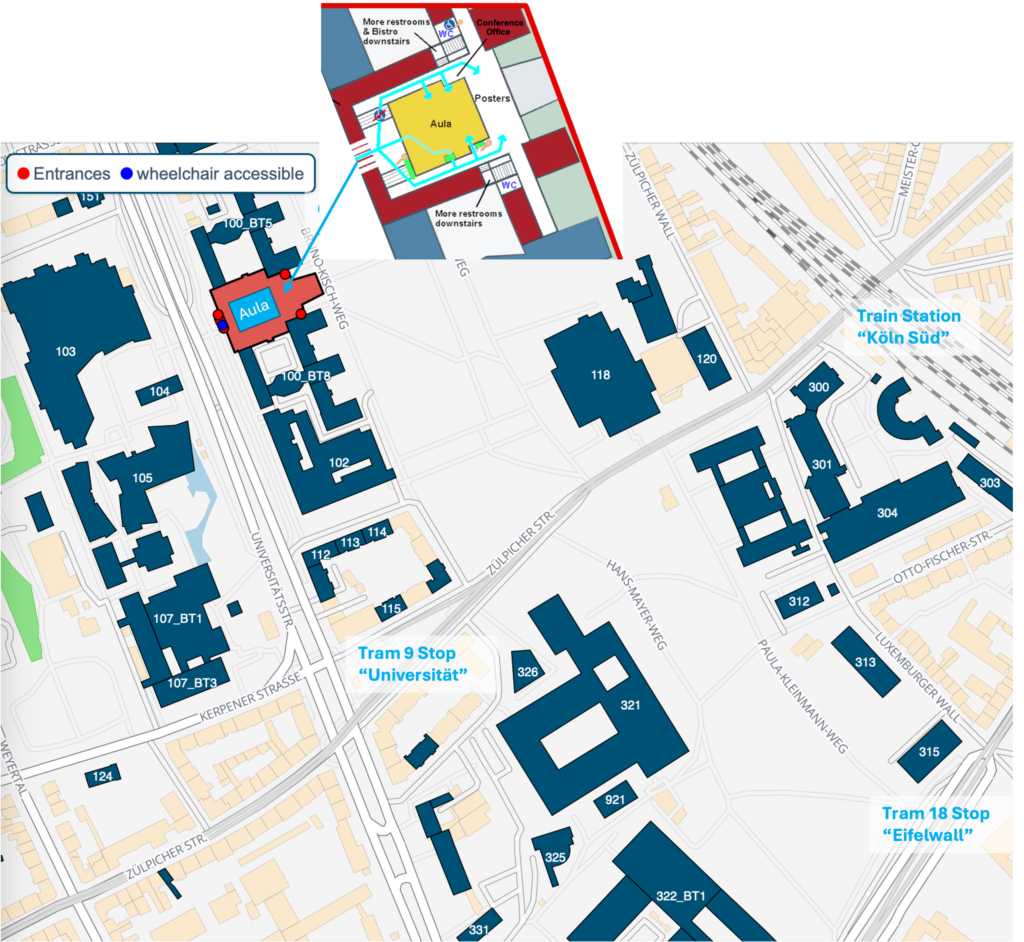
The conference rooms can be reached barrier-free with a Euro-key. Please contact us if you need assistance.
Lunch is not organized by the conference, but there are many options on and around the University campus.
The Kölner Studentenwerk runs a number of canteens at which conference attendees can benefit from the ‘Guest’ rates by showing their conference name tag. Please note that only cards are accepted.
The bistro closest to the conference venue ist the Uni E-Raum which is only one floor below the Aula. A larger variety of warm dishes is served at the Mensa (Zülpicher Straße 70). They also offer vegan and vegetarian options, and the daily menu and food options for each of their locations can be viewed on their website https://www.kstw.de/speiseplan/. Food is served between 11:30 am and 2:30 pm.
The surrounding areas along Zülpicher Straße offer a variety of food options and invite you to spend some time in a typical Cologne bar, enjoying the University nightlife.
To plan your visit in Cologne, we recommend this page: https://www.cologne-tourism.com/arts-culture/sights
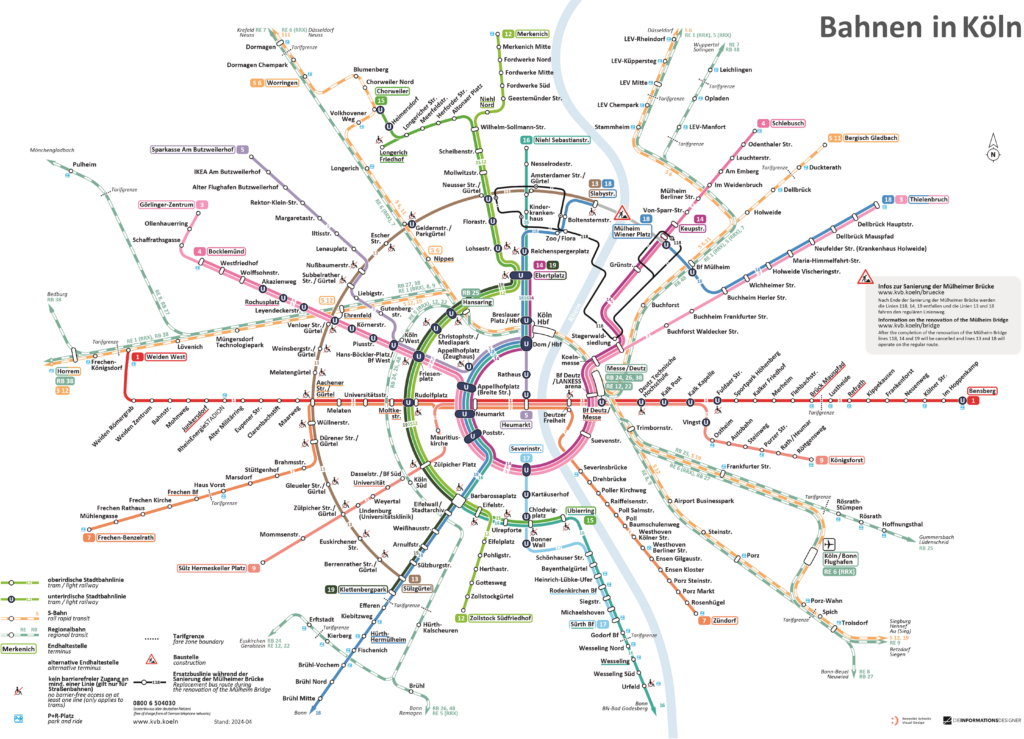
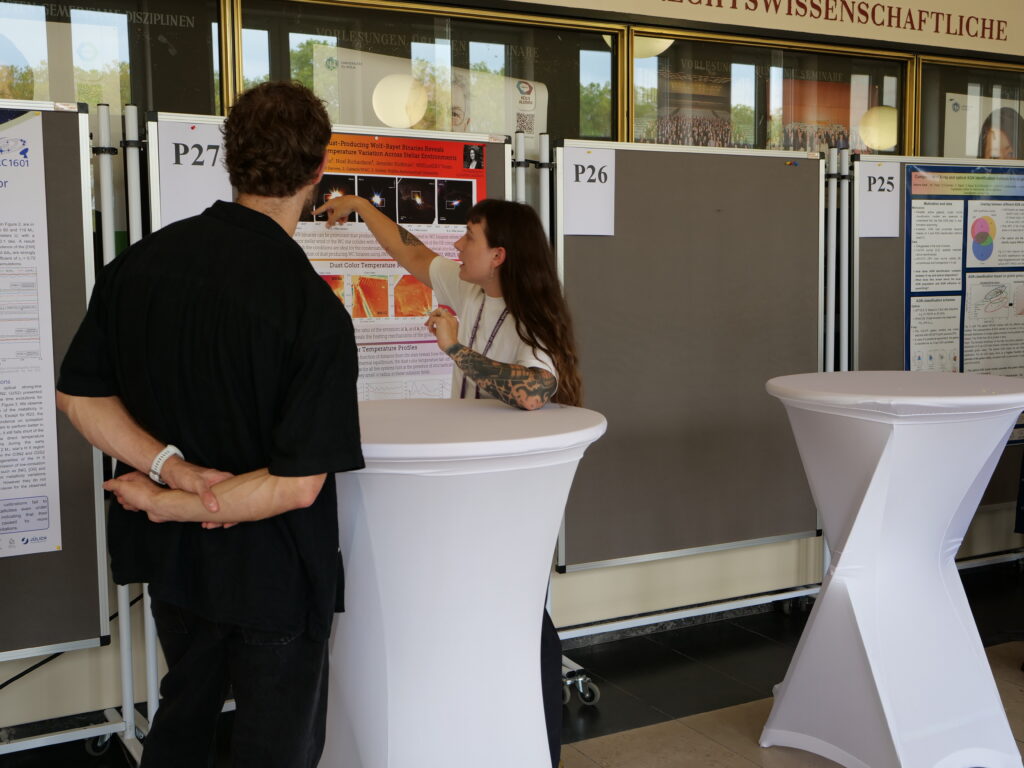
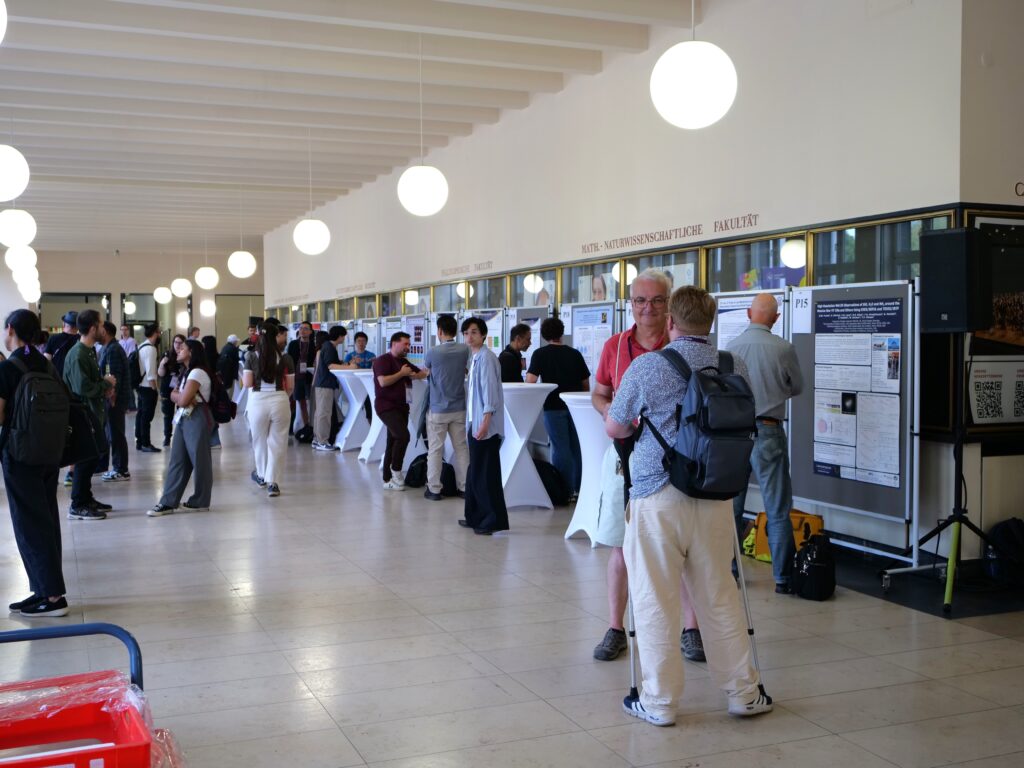
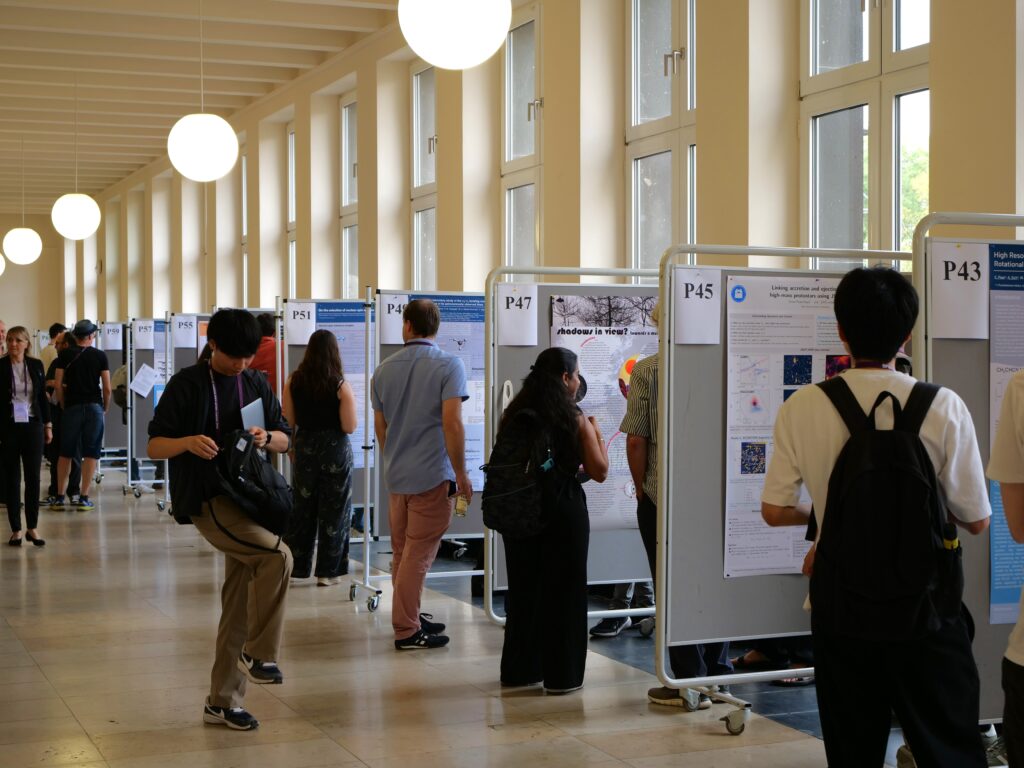
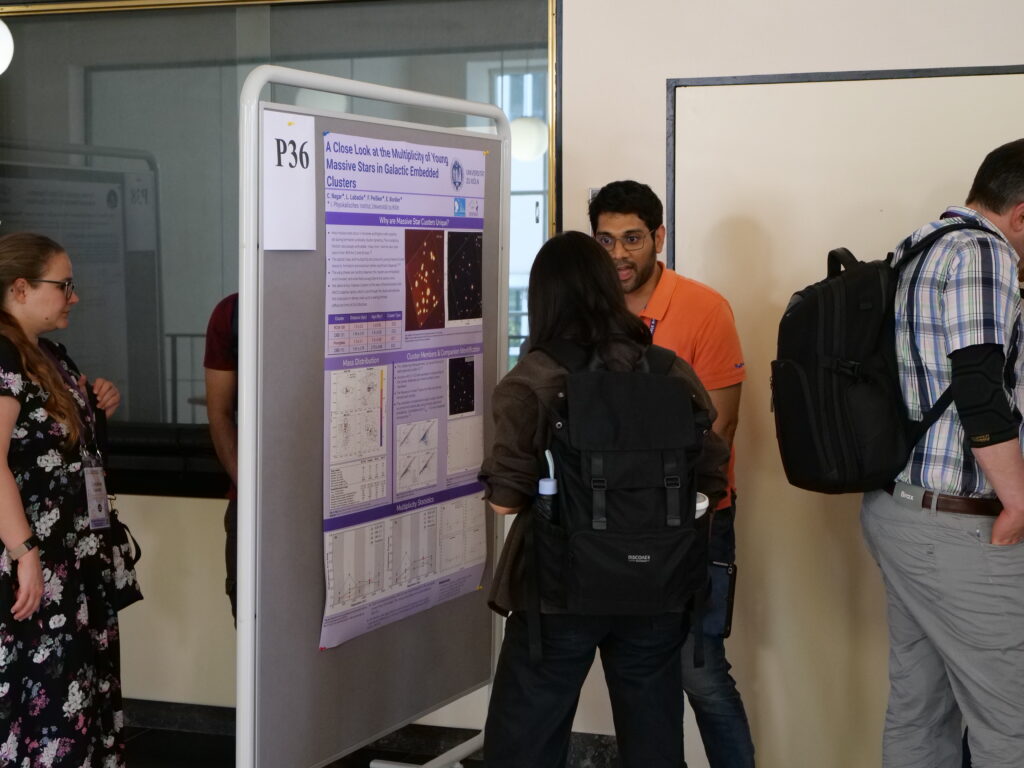
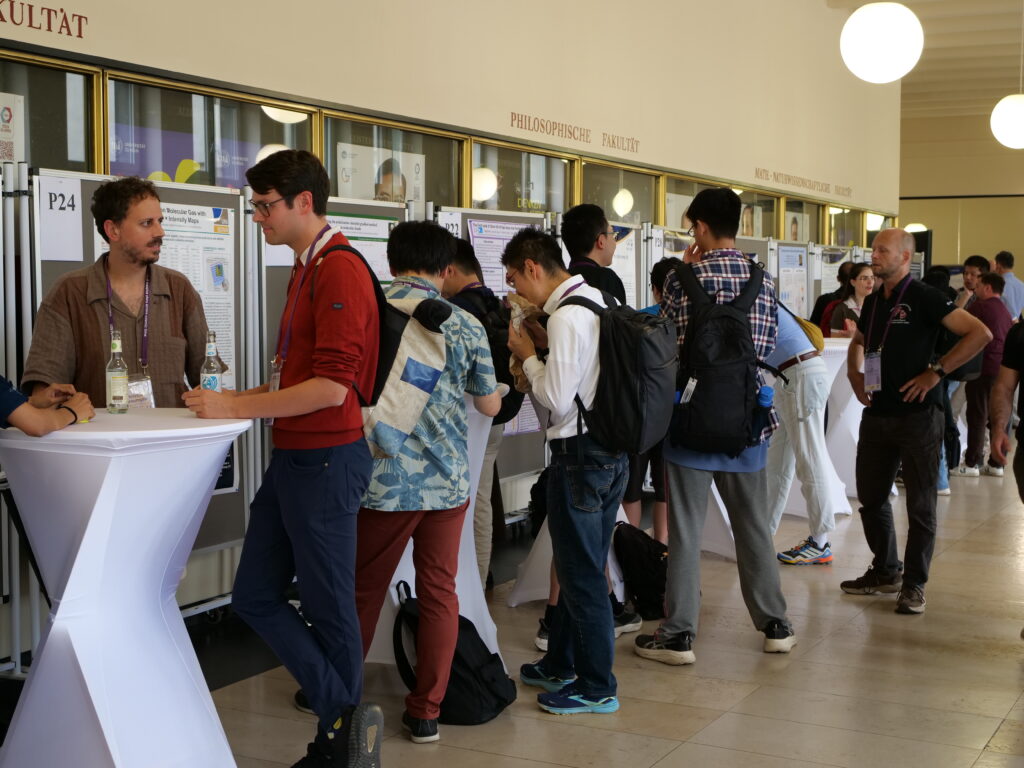
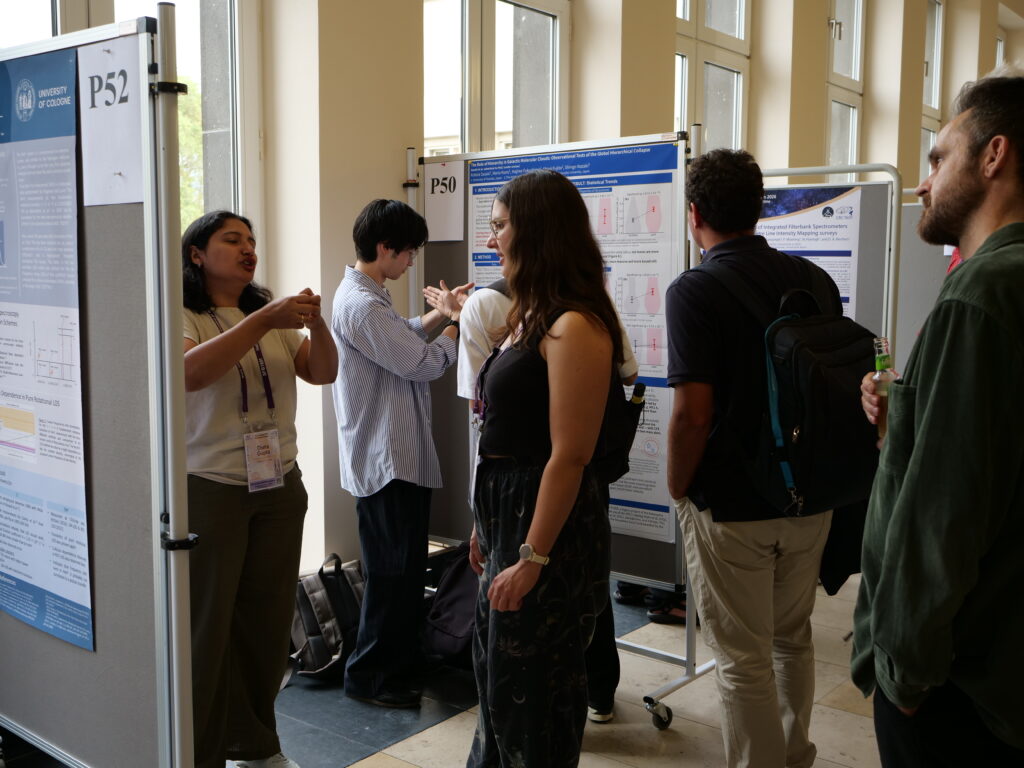
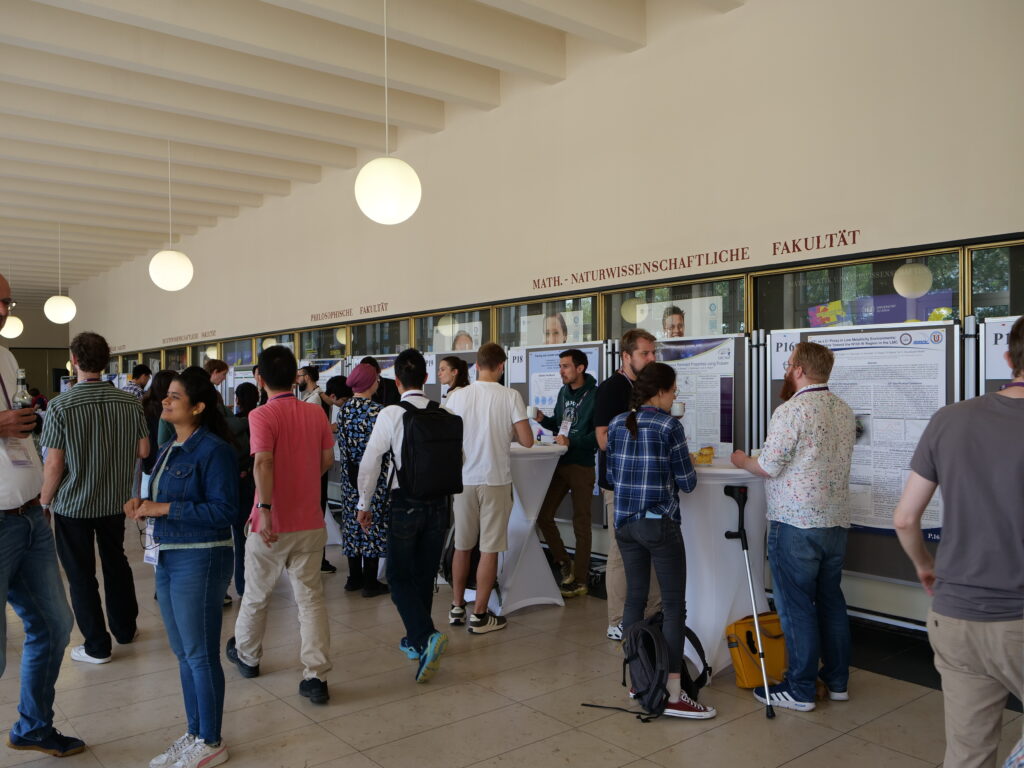
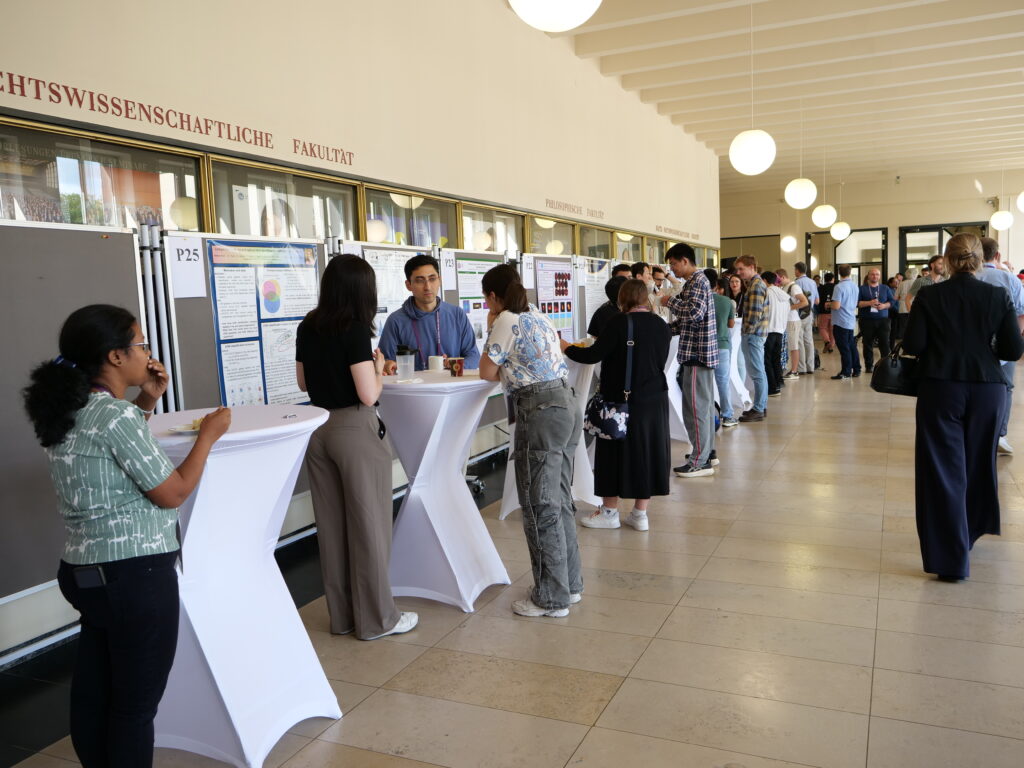
All posters will be up all week and can be visited at all times.
The maximum space for poster presentations is A0 portrait format (width: 841 mm, height: 1189 mm). Poster spaces will be available for accepted abstracts only.
In addition, we offer a 1 min poster flash talk for each poster.
For this, please prepare 1 (at most 2) slide(s) as pptx or pdf and name it according to the page in the book of abstracts.
A detailed program and the book of abstract can be downloaded on the right!
A detailed program and the book of abstract can be downloaded below!
| MONDAY, 17 August 2026 / Time: 11:55 – 12:25 | |||
| Poster Flash Presentations: PI | |||
| Identifier | Last name | First name | Title |
| P.2 | Alt | Henrik Silas | Digital Sideband Separation Using Tone-Injection calibration scheme |
| P.3 | Asvany | Oskar | Hyperfine-resolved rovibrational and rotational spectroscopy of OH⁺ |
| P.4 | Bigiel | Frank | mm-spectroscopy across nearby galaxies – dense gas fraction and star formation efficiencies from cloud to galaxy scales |
| P.5 | Böing | Julian | Towards Understanding Leak-Out Spectroscopy (LOS) in Cryogenic Ion Traps |
| P.6 | Bosmann | Jonas | Jet-Cooled Millimeter-Wave Spectroscopy of Circumstellar Refractory Species |
| P.15 | Fuchs | Guido W. | High-Resolution Mid-IR Observations of SiO, H₂O and NH₃ around the Massive Star VY CMa and Others Using EXES/SOFIA and TEXES/IRTF |
| P.16 | García | Pablo | CF⁺ as a C⁺ Proxy in Low Metallicity Environments: Observations Toward the N159-W Region in the LMC |
| P.20 | Grutzeck | Gerrit | The next-generation U-Board – A heterogeneous, closely coupled architecture for radio astronomy |
| P.33 | Misra | Prachi | Rotational Spectroscopy of C₃H₄O₂ using Updated CP-FTMW Spectrometer |
| P.35 | Müller | Holger | Rotational Spectroscopy of Vibrationally Excited States as a Tool for Astrophysics: Investigations of ¹³CH₃CN and CH₃¹³CN up to v₈ = 2 and a Search for v₈ = 2 Transitions Toward Sagittarius B2(N) |
| P.40 | Owen | Morgan | WCCC versus HC chemistry through the lens of deuterium fractionation |
| P.43 | Plaar | Eline | High resolution rovibrational and rotational spectroscopy of HC₃N⁺ |
| P.46 | Röllig | Markus | Updated H₂ ro-vibrational and UV line & continuum physics in the KOSMA-τ PDR code |
| P.49 | Salomon | Thomas | High-resolution laboratory study of the ν2/ν4 bending motion of CH₃⁺ and assignment of its astronomically observed lines |
| P.51 | Schlemmer | Stephan | On the selection of nuclear spin species in an ion trap |
| P.52 | Schneider | Lea | Combining a cryogenic ion trap with a 2 THz multiplier chain source: revisiting the J=1 |
| P.56 | Thorwirth | Sven | Pure-rotational spectroscopy of cis- and trans-1,3-dichloropropene |
| P.57 | Thorwirth | Sven | Laboratory spectroscopic studies of COMs in vibrationally excited states |
| P.63 | Wang | Chenxu | The Rotational Spectrum of trans-2,3-Epoxybutane: A Combined Chirped-Pulse Fourier Transform and Absorption Microwave Study |
| P.47 | Roth | Tim Otto | Solar aesthetics – how other star forms might impact perceptual systems |
| TUESDAY, 18 August 2026 / Time: 12:00 – 12:30 | |||
| Poster Flash Presentations: PII | |||
| Identifier | Last name | First name | Title |
| P.7 | Canal i Saguer | Mar | Systematic study of HII regions in the Magellanic Clouds with eROSITA |
| P.9 | Cheriyan | Amal George | Polarization study toward the massive protostellar jet system HH 80-81 |
| P.12 | Dannhauer | Simon | Disentangling the accretion flow in S106 |
| P.17 | Gebauer Werner | Lucia | Exploring Supernova Remnant Properties Using Pulsars |
| P.19 | Großekathöfer | Lena | A polychromatic analysis of the dissolving stellar association IRS 6 in the center of our Galaxy |
| P.26 | Keilmann | Eduard | An Apparent [C II]-Deficit in S144/RCW79 Caused by Self-Absorption |
| P.27 | Lieb | Emma | Survey of 5 Dust-Producing Wolf-Rayet Binaries Reveals Grain Size and Temperature Variation Across Stellar Environments |
| P.29 | Mehta | Parit | [CII] self-absorption in M17: a large-scale view from SOFIA FEEDBACK |
| P.37 | Nandre | Tanish | The Carbon Budget in the Milky Way |
| P.44 | Rathjen | Tim-Eric | Radiation and cosmic rays shaping the multiphase interstellar medium |
| P.45 | Reyes | Simon | Connecting accretion and ejection rates for massive protostars using JWST/MIRI |
| P.48 | Saha | Himadri | Performance modelling of Integrated Filterbank Spectrometers towards sub-millimetre Line Intensity Mapping surveys |
| P.50 | Sasaki | Kotora | The Role of Hierarchy in Galactic Molecular Clouds: Observational Tests of the Global Hierarchical Collapse |
| P.58 | Ushirogi | Taishi | Mass Budgets of Episodic Protostellar Outflows in an Isolated Turbulent Core |
| P.59 | Vandersnickt | Jelle | Asteroseismic detection of an internal magnetic field inside an evolved massive main sequence star |
| P.61 | Vider | Sebastian | Confronting Observations with Simulations – Blister-Type HII Regions |
| P.62 | Vrancken | Jasmine | Probing Massive‑Star Formation with Intrinsic Multiplicity Constraints from TESS Eclipsing Binaries |
| P.64 | Weng | Jixiang | The Keplerian disk, envelope, and streamers surrounding an early O-type protostar in the Sagittarius C cloud of the Central Molecular Zone |
| P.66 | Yamada | Rin | Formation of the Rich Network of Filaments Driven by an Expanding HI Bubble in the Perseus Molecular Cloud |
| P.67 | Yap | Mervin Zhi Rong | Multidimensional CWENO finite volume method with constrained transport for MHD simulations of shockwaves in the ISM |
| WEDNESDAY, 19 August 2026 / Time: 12:00 – 12:30 | |||
| Poster Flash Presentations: PIII | |||
| Identifier | Last name | First name | Title |
| P.8 | Cheema | Anahat | The frst C-band rotation measure grid through the Galactic plane: Expanding the population of polarized radio sources |
| P.10 | Clarke | Jonathan | Line intensity mapping: Modelling star-forming galaxy emission at the epoch of reionisation for FYST using catalogue data |
| P.21 | Guerrero | Andrea | CIB modeling to constrain the faint-end slope of galaxy number counts |
| P.22 | Hu | Ying-Chi | First look of 18cm OH masers and Zeeman splitting of high-mass star forming regions in MMGPS |
| P.24 | Karoumpis | Christos | Line intensity mapping with the ALMA interferometer |
| P.25 | Kast | Helene | Comparison of X-ray and optical AGN identification methods in local galaxies |
| P.30 | Mertens | Marc | Mini-CHAI, a First Light Heterodyne Instrument for the CCAT Observatory |
| P.31 | Miklósi | Rebeka | Superconducting Intermediate Frequency Circuitry for the CCAT Heterodyne Array Instrument |
| P.34 | Mohammad Bokhari | Nurul Husna | Investigating low and high mass protostellar outflows with ALMA observations |
| P.38 | Okada | Yoko | Operation of Cerro Chajnantor Atacama Telescope (CCAT) Observatory |
| P.41 | Patra | Sudeshna | Exploring the extragalactic dense gas tracers in the Milky Way with APEX |
| P.42 | Peregrina García | Damián | Properties of NbTiN-Nb-Al/AlOx/Nb tunnel junctions in dependence of Nb interlayer thickness |
| P.53 | Schneider | Nicola | Synergy between GEco and FEEDBACK |
| P.54 | Syaifoel | Kian | Probing the Lower Limit of Two-Level System Noise in Parallel-Plate Capacitor Kinetic Inductance Detectors using Crystalline-Silicon Dielectric |
| P.55 | Tanchon | Ella | Decoding Cluster Formation and Evolution through Forward Modelling of PHANGS Star Clusters |
| P.60 | Verbena | Juan Luis | grex: A Python Pipeline for SOFIA/GREAT Spectral Data Reduction |
| P.65 | Woolvett O’Ryan | Vicente José | The APEX Microwave Kinetic Inductance Detector camera (A-MKID): from commissioning to early observations |
| WEDNESDAY, 19 August 2026 / Time: 15:15 – 15:30 | |||
| Poster Flash Presentations: PIV | |||
| Identifier | Last name | First name | Title |
| P.1 | Aberfelds | Artis | Is the CH₃OH maser transition at 6.7 GHz a tracer of the inner outflow cavities near YSOs? |
| P.11 | Coors | Alice | Tracing shock-driven shaping of molecular clouds as a trigger for star formation |
| P.13 | Dincer | Furkan | The role of massive stars in the cluster expansion phase |
| P.14 | Elbakyan | Vardan | Accretion Bursts in High-Mass Stars: Mechanisms and Observational Implications |
| P.18 | Gerasimov | Ivan | Tracing star cluster evolution through PAH morphology |
| P.23 | Kao | Jo-Shui | Testing the polarization-intensity polarization–intensity gradient method in molecular clouds and collapsing dense cores simulation |
| P.28 | Littek | Simon | Synthetic Emission Line Maps as a Benchmark for H II Region Metallicity Diagnostics |
| P.33 | Mills | Jessica | Birth Radii Analysis of Milky Way Disk Stars According to APOGEE DR17 and the NIHAO-UHD Simulation Suite |
| P.36 | Nagar | Chinmaya | A Close Look at the Multiplicity of Young Massive Stars in Galactic Embedded Clusters |
| P.39 | Ortaköse | Nuray | From Flows to Fragments: Tracking Core Evolution in Star-Forming Environments |
Please note that registration is mandatory to participate in the conference.
The following link leads you to the registration page of our partner Converia. This link is also valid for uploading your abstract (also named “Paper” in the registration system). Only registered participants may upload an abstract. Details about the conditions can be found further below.
Important dates:
- Deadline for submission of abstracts: May 4, 2026
- Deadline for early bird registration: April 15, 2026
- Deadline for regular registrations is June 30, 2026.
The following services are included in the basic registration fee:
- Coffee breaks with snacks throughout the conference
- Welcome reception with scientific talks and drinks
- Excursion
- Science dinner on Thursday (August 20, 2026)
Please indicate your participation for points 2 to 4 and add your food preferences during the registration process.
Conference Fees
| early bird | regular | |
| Regular participants | € 300 | € 360 |
| online participation | € 120 | € 120 |
| Invited Speakers, Invited Guests, and Accredited Journalists | free | free |
Please note: Only credit card payment is possible.
Cancellation Policy
Your conference fee will be partially refunded (50%) if you cancel your registration until June 30, 2026.
Cancellation with full refund (excl. a handling fee of 10€) will be possible until 1 week after the announcement of the SOC only for registered participants, for whom the SOC selected neither a submitted talk abstract nor a submitted poster abstract.
Hotels close to the venue (shorter distances at the top):
All can be reached by public transport
Apartmenthotel Sleepy Inn
Uni Center, Luxemburger Str. 124-136
50939 Köln
Stayery Köln Sülz
Weißhausstr. 23a
50674 Cologne
Black Sheep Hostel
Barbarossaplatz 1
50674 Cologne
Nuno Hotel
Barbarossapl. 4A
50674 Cologne
Hotel Esplanade
Hohenstaufenring 56
50674 Cologne
IBIS Köln Centrum
Neue Weyerstrasse 4
50676 Cologne
Maison Marsil
Marsilstein 25-27
50676 Cologne
Motel 1 Neumarkt
Cäcilienstraße 32
50667 Cologne
Youth Hostels in Cologne:
Youth hostel DJH Cologne Deutz
Siegesstr. 5
50679 Cologne
https://www.jugendherberge.de/jugendherbergen/koeln-deutz/
Youth hostel DJH Cologne Riehl
An der Schanz 14
50735 Cologne
https://www.jugendherberge.de/jugendherbergen/koeln-riehl/
Abstract submission is only possible after registration to the conference (deadline for abstract submission: May 4, 2026). After logging in to your registration profile (available here https://uni-koeln.converia.de/frontend/index.php?folder_id=616&page_id= ), click on “Submit new paper” and follow the instructions.
Please use the template provided further down on this page or download it during the submission process. Please strictly stick to the page limit of one page and upload a zip file including your LaTeX file (.tx) and the figure.
During abstract submission, you will be able to select a poster presentation or a contributed talk (15 min). Decisions on the acceptance of contributed talks will be made by the scientific organizing committee. If not accepted as a contributed talk, contributions will be converted into a poster presentation. Early career researchers are particularly encouraged to submit contributions as talks.
Abstract template:
Cancellation with full refund (excl. a handling fee of 10€) will be possible until 1 week after the announcement of the SOC only for registered participants, for whom the SOC selected neither a submitted talk abstract nor a submitted poster abstract.
The CRC 1601 as the organizer of this Symposium is committed to conduct the meeting to be productive and enjoyable for everyone. The organizers will not tolerate harassment of participants in any way. By attending this Symposium you agree to:
- Behave professionally. Exclusionary or offensive comments or jokes related to personal attributes are not appropriate.
- Personal attributes covered by this policy include but are not limited to (alphabetically): age, disability, ethnicity, gender, gender expression, gender identity, lactation, nationality, physical appearance, political affiliation, pregnancy, race, religion, sexual orientation, and status as a caregiver (including as a parent).
- Unacceptable behavior includes, but is not limited to, sustained disruption of talks or other events, unwelcome physical contact, sexual attention or innuendo, intimidation, stalking and recording of an individual without consent. Consent for photography may be assumed only when the subject is giving a talk during the Symposium or during the official shooting of the conference photo.
- Communicate appropriately. Aim for a professional audience including people of many different backgrounds. Sexual language and imagery are not acceptable.
- Be kind. Do not insult or put down other meeting participants.
All participants are empowered to request that undesirable behavior be stopped. Participants asked to stop any behavior inconsistent with this Meeting CoC are expected to comply immediately. The Symposium will have two designated Meeting Contact People with the authority to take action up to and including requiring an attendee to leave a meeting. In addition to the Meeting Contact People, any participant who wishes to discuss a violation of the Meeting CoC can speak, in confidence, to the Chair of CRC 1601.
This is a hybrid meeting – Refrain from sharing any pictures or recording from this meeting without explicit written consent.
The Code of Conduct applies in all conference spaces.
Meeting Contact Persons:
The LOC may be contacted at any time. You will recognise them from their badges during the conference.
loc-msf2026 [at] ph1.uni-koeln.de
| Abe | Daisei | Tohoku University / CEA Paris-Saclay |
| Aberfelds | Artis | Ventspils University of Applied Sciences |
| Adscheid | Sylvia | Argelander Institut für Astronomie – Universität Bonn |
| Alt | Henrik Silas | Max-Planck-Institut für Radioastronomie |
| Anguera Gonzalez | Alexia | European Southern Observatory (ESO) / University of Barcelona |
| Arai | Reiji | Shizuoka University / NAOJ |
| Asvany | Oskar | Universität zu Köln |
| Bazzi | Zein | University of Bonn |
| Bertoldi | Frank | Argelander Institut für Astronomie – Universität Bonn |
| Beyer | Aaron | University of Cologne |
| Bigiel | Frank | |
| Böhm | Lennart | European Southern Observatory (ESO) |
| Böing | Julian | Universität zu Köln |
| Bomans | Dominik | Ruhr University Bochum, Faculty of Physics and Astronomy |
| Bonfand | Mélisse | University of Virginia |
| Bordier | Emma | I. Physikalisches Institut Universität zu Köln |
| Borg | Francesca | University of Cologne |
| Bosmann | Jonas | Universität Kassel |
| Breloy | Isabelle | University of Cologne |
| Bryant | Aaron | Universität Stuttgart |
| Canal i Saguer | Mar | Dr. Remeis-Sternwarte Bamberg (FAU) |
| Chayeb | Wajdee | University at Cologne |
| Cheema | Anahat | Max Planck Institut fuer Radioastronomie |
| Chen | C.-H. Rosie | MPIfR |
| Chen | Wei-An | Jodrell Bank Center for Astrophysics |
| Cheriyan | Amal George | Indian Institute of Space Science and Technology |
| Chiti Tegli | Francesco | Max-Planck-Institut für Astronomie |
| Clark | Paul | Cardiff University |
| Clarke | Jonathan | Univerisity of Cologne |
| Coors | Alice | University of Cologne PH1 |
| Cosentino | Giuliana | Institut de Radioastronomie Millimetrique |
| Cox | Pierre | Institut d’Astrophysique de Paris |
| Dannhauer | Simon | University of Cologne |
| den Brok | Jakob | MPIA |
| Dincer | Furkan | FZ Jülich |
| Egorov | Oleg | Heidelberg University |
| Ejlali | Golshan | IRAM Institut fuer Radioastronomie im Millimeterbereich Grenoble |
| Elbakyan | Vardan | University of Duisburg-Essen |
| Fackendahl | Petra | University of Cologne |
| Figueira | Miguel | National Centre for Nuclear Research |
| Fotopoulou | Constantina | University of Cologne |
| Fuchs | Guido W. | University of Kassel |
| Fukui | Yasuo | Nagoya University |
| Gabrielli | Francesco | Uppsala University |
| Gaches | Brandt | University of Duisburg-Essen |
| García | Pablo | NATIONAL ASTRONOMICAL OBSERVATORIES OF CHINA |
| Garrod | Robin | University of Virginia |
| Gautam | Aayush | University of Virginia |
| Gebauer Werner | Lucia | Max-Planck Institut für Radioastronomie, Bonn |
| Gerasimov | Ivan | |
| Gerlach | Lina Marie | Keele University |
| Ghosh | Esan Mouli | Kapteyn Astronomical Institute, University of Groningen |
| Gieser | Caroline | Max Planck Institute for Astronomy |
| Gol Bashmani Moghadam | Mahdieh | Brock University |
| Grebel | Eva | Heidelberg University |
| Großekathöfer | Lena | Universität zu Köln, I. Physikalisches Institut |
| Grutzeck | Gerrit | Max-Planck Institut für Radioastronomie, Bonn |
| Guerrero | Andrea | Argelander Institute for Astronomy, University of Bonn |
| Gupta | Akash | I. Physikalisches Institut Universität zu Köln |
| He | Hao | University of Bonn |
| Honingh | Netty | Uni zu Köln |
| Hu | Ying-Chi | Univerisity of Cologne PH1 |
| Irons | Raina | Queen’s University |
| Jacob | Arshia Maria | I. Institute of Physics University of Cologne, |
| Kabanovic | Slawa | Zentrum für Astronomie der Universität Heidelberg |
| Kaiser | Leonard | Universität zu Köln, I. Physikalisches Institut |
| Kao | Jo-Shui | Institute of Astronomy and Astrophysics, Academia Sinica (ASIAA) |
| Karoly | Janik | University College London |
| Karoumpis | Christos | University of Bonn |
| Kast | Helene | Argelander Institute for Astronomy, University of Bonn |
| Keilmann | Eduard | I. Institute of Physics University of Cologne, |
| KHAN | SARWAR | |
| Kimura | Kazutaka | Tohoku University |
| Kobayashi | Masato | National Institute for Fusion Science |
| Kocjan | Zuzanna | University of Maryland, College Park |
| Koda | Jin | Stony Brook University – SUNY |
| Komichi | Yuto | The University of Tokyo |
| Kong | Shuo | University of Arizona |
| Kramer | Michael | Max-Planck-Institut fuer Radioastronomie |
| Labadie | Lucas | 1. Institute of Physics, University of Cologne |
| Lee | Han-Tsung | I. Physikalisches Institut Universität zu Köln |
| Lee | Janice | |
| Liang | Xinyue | Heidelberg University |
| Lieb | Emma | University of Denver |
| Lin | Shang-Jing | University of Cologne, 1. Physikalisches Institut |
| Littek | Simon | University of Cologne PH1 |
| Mackey | Jonathan | Dublin Institute for Advanced Studies |
| Makarenko | Ekaterina | Max Planck Institute For Extraterrestrial Physics |
| Mazoochi | Farideh | Institute for Research in Fundamental Sciences (IPM) |
| McLeod | Anna | Durham University |
| Mehta | Parit | Universität zu Köln |
| Melamed | Maria | University of Cologne, 1. Physikalisches Institut |
| Mercimek | Şeyma | University of Manchester |
| Mertens | Marc | PH1, U.Cologne |
| Miklósi | Rebeka | 1. Institute of Physics University of Cologne |
| Mills | Jessica | Argelander-Institut für Astronomie |
| Misra | Prachi | Universität zu Köln |
| Mohammad Bokhari | Nurul Husna | Leiden University |
| Müller | Holger | Universität zu Köln |
| Münning | Felix | University of Cologne |
| Mutale | Mubela | University of Leeds |
| Nagar | Chinmaya | University of Cologne, 1. Physikalisches Institut |
| Nandre | Tanish | Argelander Institute for Astronomy, University of Bonn/ Max Planck Institute for Radio Astronomy |
| Neralwar | Kartik Rajan | MPIfR |
| Neupane | Sudeep | MPIfR |
| Oak | Tejas | Argelander Institut für Astronomie – Universität Bonn |
| Okada | Yoko | Universität zu Köln |
| Ortaköse | Nuray | |
| Ossenkopf-Okada | Volker | Universität zu Köln |
| Oudmaijer | René | Royal Observatory of Belgium |
| Owen | Morgan | Universität zu Köln |
| Panda | Devismita | Laboratoire d’Astrophysique de Bordeaux |
| Patra | Sudeshna | Institute of Advanced Studies, Nicolaus Copernicus University in Toruń |
| PAUCHET | Anaïs | Univerisity of Cologne PH1 |
| Peregrina García | Damián | I. Physikalisches Institut Universität zu Köln |
| Pfalzner | Susanne | Forschungszentrum Jülich GmbH |
| Piluso | Aurelien | CNRS UMR8262 |
| Plaar | Eline | I. Physikalisches Institut, |
| Prajapati | Prachi | PH1, U.Cologne |
| Rathjen | Tim-Eric | Univerisity of Cologne PH1 |
| Rebolledo | David | Joint ALMA observatory |
| Reyes | Simon | Max Planck Institute for Astronomy |
| Riechers | Dominik | Universität zu Köln |
| Rodrigues da Costa | Eleonore | Univerisity of Cologne |
| Rodriguez | Tatiana | I. Physikalisches Institut, Universität zu Köln |
| Röllig | Markus | Physikalischer Verein |
| Roth | Tim Otto | imachination labs |
| Rybak | Matus | |
| Saha | Himadri | I. Physikalisches Institut, Universität zu Köln |
| Saintonge | Amelie | Max Planck Institute for Radio Astronomy |
| Salomon | Thomas | Universität zu Köln |
| Sasaki | Kotora | University of Tsukuba |
| Schilke | Peter | University of Cologne, Institute for Astrophysics |
| Schlemmer | Stephan | I. Physikalisches Institut, Universität zu Köln |
| Schlöder | Frank | Universität zu Köln |
| Schneider | Lea | Universität zu Köln |
| Schneider | Nicola | University of Cologne |
| Schulz | Bernhard | Uni Stuttgart |
| Seifried | Daniel | University of Cologne |
| Sewilo | Marta | University of Maryland / NASA Goddard Space Flight Center |
| Silva | Weslley G. D. P. | Universität zu Köln |
| Simon | Robert | Univeristät zu Köln |
| Sinha | Aditi | University of Cologne |
| Stutzki | Jürgen | Universität zu Köln |
| Syaifoel | Kian | |
| Tanaka | Kei | Institute of Science Tokyo |
| Tanchon | Ella | |
| Teh | Jia Wei | Heidelberg University, Zentrum für Astronomie |
| test | test | |
| Thorwirth | Sven | Universität zu Köln |
| Topkaras | Theodoros | Universität zu Köln, I. Physikalisches Institut |
| Tsuge | Kisetsu | Gifu University |
| Ushirogi | Taishi | University of Cologne |
| Vandersnickt | Jelle | KU Leuven |
| Verbena | Juan Luis | University of Cologne |
| Vider | Sebastian | |
| Vrancken | Jasmine | KU Leuven |
| Walch-Gassner | Stefanie | Univerisity of Cologne |
| Wang | Chenxu | Universität zu Köln, I. Physikalisches Institut |
| Wang | Youxin | MPIfR |
| Weng | Jixiang | Shanghai Astronomical Observatory, Chinese Academy of Sciences |
| Woolvett O’Ryan | Vicente José | |
| Wyrowski | Friedrich | Max Planck Institut fuer Radioastronomie |
| Yamada | Rin | National Astronomical Observatory of Japan |
| Yap | Mervin Zhi Rong | University of Cologne |
| Zhang | Huixin | University College London |
| Zhao | Yanhanle Lauryn | Argelander Institute for Astronomy, University of Bonn/ Max Planck Institute for Radio Astronomy |
| Zimmermann | Birka | University of Cologne |
| Zinchenko | Igor | Institute of Applied Physics, Russian Academy of Sciences |
| Zinnecker | Hans | Universidad Autonoma de Chile |