
While the evolution of massive stars is often studied in isolation or in binary systems, a large fraction of massive stars reside in triple or higher-order multiple systems. The lack of observational constraints on the properties of these systems has long been a major limitation for population synthesis models.
Using the Southern Massive Stars at High Angular Resolution (SMaSH+) survey, we carried out the first homogeneous observational census of hierarchical O-type triple systems in the Milky Way. By combining long-baseline interferometry, aperture masking, and spectroscopy, we identified 26 hierarchical triples and measured the properties of both their close inner binaries and distant tertiary companions.
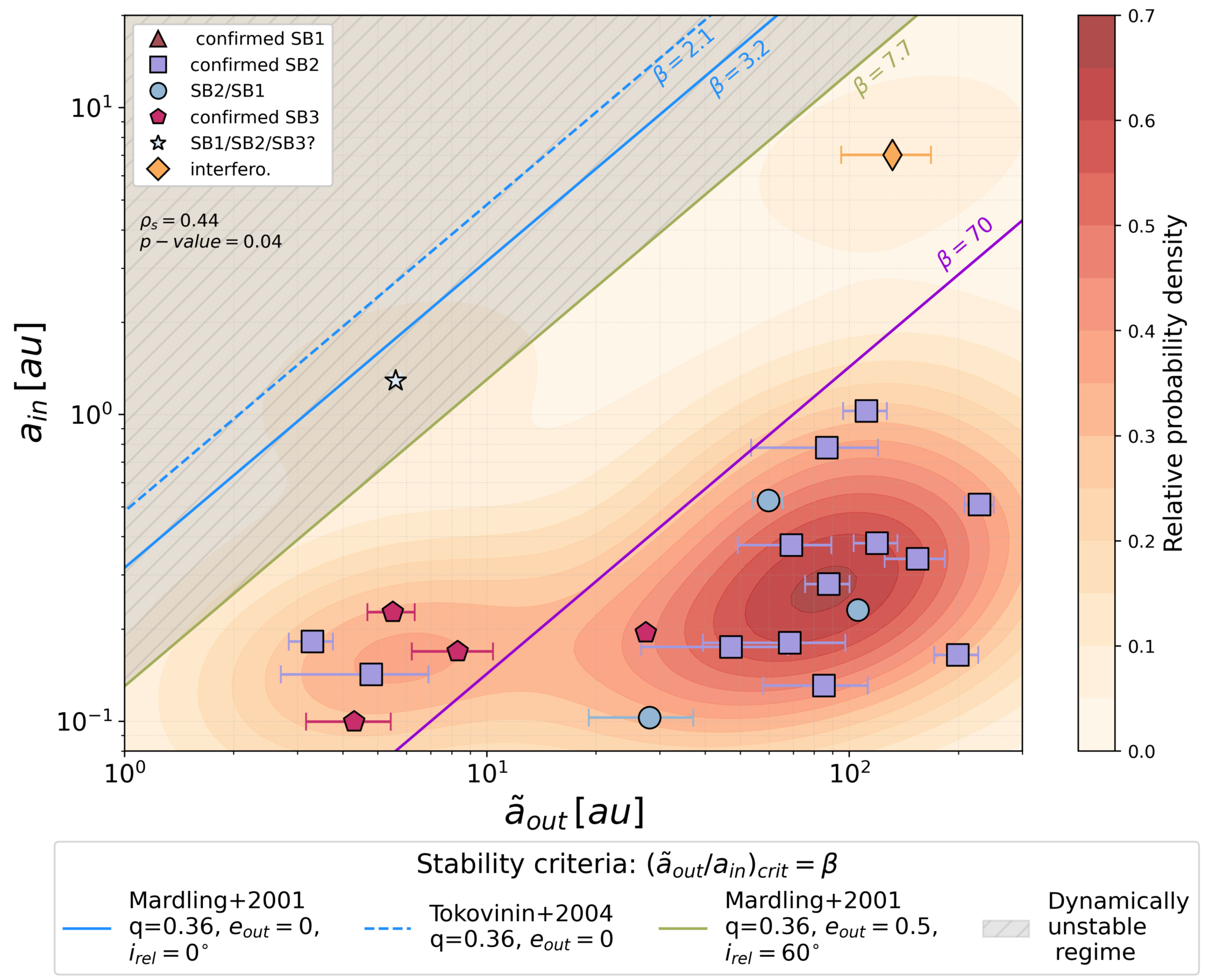
The observed systems occupy a remarkably well-defined region of parameter space. The inner binaries have typical separations of 0.1–10 au, while the tertiary companions are found at 3–230 au, corresponding to highly hierarchical configurations with outer-to-inner separation ratios typically exceeding 70 (see Figure). All systems satisfy the classical dynamical stability criteria defined by Mardling and Aarseth 2001, indicating that they are long-lived architectures rather than transient configurations.
We further investigated the role of secular dynamics through the von Zeipel–Kozai–Lidov (ZKL) mechanism, which can drive large oscillations of orbital eccentricity and inclination. During the course of these oscillations, a distant companion can modify the orbit of the inner binary and potentially trigger interactions, mergers or ejections. For several systems with well-constrained orbital solutions, the ZKL timescale is shorter than competing precession mechanisms (tides, general relativity), indicating that tertiary companions may significantly influence the long-term evolution of the inner binary.
This work provides the first empirical benchmark for the architecture of massive hierarchical triples. The resulting distributions constitute an important new ingredient for binary and multiple-star evolution models, helping to constrain the formation pathways of interacting binaries, stellar mergers, X-ray binaries, and gravitational-wave progenitors.
Figure: Inner separation (a_in) as a function of the outer separation (a_out). Both quantities are expressed in au and displayed on a logarithmic scale. The symbols indicate the type of inner spectroscopic binary. We also display the dynamically unstable regime (region in light gray) with reference values of β for different mass ratios, eccentricities and inclinations.
Accepted for publication in Astronomy & Astrophysics: https://arxiv.org/abs/2606.28159