In a collaboration spanning nine subprojects of CRC1601, Kabanovic et al. turned three interstellar clouds into a spectroscopic laboratory, using light emitted by distant gas to measure the internal energy structure of the rare isotope of ionized carbon, 13C+, with a precision exceeding what is currently achievable on Earth.
The main isotope, 12C+, dominates the cooling of interstellar gas across a wide range of conditions, but its spectral profile is often modified by optical depth effects. The intrinsic line shape can be reconstructed by comparison with emission from the less abundant 13C+, but exploiting it requires accurate rest frequencies, complicated by the hyperfine splitting that turns the single 12C+ line into three 13C+ transitions.
Direct laboratory measurements of these line frequencies have so far not succeeded, hindered by the low transition probabilities and the high reactivity of the ion. Hence, previous values rested entirely on theoretical, quantum-mechanical approximations. Interstellar space offered an alternative: in quiescent clouds with low turbulence, the intrinsic line widths are narrow, and the 12C+ and 13C+ column densities are large enough to yield sharp, high-quality line profiles.
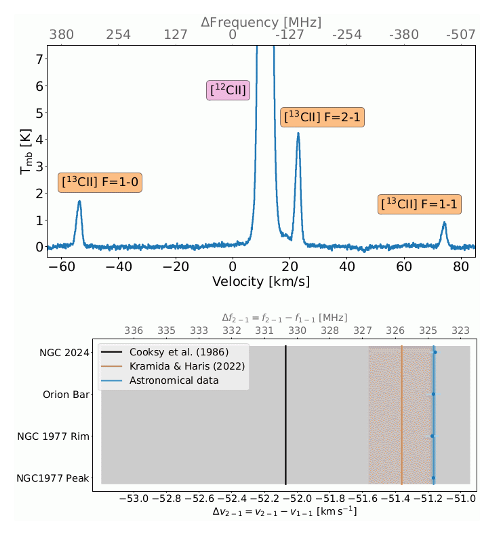
Using the upgraded German Receiver for Astronomy at Terahertz Frequencies (upGREAT) on board the Stratospheric Observatory for Infrared Astronomy (SOFIA), the authors observed the [12CII] fine-structure line together with all three [13CII] hyperfine components in NGC 1977, NGC 2024, and the Orion Bar. From these they derived the magnetic-dipole hyperfine constants Ahf1/2 = 810.71 MHz and Ahf3/2 = 162.18 MHz with unprecedented precision.
The result inverts the usual relationship between laboratory physics and astronomy: instead of using terrestrial spectroscopy to interpret astronomical signals, the light reaching us from distant ions is used to pin down the atomic structure of the ions themselves. The universe becomes the laboratory, an approach that can be extended to other atoms and molecules for which terrestrial measurements remain out of reach.
Figure: The upper panel shows a spectrum with all four lines measured in NGC1977, the lower panel compares the accuracy of the determination of the one of the energy splits from previous computations, with error bars in gray and orange, with our new data with an error bar in blue
Accepted for publication in Astronomy & Astrophysics. Preprint: https://arxiv.org/pdf/2605.07995