
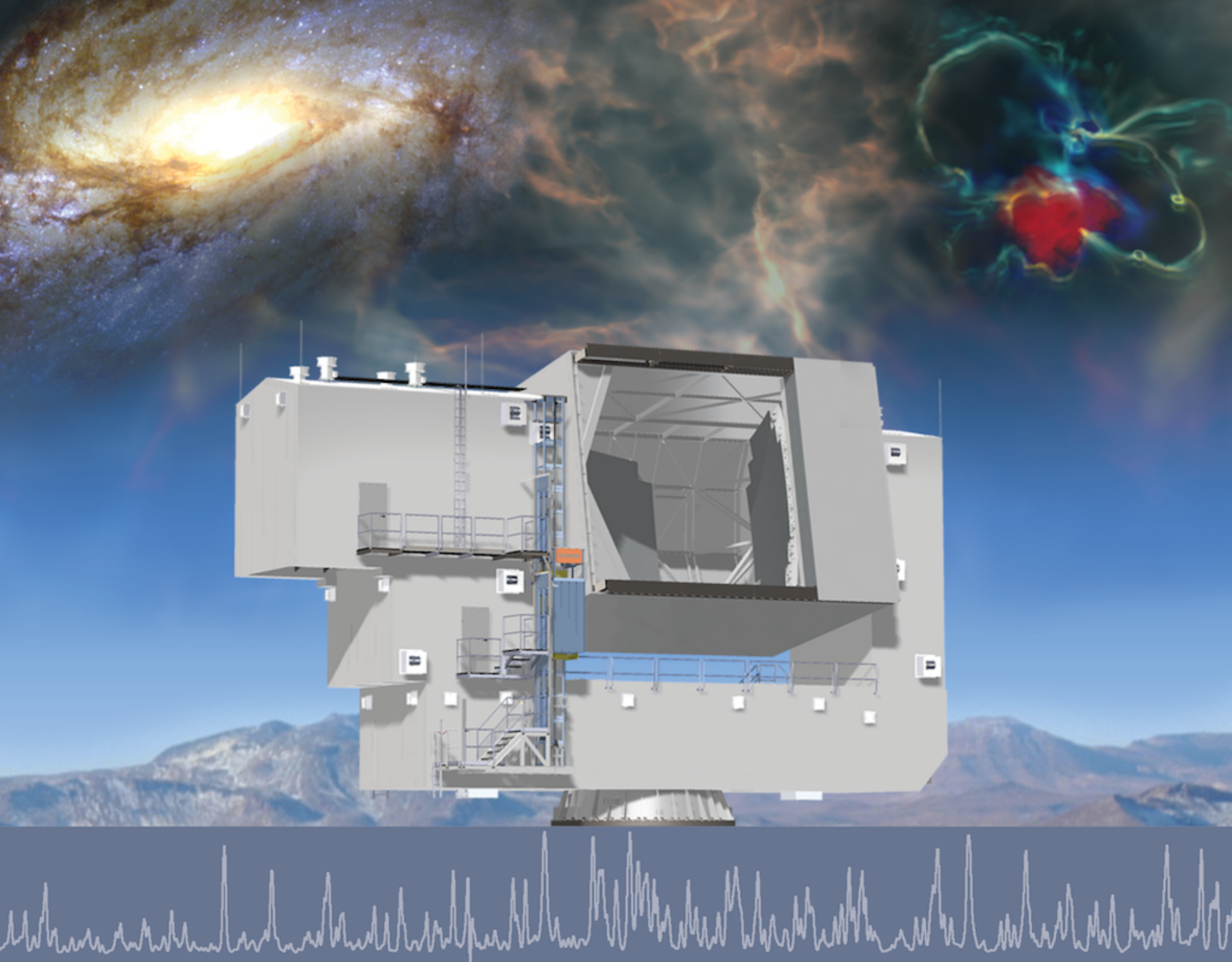
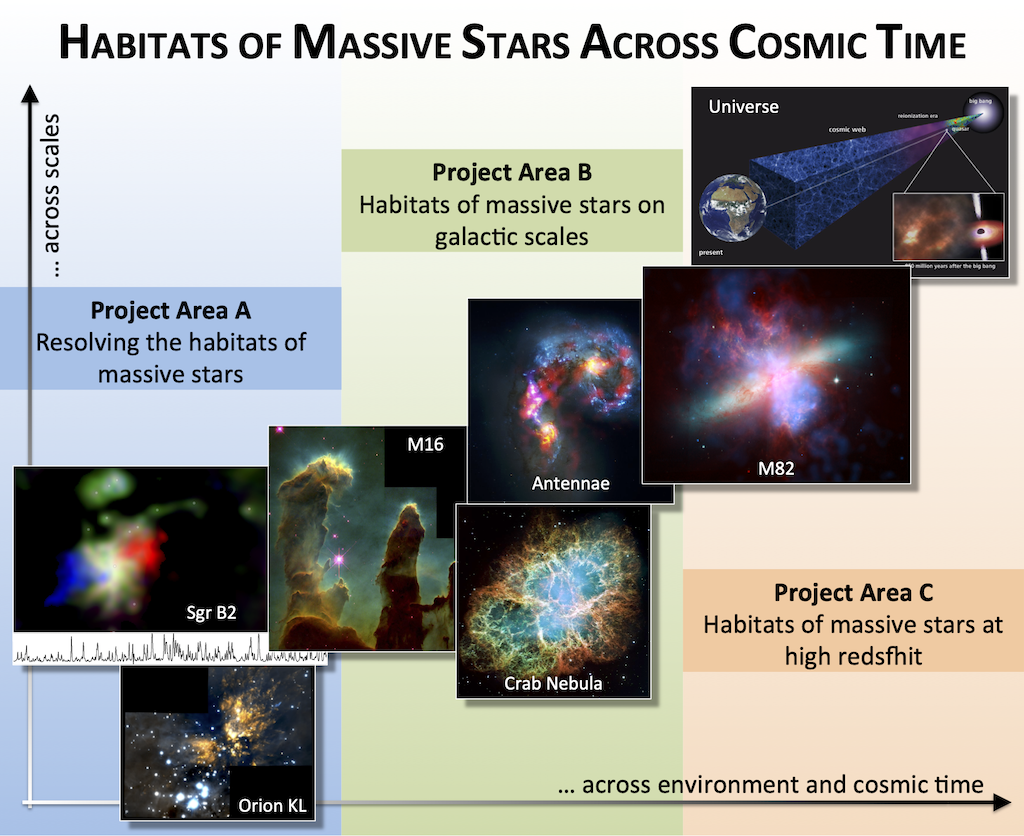
Massive stars, due to their short lifetime and high energy output, drive the evolution of galaxies across cosmic time. Hence, they substantially contribute to shaping the present-day Universe. The Collaborative Research Centre (CRC) will unravel the “habitats of massive stars across cosmic time”. “Habitats” are the gaseous environments within which massive stars are born and which they interact with via their feedback. Over the anticipated 12-year lifetime of this new CRC initiative, we aim to connect the physical processes that govern the habitats of massive stars across the full range of environments hosting massive stars – from sub-parsec to mega-parsec scales and from the Milky Way to the high-redshift Universe, where massive stars leave their cosmological fingerprint by driving cosmic reionisation.
Key Profile Area
“Dynamics of the Universe”
Our universe is full of fascinating, mysterious and often surprising phenomena. Understanding and explaining this in physical terms is the task of the new key profile area Dynamics of the Universe.
The Dynamics of the Universe key profile area establishes an excellent environment for training, early contact with current research, and exchange in international co-operations and competitions. In addition, the interdisciplinary collaboration between the fields of physics, computer science and applied mathematics will be strengthened in the long term. This is particularly important given the need to meet unprecedented challenges arising from the large amounts of observational data being generated by way of innovative ideas and algorithms, and to enable and efficiently advance complex simulations using new hardware technologies.
SFB 1601 News
Public Outreach
Symposium 2026
HRMS 2025
Colloquium
Child Care
Publications
Videos & Articles
SFB 1601 Projects
PhD Students
Family & Diversity
Sustainability
Science Highlight
-
B3: The lifetime of 100,000 molecular clouds in the nearby Universe (Zein Bazzi, Frank Bigiel, Dario Colombo)
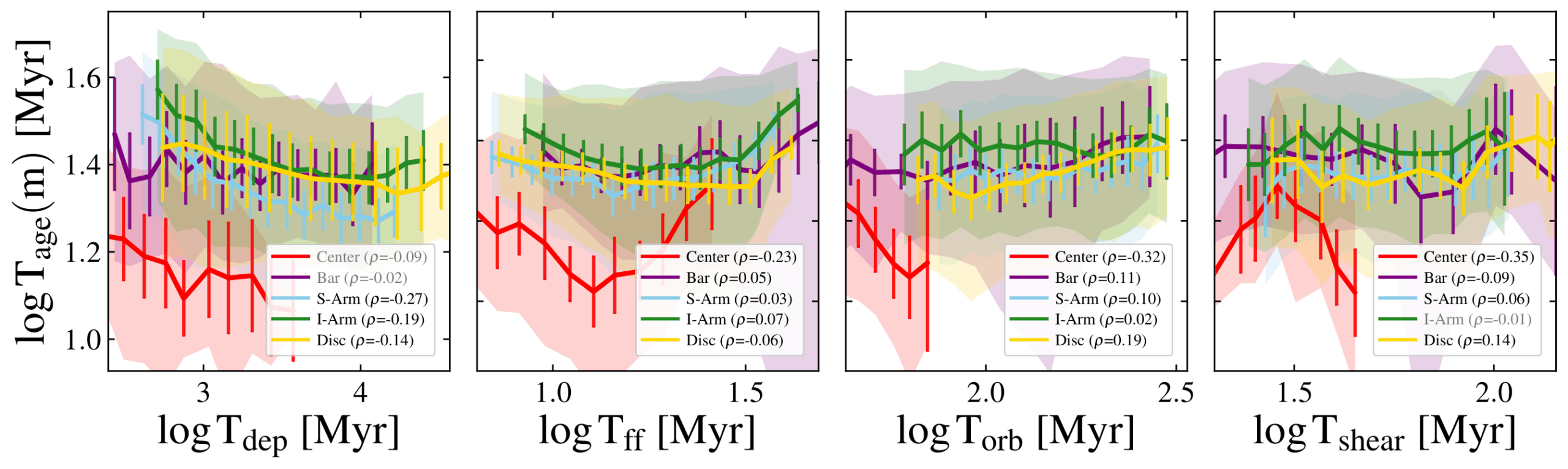
Multiple mechanisms are proposed for forming giant molecular clouds (GMCs), from gravitational free-fall driven by self-gravity to stellar feedback-driven gas compression. Both the galactic environment and galaxy conditions may also enhance formation through gas surface density and star-formation activity. In Bazzi et al. 2026a, we presented a catalog of 108,466 GMCs identified by F770W PHANGS-JWST imaging across 66 galaxies at a resolution of 5-30 pc. In Bazzi et al. 2026b, we use this catalog to measure the mass spectra in various galactic regions, whose power-law slopes vary from -1.2 to -2.0. We then estimate the formation time of each cloud using a model in which GMCs (e.g., Inutsuka et al. 2015; Kobayashi et al. 2017) form by multiple feedback compression, and find that clouds with masses ≤ 10^5 M☉ form in 20 Myr on average, and more massive clouds (~ 10^6-7 M☉) take up to 100 Myr. We also find that cloud formation proceeds most rapidly in the central regions of galaxies, with formation timescales typically shorter by ~ 5-10 Myr than in galactic disks. This highlights the role of intense massive star formation, high molecular gas surface densities, and strong supersonic compressions in accelerating cloud formation. However, star formation is generally inefficient, as shown in Figure 1, where the cloud lifetime is ~1% of the molecular depletion time. Also, cloud formation time is ~0.1 dex longer than the free-fall time. This suggests that magnetic fields, stellar feedback, or other mechanisms may prolong formation rather than allowing immediate free-fall collapse. This also indicates a longevity of massive GMCs. The GMC ages also show only limited variation with galactocentric radius in both spiral and disk galaxies, suggesting that cloud formation proceeds similarly in these galaxy types.
Paper Link: https://www.aanda.org/articles/aa/abs/2026/06/aa59653-26/aa59653-26.html (Bazzi et al. 2026b)
We value our Planet:
1st funding period: 10/2023 – 06/2027