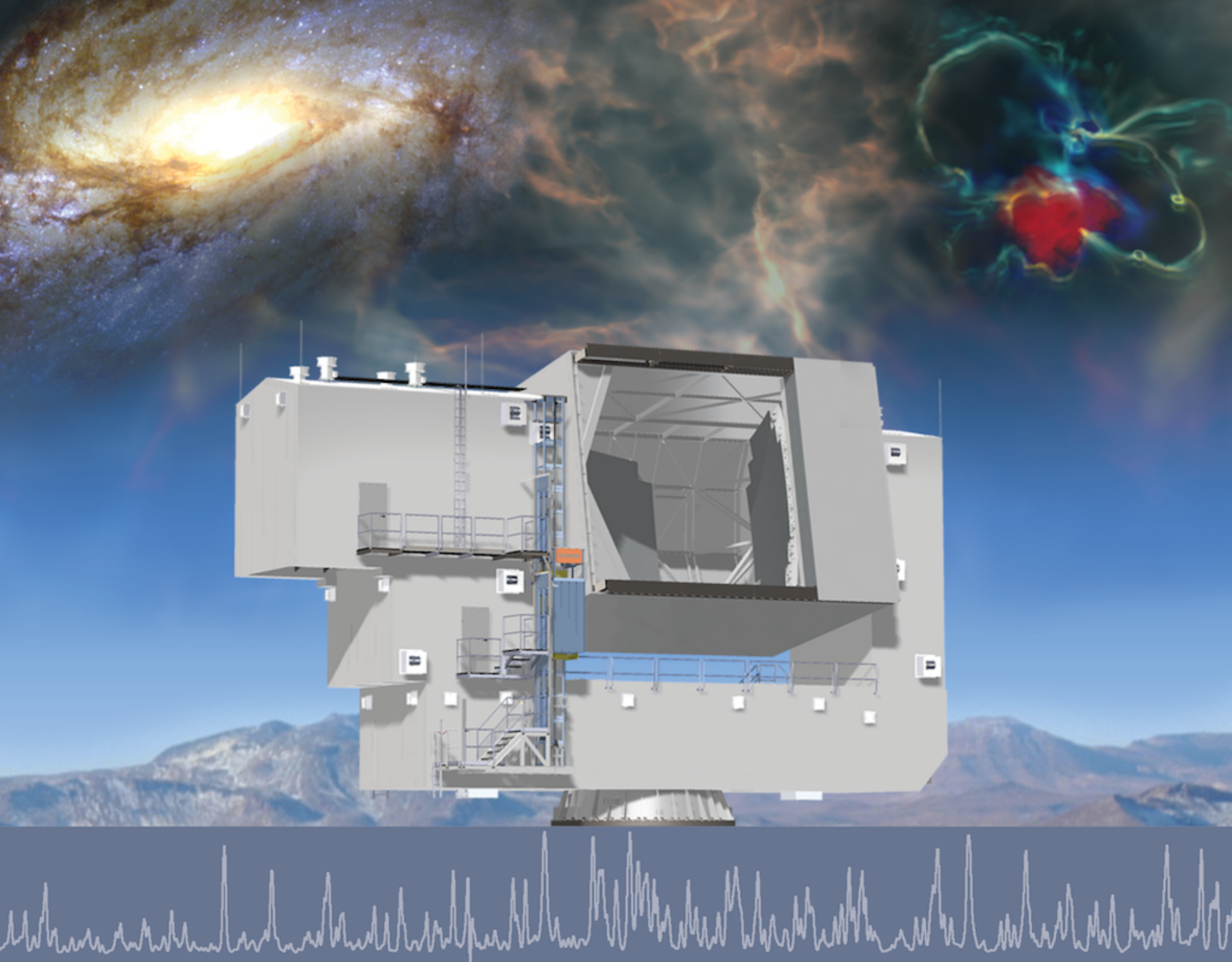
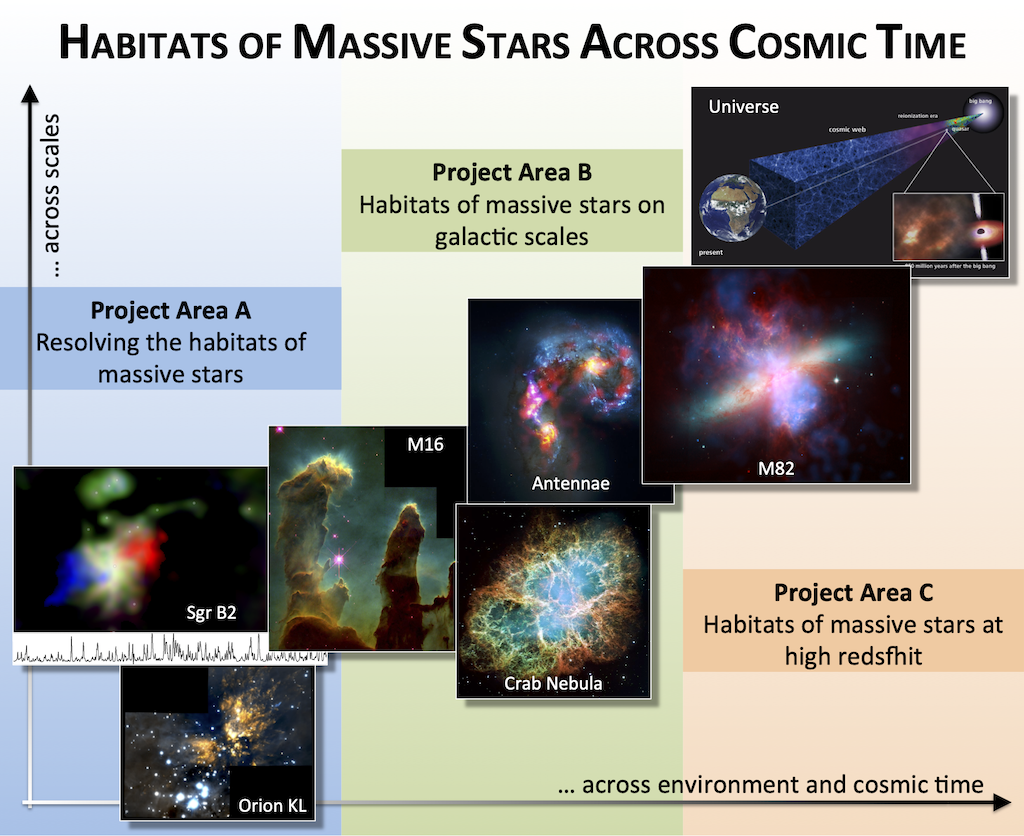
Massive stars, due to their short lifetime and high energy output, drive the evolution of galaxies across cosmic time. Hence, they substantially contribute to shaping the present-day Universe. The Collaborative Research Centre (CRC) will unravel the “habitats of massive stars across cosmic time”. “Habitats” are the gaseous environments within which massive stars are born and which they interact with via their feedback. Over the anticipated 12-year lifetime of this new CRC initiative, we aim to connect the physical processes that govern the habitats of massive stars across the full range of environments hosting massive stars – from sub-parsec to mega-parsec scales and from the Milky Way to the high-redshift Universe, where massive stars leave their cosmological fingerprint by driving cosmic reionisation.
Key Profile Area
“Dynamics of the Universe”
Our universe is full of fascinating, mysterious and often surprising phenomena. Understanding and explaining this in physical terms is the task of the new key profile area Dynamics of the Universe.
The Dynamics of the Universe key profile area establishes an excellent environment for training, early contact with current research, and exchange in international co-operations and competitions. In addition, the interdisciplinary collaboration between the fields of physics, computer science and applied mathematics will be strengthened in the long term. This is particularly important given the need to meet unprecedented challenges arising from the large amounts of observational data being generated by way of innovative ideas and algorithms, and to enable and efficiently advance complex simulations using new hardware technologies.
SFB 1601 News
Public Outreach
Symposium 2026
HRMS 2025

Colloquium
Child Care
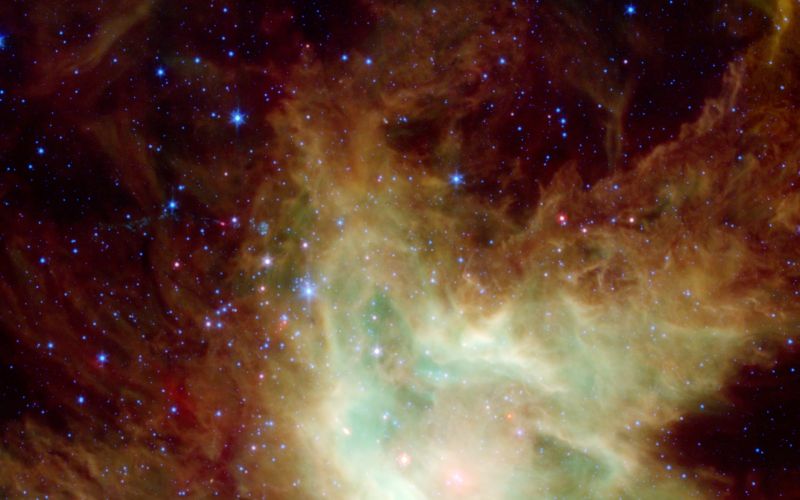
Publications
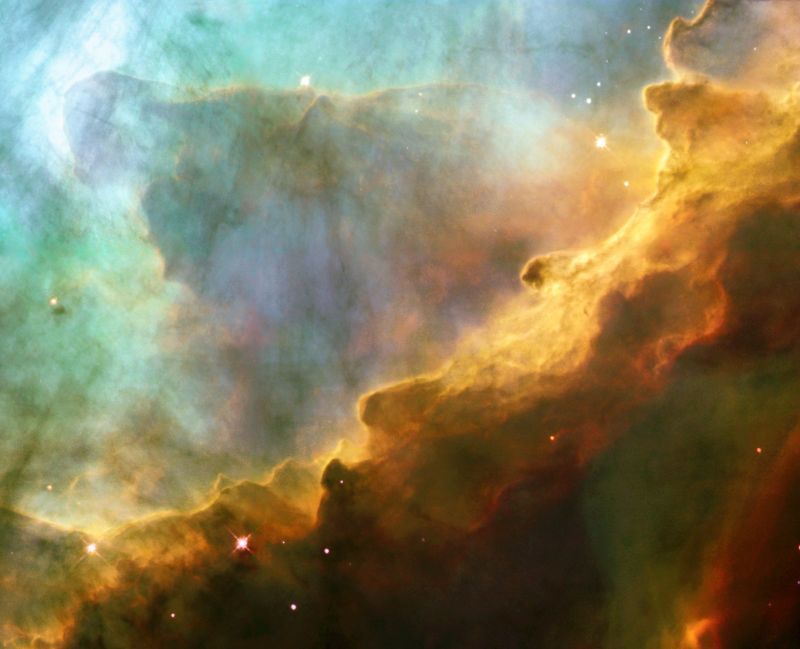
Videos & Articles
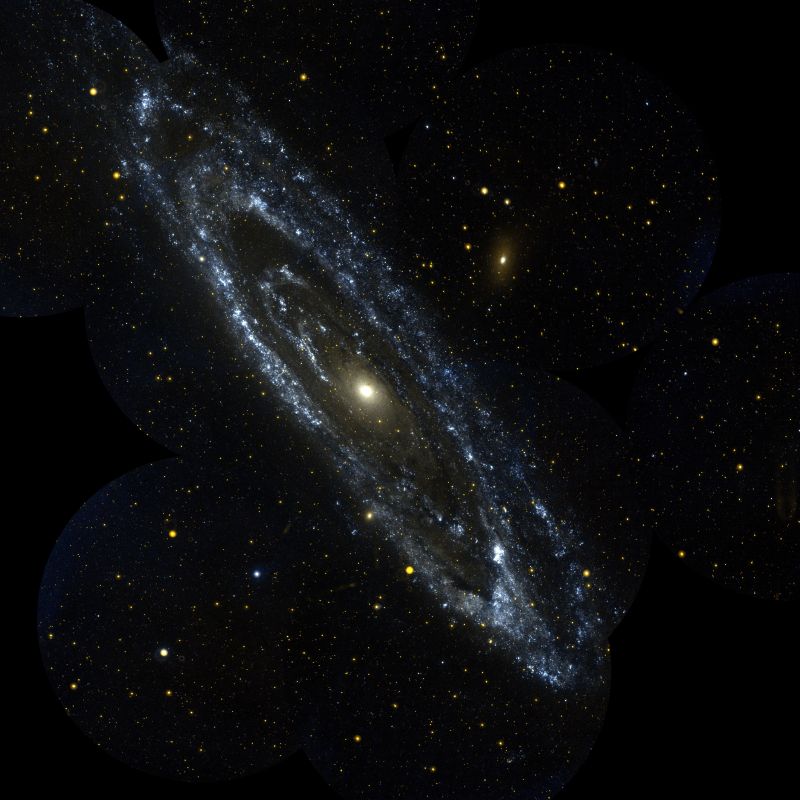
SFB 1601 Projects
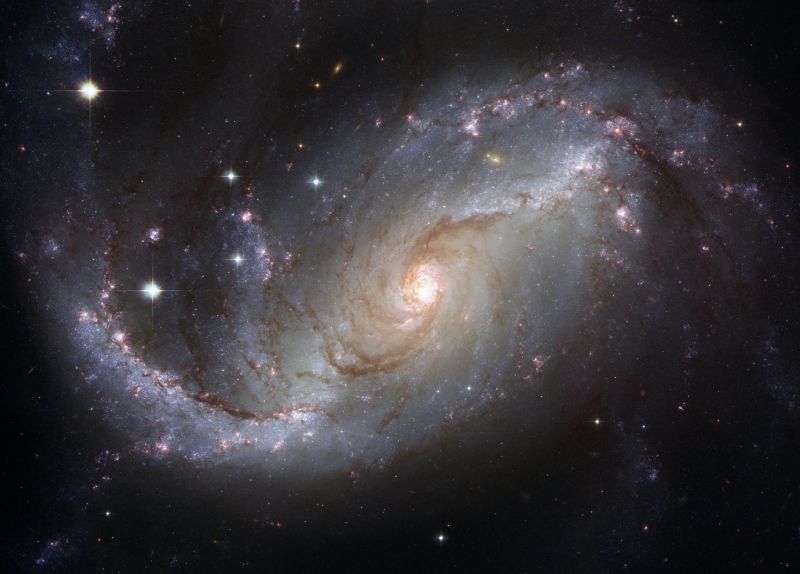
PhD Students
Family & Diversity
Sustainability
Science Highlight
-
A4: First Measurements of the rotational Spectrum of Phosphabutyne (Sven Thorwirth, Luis Bonah)
Many places in space are too far away to learn about them by sending spacecraft there. So they cannot be examined directly but instead, we can learn about them by analyzing their emitted light.
Due to quantum mechanics, each molecule has a set of characteristic transition lines that uniquely identify it. When these transition lines are found in the emitted spectrum, we can be sure that the respective molecule appears in the observed object.
However, to identify molecules in space, we first have to understand their characteristic patterns in the laboratory. We do so by measuring the rotational spectrum of the molecules in our experiment and then fitting quantum mechanical models to them. These models can then be used by astronomers to identify the molecules in space and also to infer the physical conditions of the corresponding regions in space. For example, the temperature can be deduced from intensity relations, the pressure from the lineshape, and the molecule’s abundance can be inferred from its intensity.
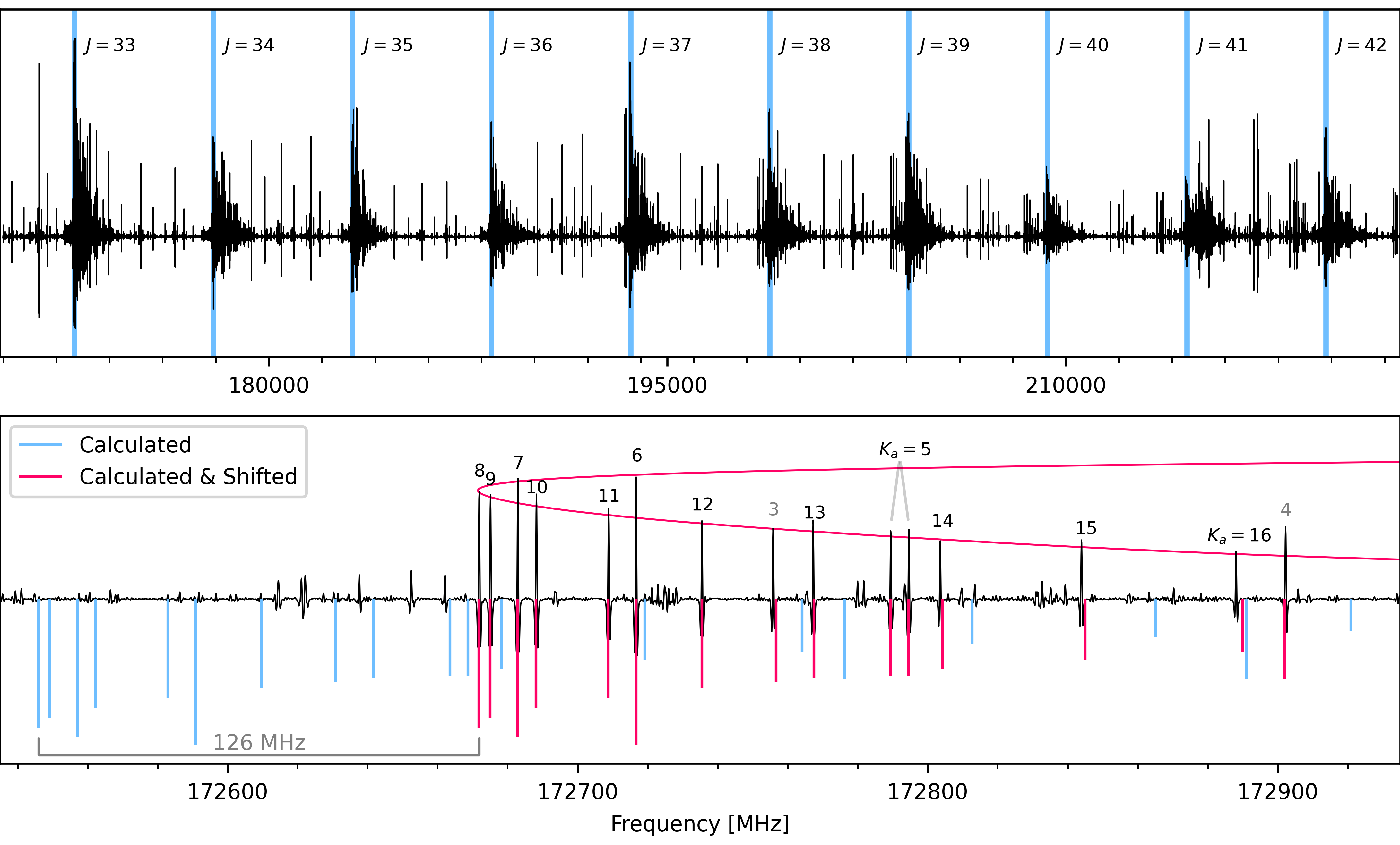
Here, we measured the pure rotational spectrum of phosphabutyne (C2H5CP) for the first time and analyzed its vibrational ground state as well as its three singly 13C-substituted isotopologues. This will allow astronomers to search for phosphabutyne in space and determine the prevailing conditions of the corresponding regions. The figure shows a section of the measured broadband spectrum on top, highlighting the pattern repeating with the total angular momentum quantum number J, while the zoom-in on the bottom highlights the very good agreement between the calculated and measured spectrum, especially when applying a small shift of 126 MHz.
This work was performed in collaboration with Jean-Claude Guillemin (University Rennes) and Michael E. Harding (KIT).
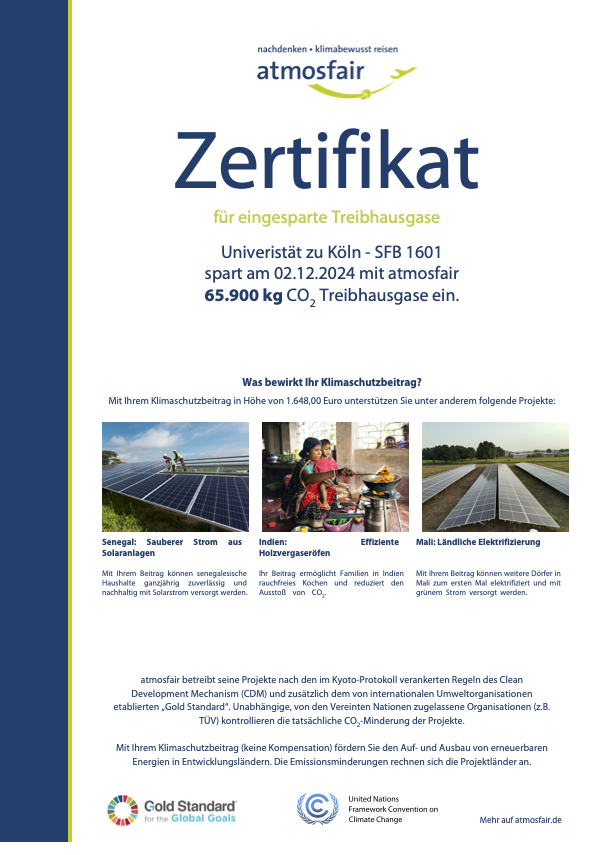
We value our Planet:
1st funding period: 10/2023 – 06/2027