
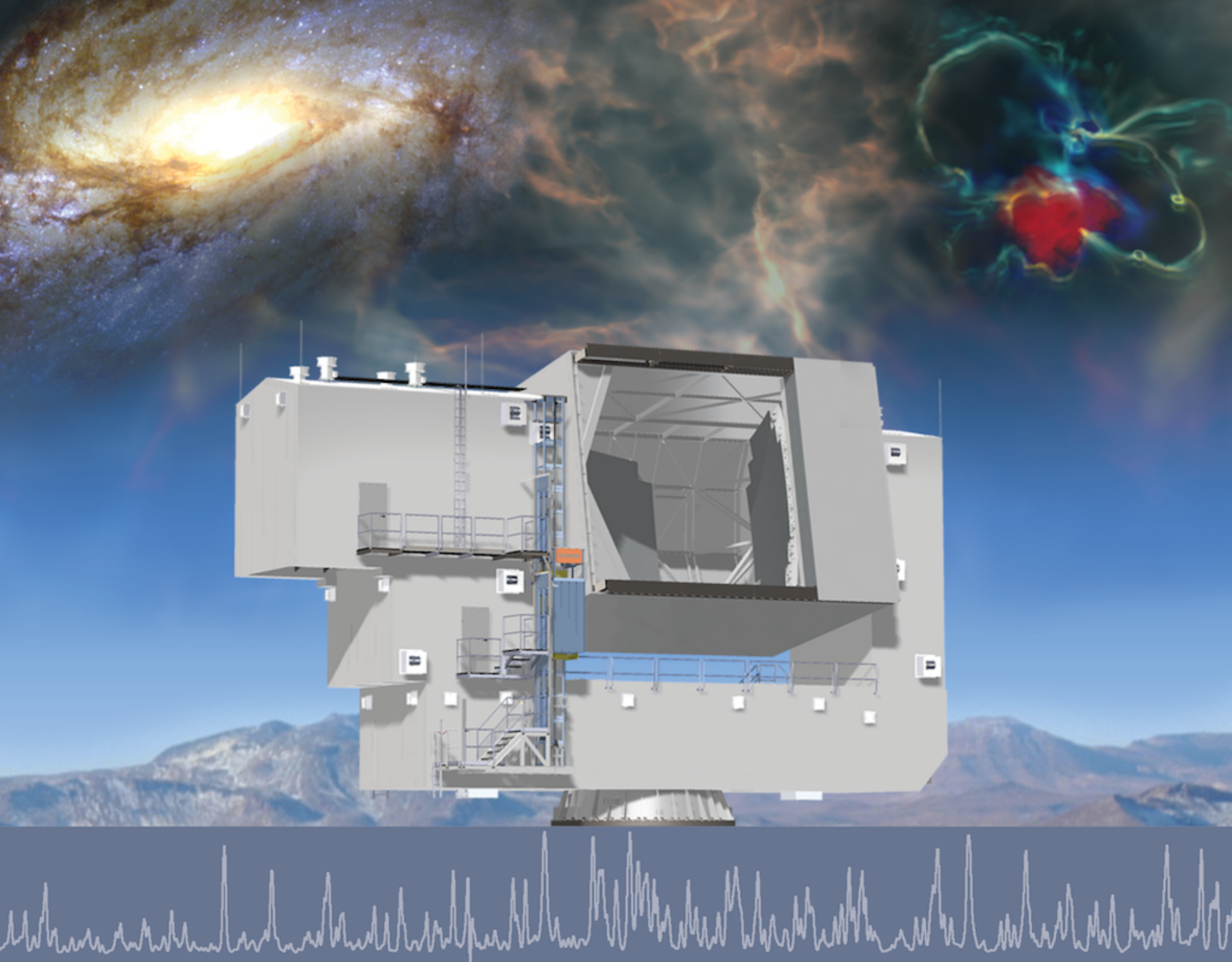
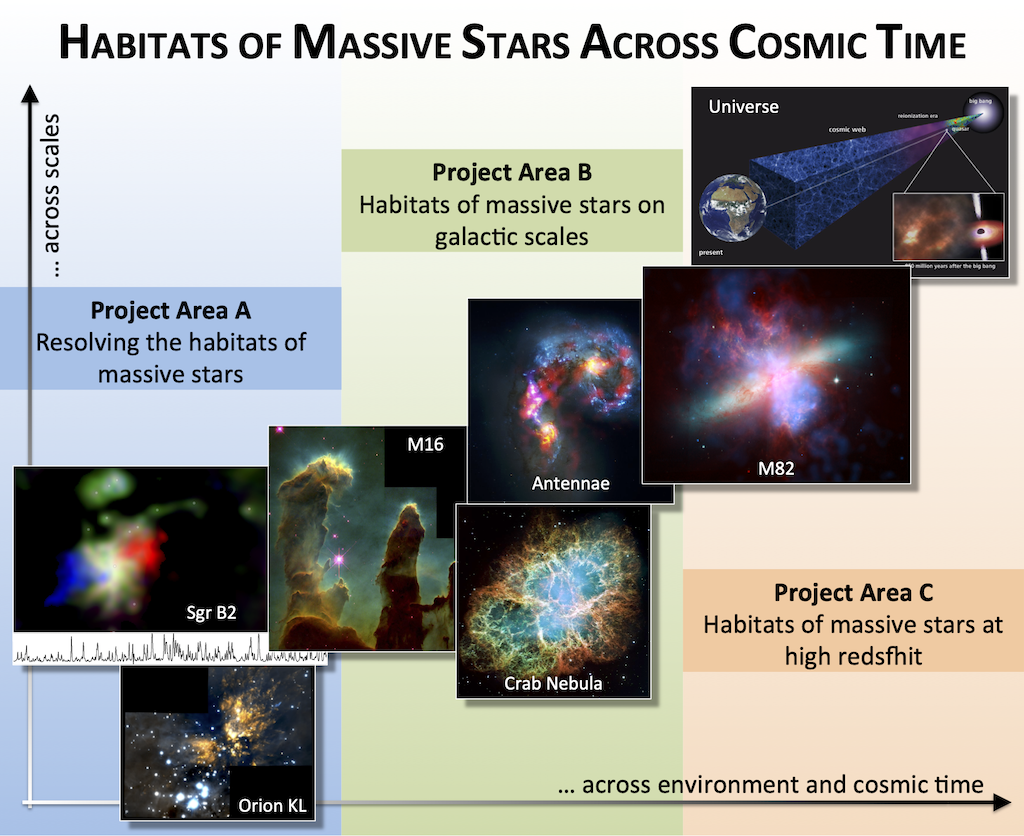
Massive stars, due to their short lifetime and high energy output, drive the evolution of galaxies across cosmic time. Hence, they substantially contribute to shaping the present-day Universe. The Collaborative Research Centre (CRC) will unravel the “habitats of massive stars across cosmic time”. “Habitats” are the gaseous environments within which massive stars are born and which they interact with via their feedback. Over the anticipated 12-year lifetime of this new CRC initiative, we aim to connect the physical processes that govern the habitats of massive stars across the full range of environments hosting massive stars – from sub-parsec to mega-parsec scales and from the Milky Way to the high-redshift Universe, where massive stars leave their cosmological fingerprint by driving cosmic reionisation.
Key Profile Area
“Dynamics of the Universe”
Our universe is full of fascinating, mysterious and often surprising phenomena. Understanding and explaining this in physical terms is the task of the new key profile area Dynamics of the Universe.
The Dynamics of the Universe key profile area establishes an excellent environment for training, early contact with current research, and exchange in international co-operations and competitions. In addition, the interdisciplinary collaboration between the fields of physics, computer science and applied mathematics will be strengthened in the long term. This is particularly important given the need to meet unprecedented challenges arising from the large amounts of observational data being generated by way of innovative ideas and algorithms, and to enable and efficiently advance complex simulations using new hardware technologies.
SFB 1601 News
Public Outreach
Symposium 2026
HRMS 2025
Colloquium
Child Care
Publications
Videos & Articles
SFB 1601 Projects
PhD Students
Family & Diversity
Sustainability
Science Highlight
-
B2: Molecular cloud dispersal traced by the ionized carbon 158 micron line (Nicola Schneider, Simon Dannhauer, Robert Simon)
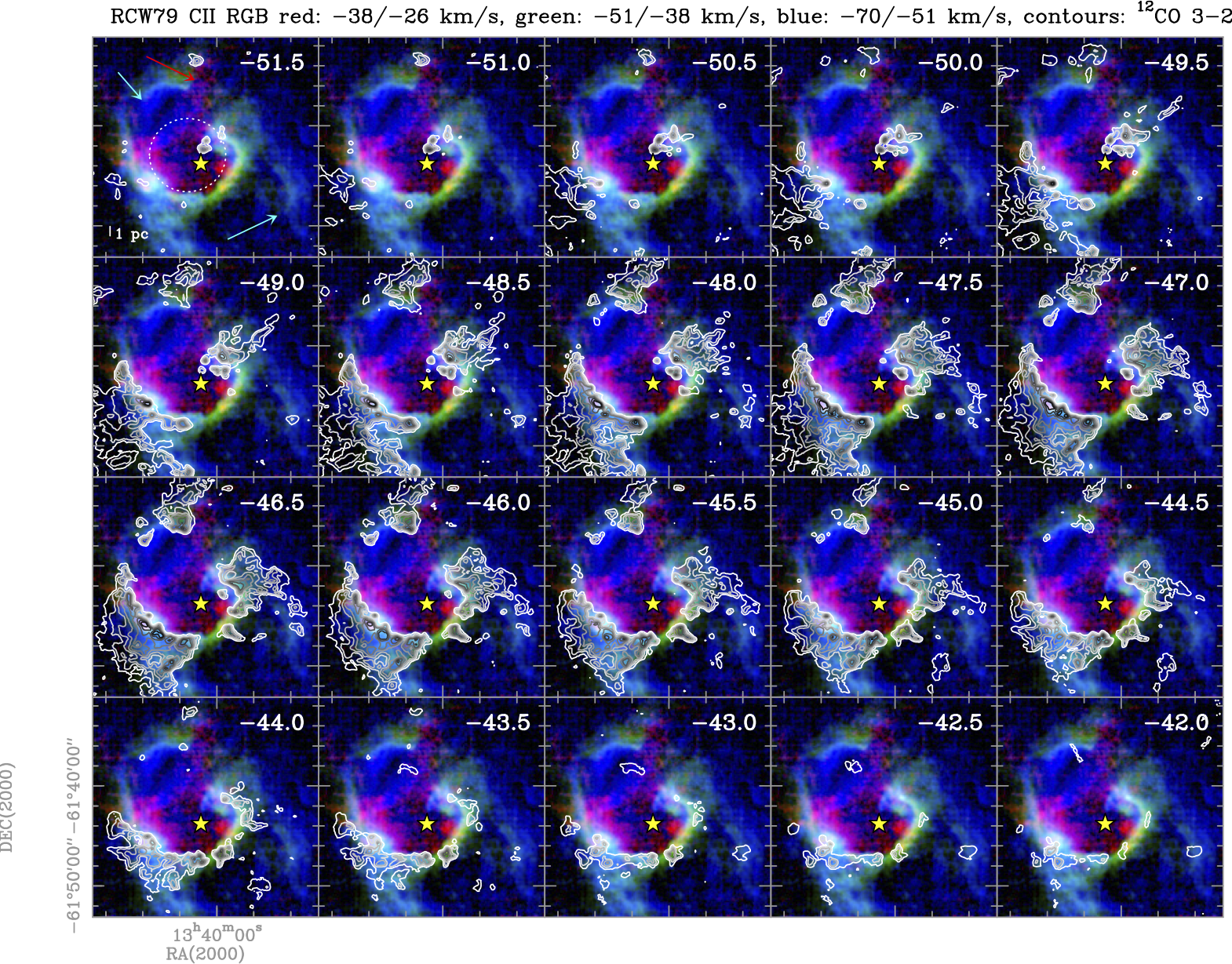
Massive stars are slowly but surely destroying the clouds that gave birth to them. This study by Bonne et al. uses observations of the ionized carbon line at 158 µm ([CII]) to systematically trace how radiation and winds from massive O-type stars erode their parent molecular clouds. Using the airborne observatory SOFIA, ten star-forming regions were mapped. All clouds show fast-moving gas, reaching velocities of 5–30 km/s above the cloud’s escape velocity, meaning this gas is permanently lost from the cloud.
The key finding is that this high-velocity gas cannot be explained by a simple, coherent expanding bubble,as was found in earlier studies of some HII regions. The dynamical timescales derived from the gas motions are always shorter than 0.75 million years, regardless of whether the stellar cluster is 0.5 or 2.5 million years old — a striking inconsistency. Instead, it is proposed, similar to
conclusions from observations and simulations of Dannhauer et al. (2025), that the initial bubble breaks open within about 0.1 million years. The gas continuously streams out of the cloud through holes and low-density channels carved into the irregular, fragmented cloud structure.These erosion flows are efficient enough to ultimately disperse the entire molecular cloud within a few million years. Mass ejection rates range from roughly 0.001 to 0.02 solar masses per year, increasing systematically with the number and luminosity of the exciting O stars. This yields cloud lifetimes of 3–10 million years after the onset of massive star formation — consistent with independent estimates from other methods. Remarkably, these mass ejection rates are comparable in magnitude to the mass infall rates measured in actively collapsing star-forming clumps, suggesting that stellar feedback can balance gravitational infall and is a key mechanism keeping star formation rates in galaxies as low as observed.
available at:
We value our Planet:

1st funding period: 10/2023 – 06/2027