Observatory

CRC1601-visit to the Public Observatory Cologne
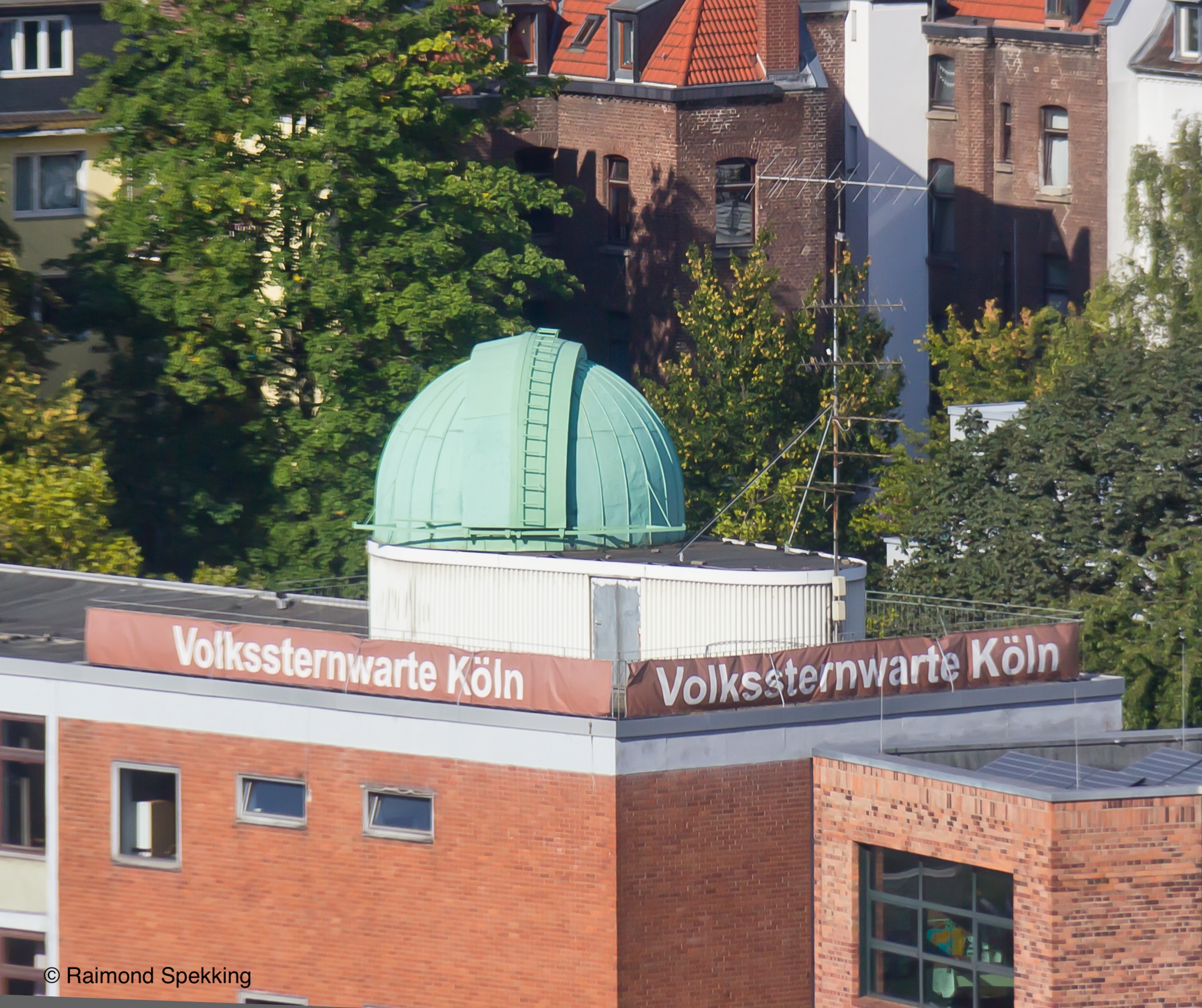
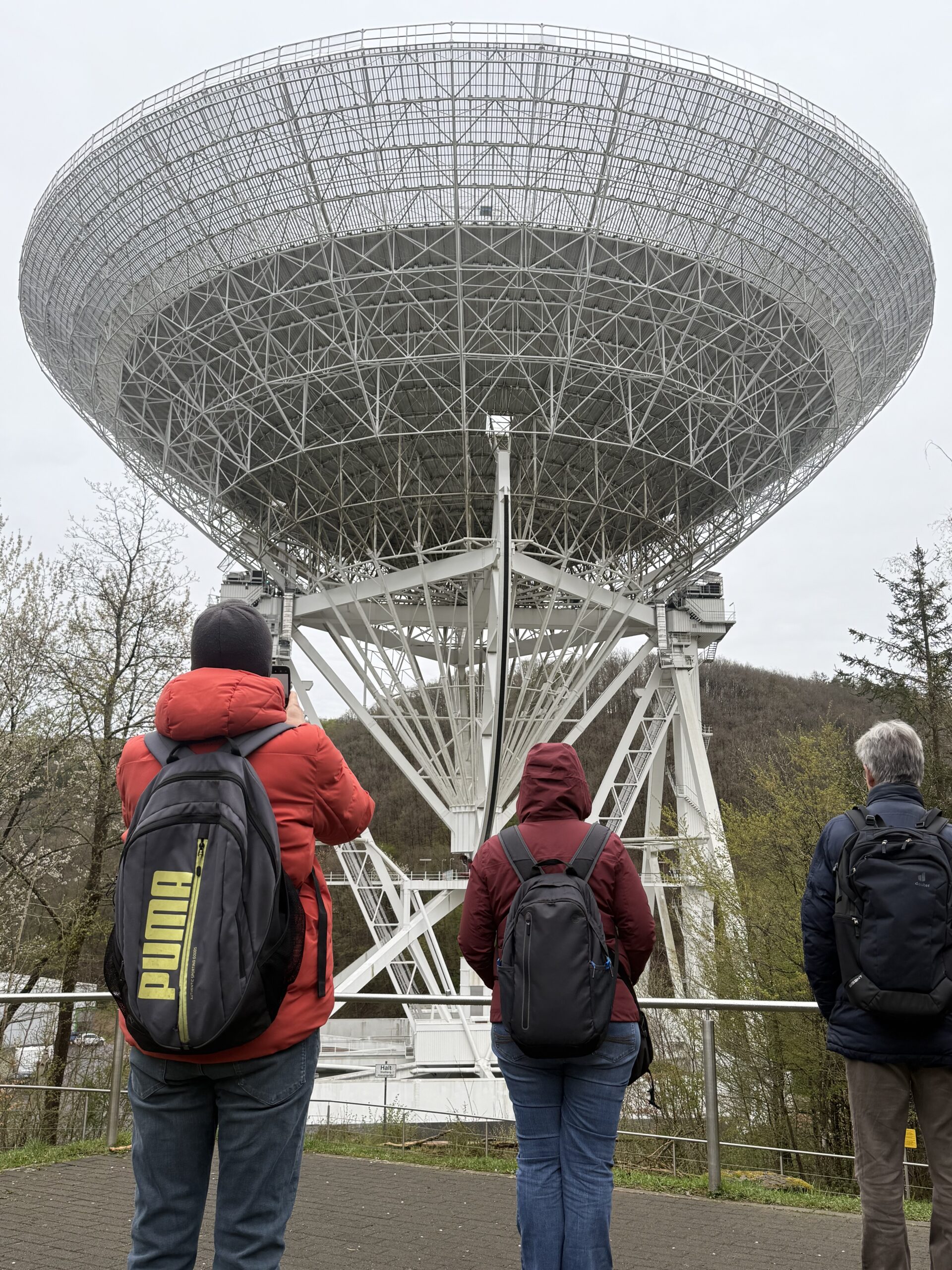
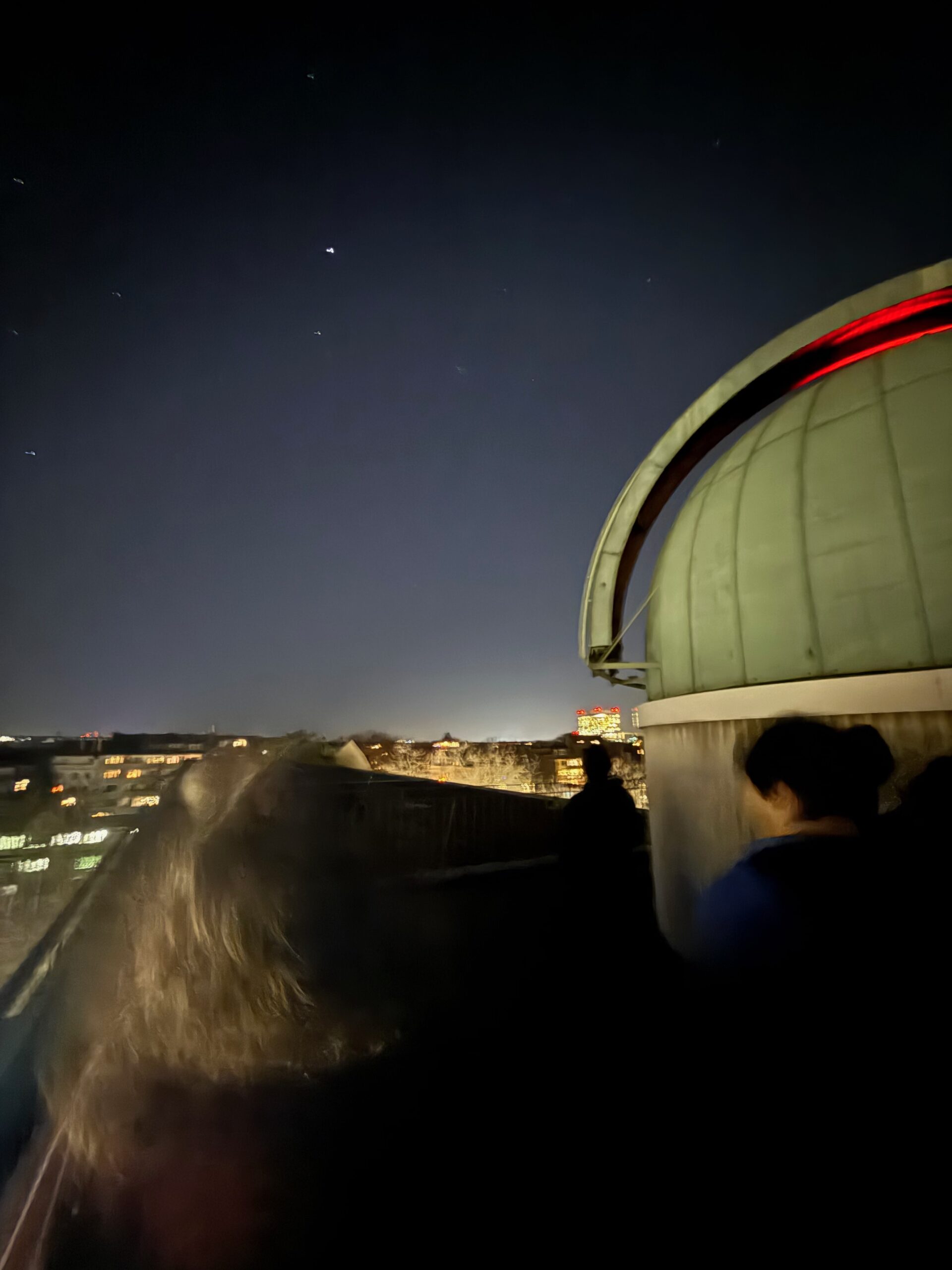
Members of the CRC1601 visited to Public Observatory Cologne on March 19, 2025. Having a clear sky, we were able to observe several stars and nebulae

Public Observatory Cologne

The Public Observatory Cologne is a private institution which is run by the members of the “Vereinigung der Sternfreunde Köln e.V.” on a voluntary basis. This association of interested amateurs and amateur astronomers was founded in 1922 with the aim of disseminating basic astronomical knowledge to the public and promoting the training and further education of active amateur astronomers within the scope of the available possibilities.With the 60cm refractor “Cologne Large Telescope” (CLT) installed in 2012, the Volkssternwarte Köln operates the largest freely accessible telescope in North Rhine-Westphalia

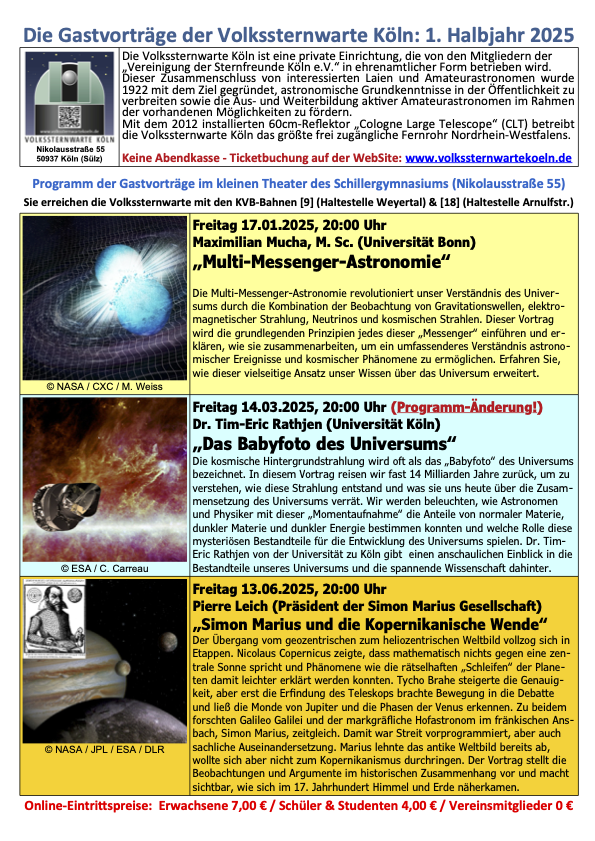
Talks at the Public Observatory Cologne

The Public Observatory Cologne is a private institution which is run by the members of the “Vereinigung der Sternfreunde Köln e.V.” on a voluntary basis. This association of interested amateurs and amateur astronomers was founded in 1922 with the aim of disseminating basic astronomical knowledge to the public and promoting the training and further education of active amateur astronomers within the scope of the available possibilities.With the 60cm refractor “Cologne Large Telescope” (CLT) installed in 2012, the Volkssternwarte Köln operates the largest freely accessible telescope in North Rhine-Westphalia
insect hotels

CRC1601 insect hotels are ready for moving in

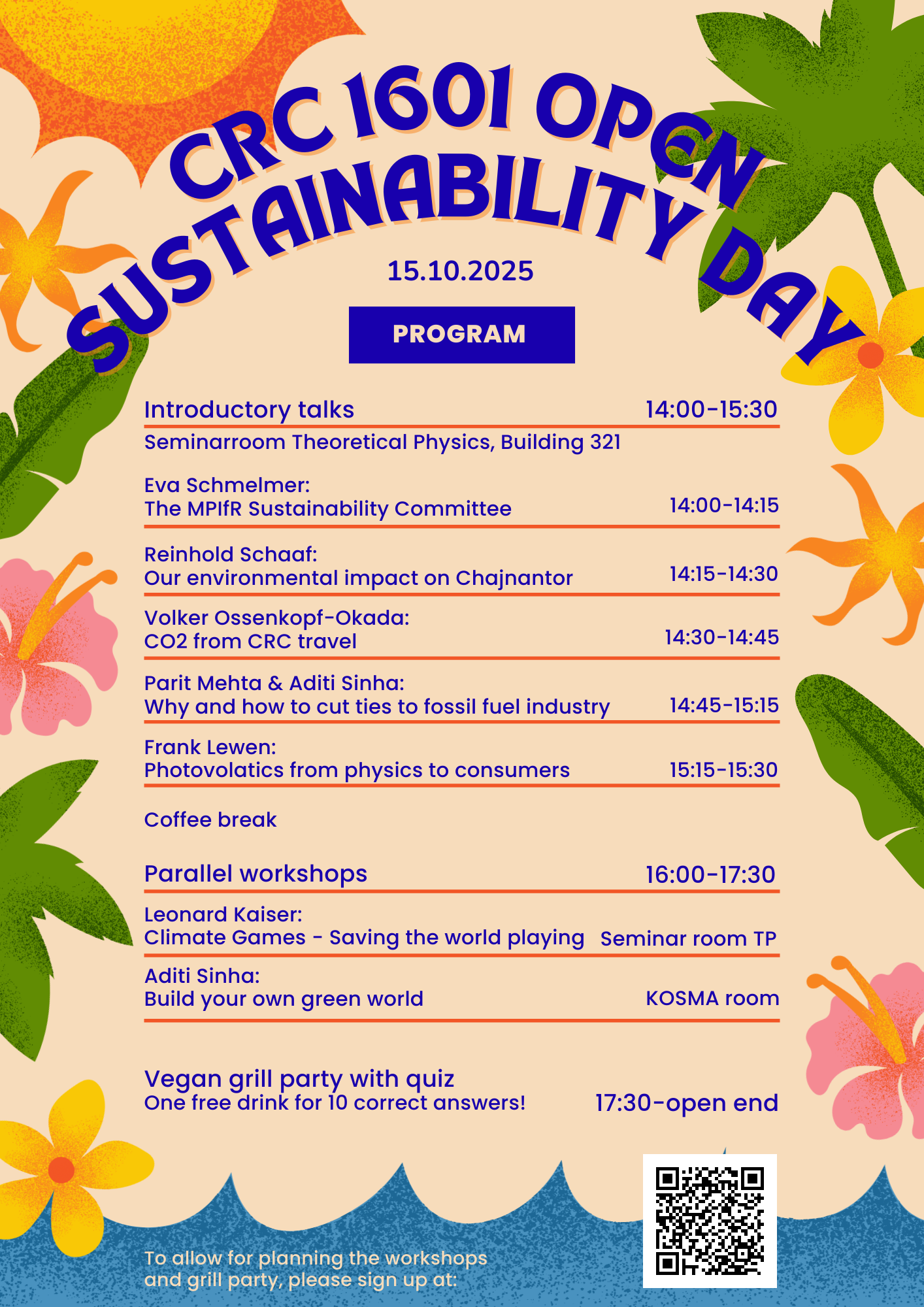
The CRC’s Sustainability Board is responsible for coordinating the evaluation of the environmental impact of the CRC’s activities and proposing measures to reduce it.  In addition, the Sustainability Board organises talks and workshops for the CRC members to raise awareness of sustainability issues and establish solutions for daily work.  During the sustainability barbecue on October 17, among other topics, the University of Cologne’s sustainability strategy and the problem of conference trips were discussed. In the afternoon, several workshops took place, one of which involved participants building their own insect hotels. This Thursday, a total of seven insect hotels were put up around the physics department of the University of Cologne. Insect hotels provide shelter and nesting facilities for a variety of insects during winter. Introducing insect hotels can help with pollination and ecosystem diversity.

The CRC1601 devotes the afternoon of October 17 to sustainability!

Did you know that the University of Cologne has its own Sustainability Office? We have invited them to present their daily work and challenges to make our university more sustainable. Do you have an idea on how to improve our university? Then join us and take this opportunity to talk to them directly!

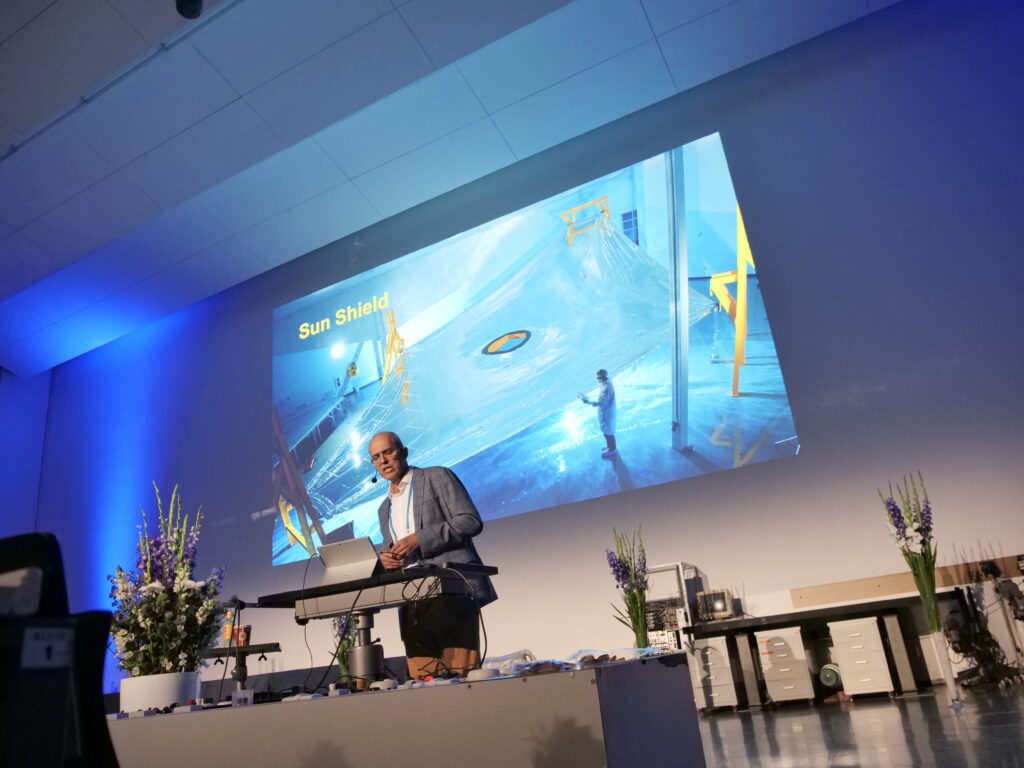
Eine Reise in die Dunkelheit – Andrina Nicola (12.09.24, Universität zu Köln)

Das Universum besteht zu 95 Prozent aus zwei mysteriösen, unsichtbaren Komponenten, der Dunklen Materie und der Dunklen Energie. Eines der Hauptziele der Kosmologie ist es, diesen Bestandteilen auf die Spur zu kommen und ihre Eigenschaften einzugrenzen. In diesem Vortrag werde ich die zugrundeliegenden Methoden erläutern und einen Überblick über die Durchmusterungen geben, die uns einen neuen Blick und neue Erkenntnisse über unser Universum geben werden.
Iris Nitzl Art

Space Debris – Art Exhibition by Iris Nitzl (09-13.09.24, University of Cologne)

Space Debris” shows lanes of debris found in the earth’s orbits – more than 130 million pieces. According to the IADC a critical point is reached (Kessler syndrome) and a chain reaction of collisions begins causing more and more garbage objects.
cat sign

Science Communication Seminar

Our science is often not visible to the public because we don’t know how to present in properly.  With the help of the UoC press department we are aiming to change that. 

Leuchtstoffraum 2, Kleinmann-Low 16.1 channel sound installation – Julian Rohrhuber & Volker Ossenkopf-Okada (18.04.24, Weltkunstzimmer Düsseldorf)

The Kleinmann-Low nebula in the Orion is a location of intense star formation with a complex spatial and chemical dynamic. Its radiation originates from finely distributed atoms and molecules, which in the light of the young stars emit a characteristic spectrum. The piece „Leuchtstoffraum“ is informed by the unusually precise measurements of the Herschel space telescope from 2010. It is based on the simple principle that the natural laws are the same on earth as in the nebula 1300 light years away. We hear the structure of electromagnetic radiation of a minute point in the sky whose frequencies may be partitioned into series of molecule spectra, known from the laboratory. Leuchtstoffraum 2 is an outcome of a collaboration between Julian Rohrhuber, professor at the Robert Schumann Hochschule Düsseldorf, with the astro-physicist PD Dr. Volker Ossenkopf-Okada, who teaches at I. Physikalische Institut of the University, Cologne.

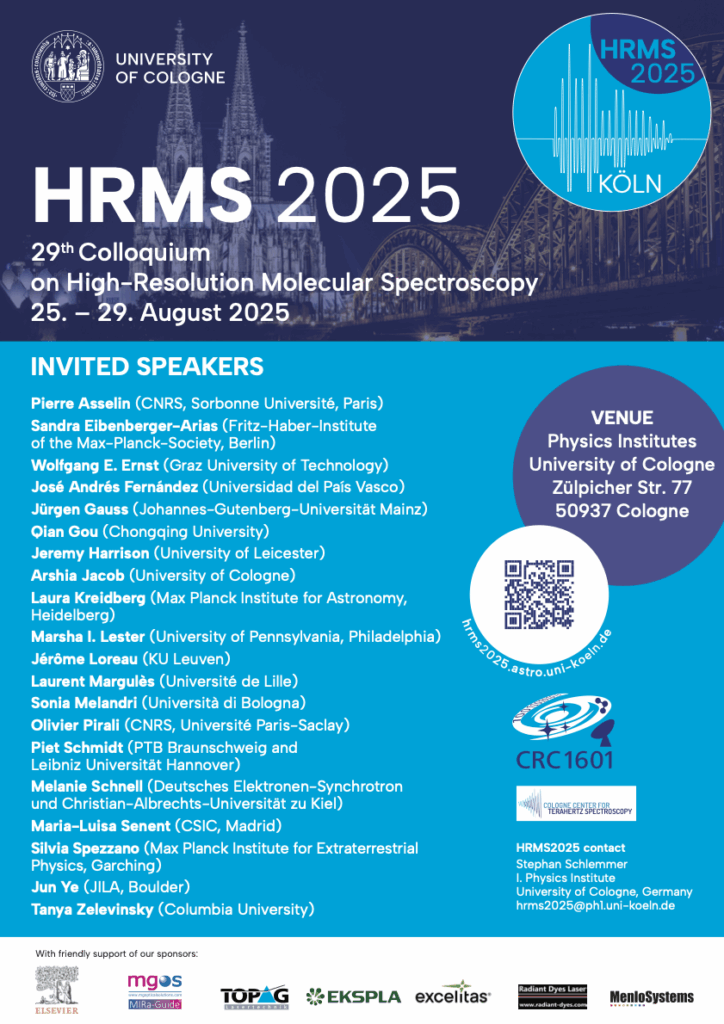
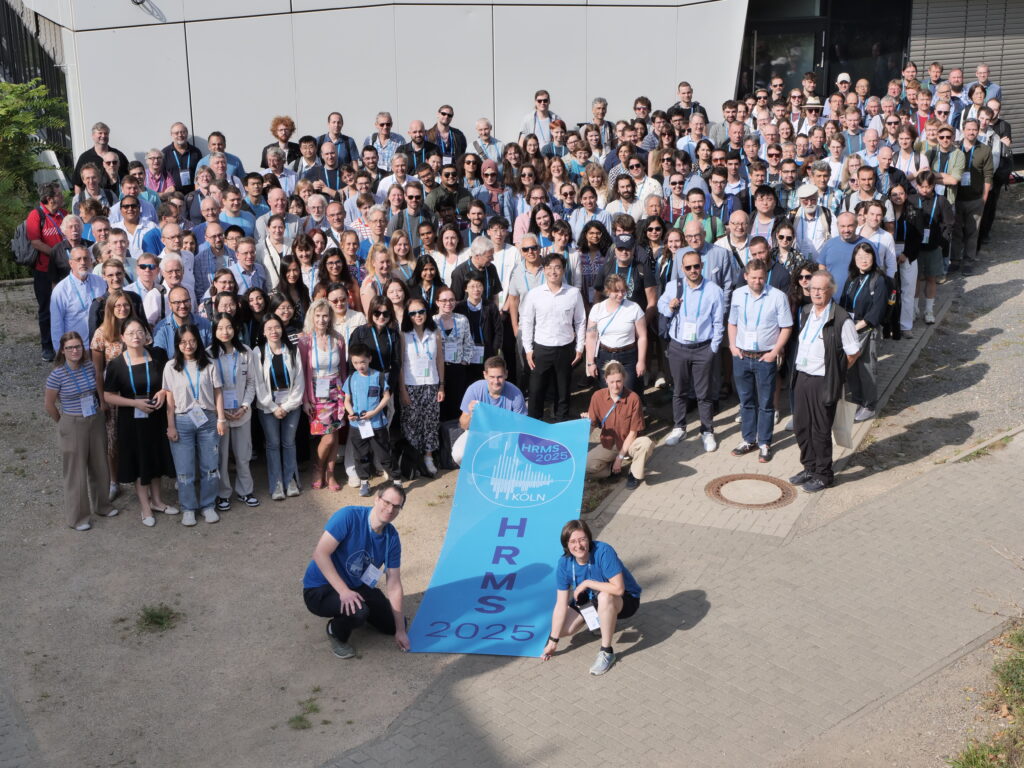
29th Colloquium on High-Resolution Molecular Spectroscopy, 25. – 29. August 2025

The 29th Colloquium on High-Resolution Molecular Spectroscopy (HRMS) was held at the Physics Institutes of the Universität zu Köln, organized locally by the “Laboratory Astrophysics Group” of the I. Physikalisches Institut, Universität zu Köln.

https://hrms2025.astro.uni-koeln.de


Scientific Program:

There were be 10 plenary lectures and 3 mini-symposia with 10 invited speakers. Parallel sessions will feature 72 contributed talks. There will be four poster sessions with more than 130 contributions. The scientific fields covered are:

  • High resolution rotational, vibrational, and electronic spectroscopy of molecules (radicals, ions, complexes, clusters, …)
  • Molecular dynamics
  • Theory assisting the prediction, simulation, and interpretation of spectra
  • New techniques for high-resolution spectroscopy
  • Applications to atmospheric sciences, astrophysics, planetology, combustion, gas-phase biomolecules, metrology and fundamental physics, cold molecules, etc.
Meeting of the Astronomical Society 2024 in Cologne

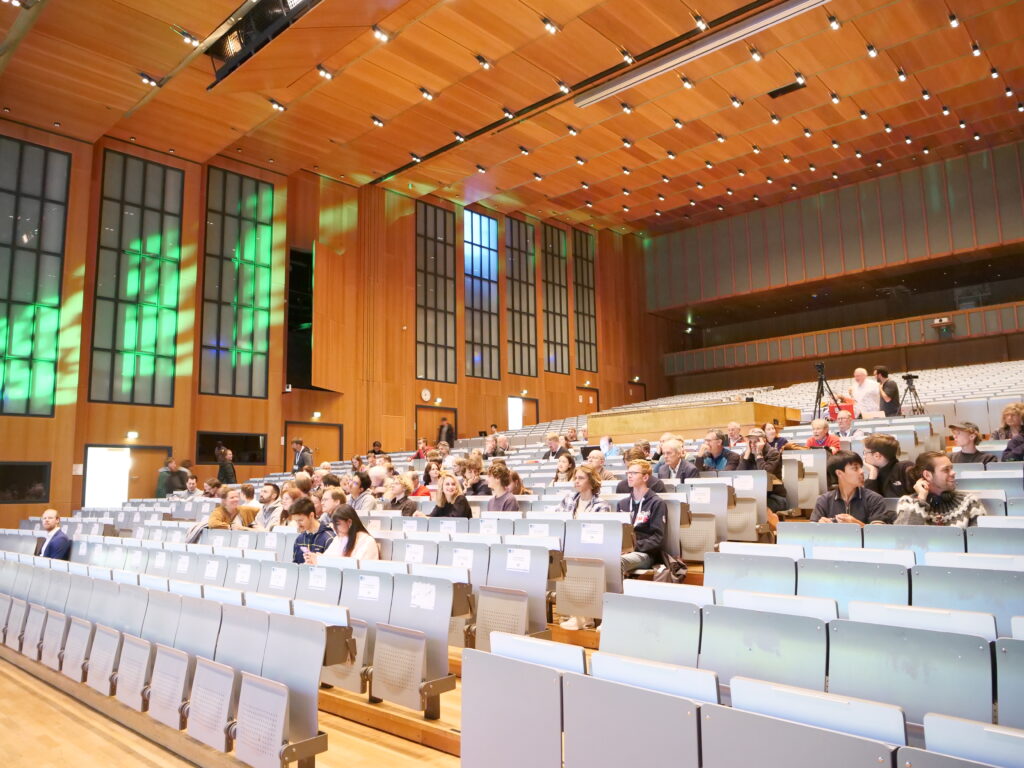
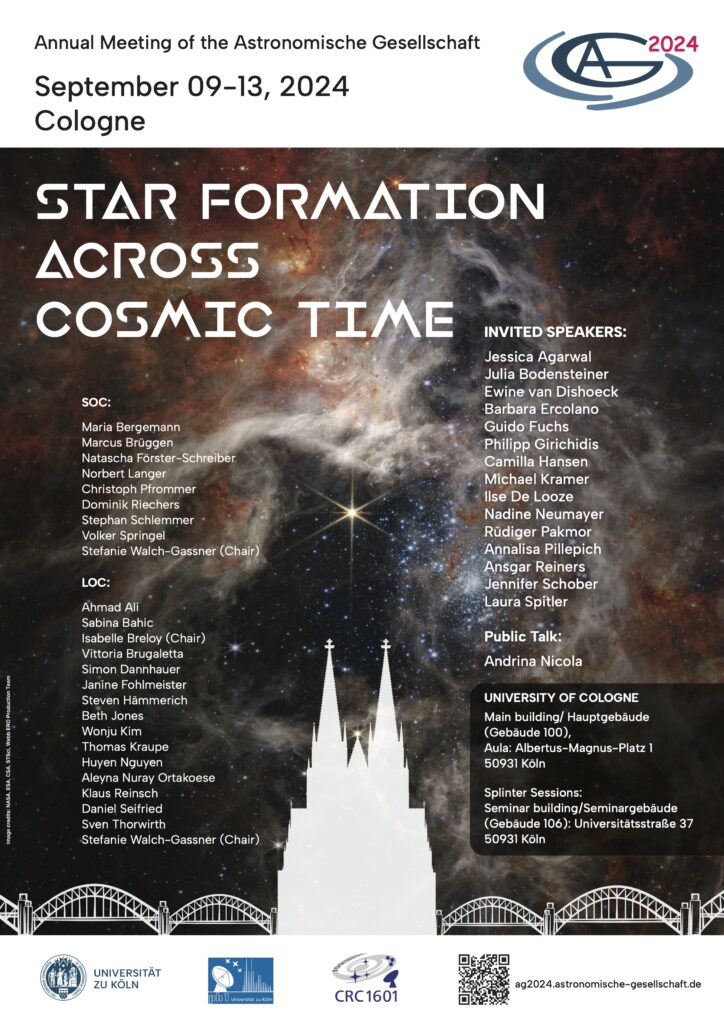
The International Annual Meeting of the German Astronomical Society was held at the University of Cologne during the week September 09-13, 2024.

The meeting included invited plenary talks, splinter sessions, and working group meetings of the Astronomical Society.
https://ag2024.astronomische-gesellschaft.de

Video recordings of the plenary talks are available for registered participants. Please, follow the links in the rightmost column under “Abstracts”. 

Video recording of the public talk given by Andrina Nicola.

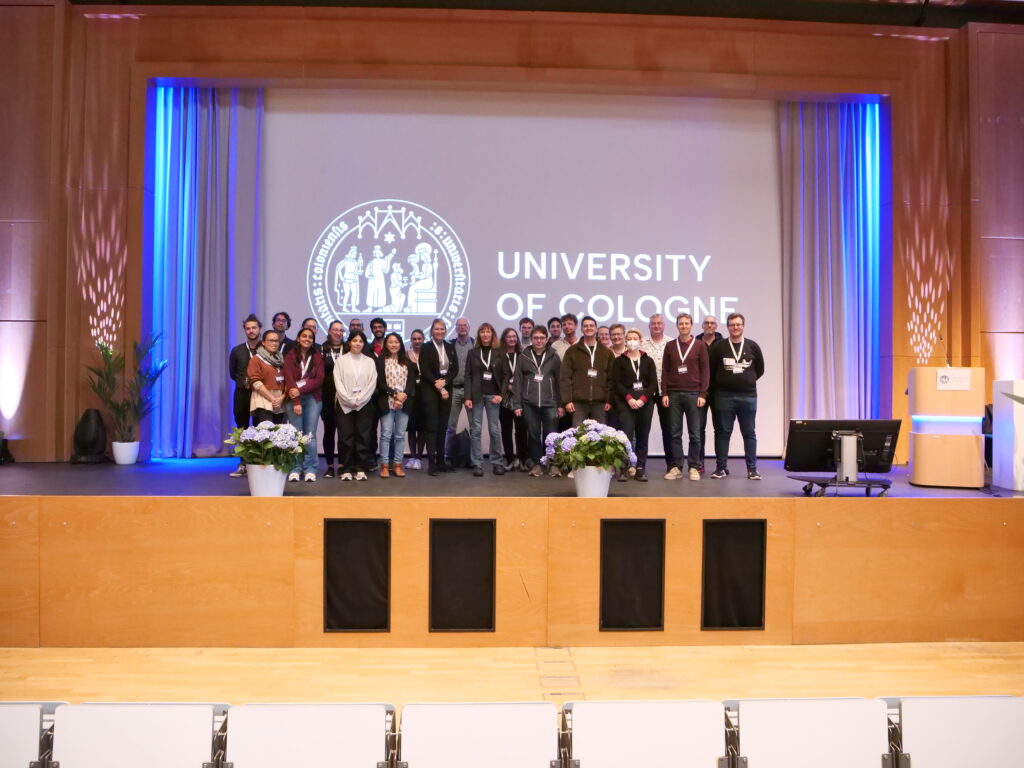
Conference photo (2024-09-12)
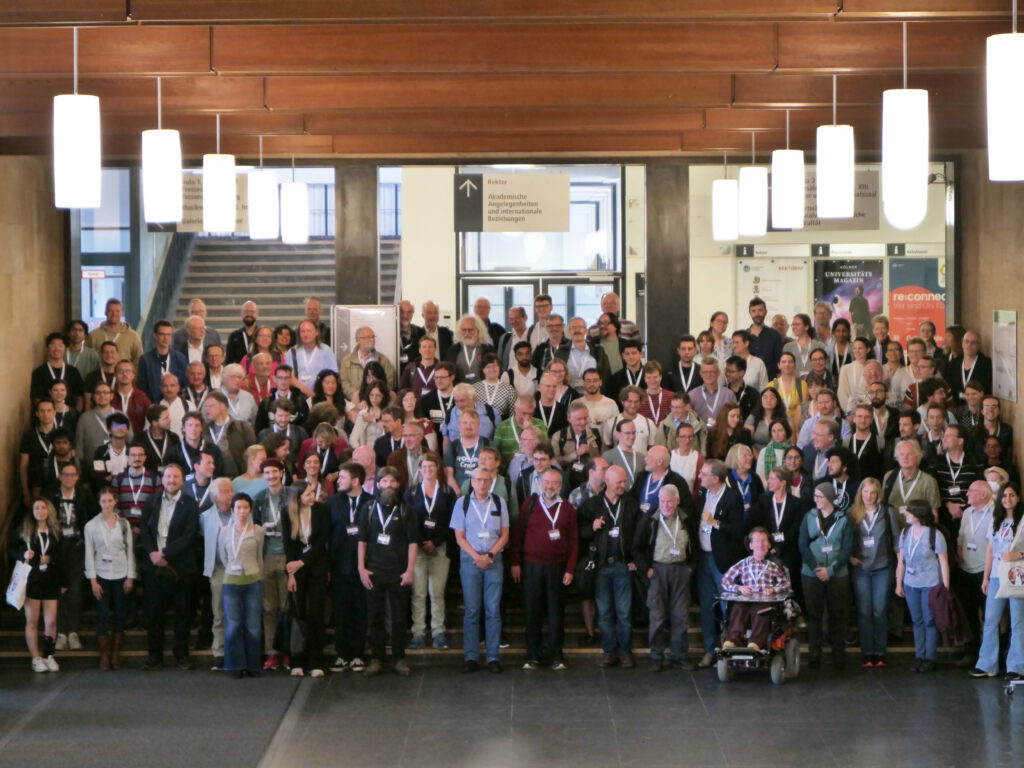
photo credit: Stephan Brackertz