
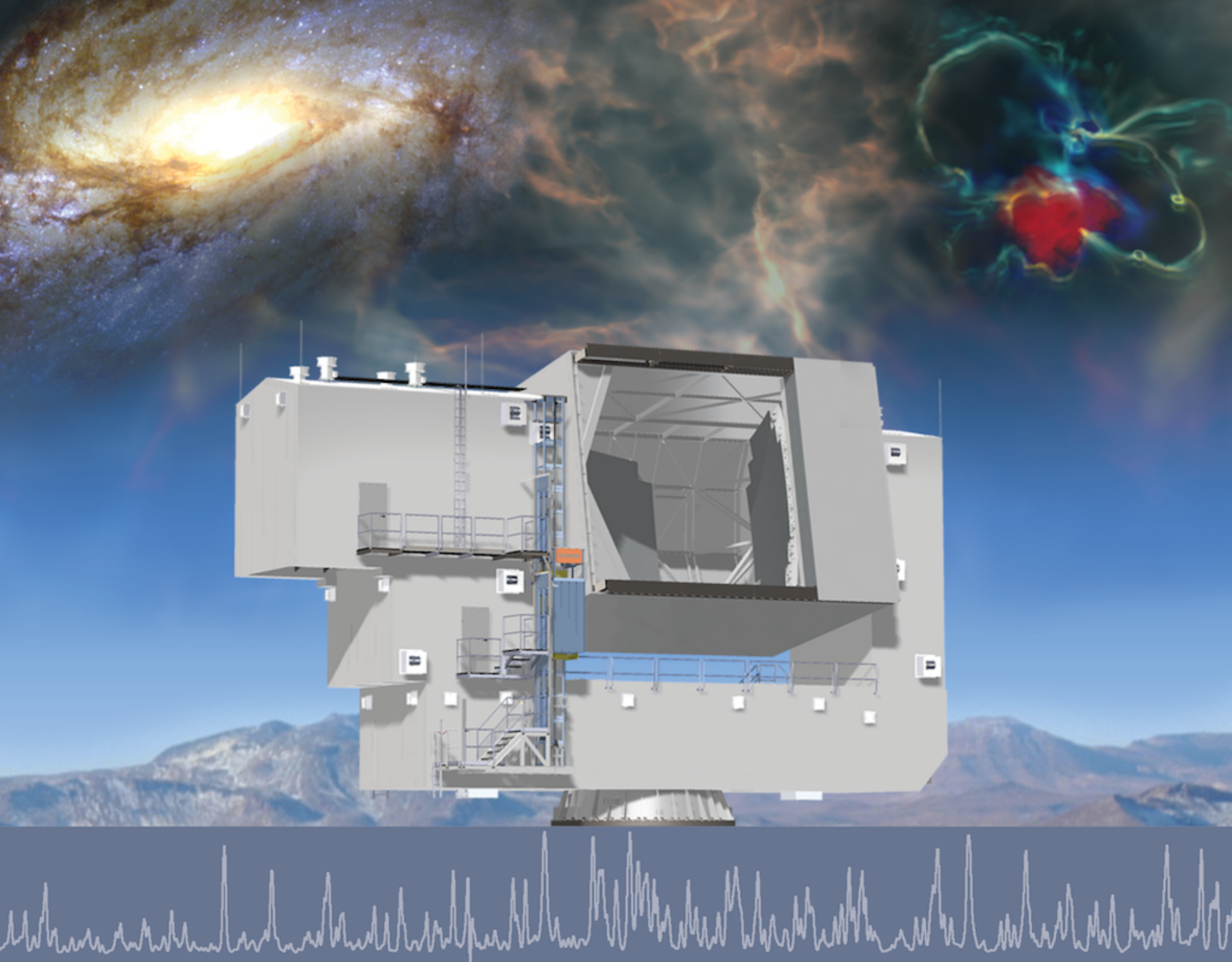
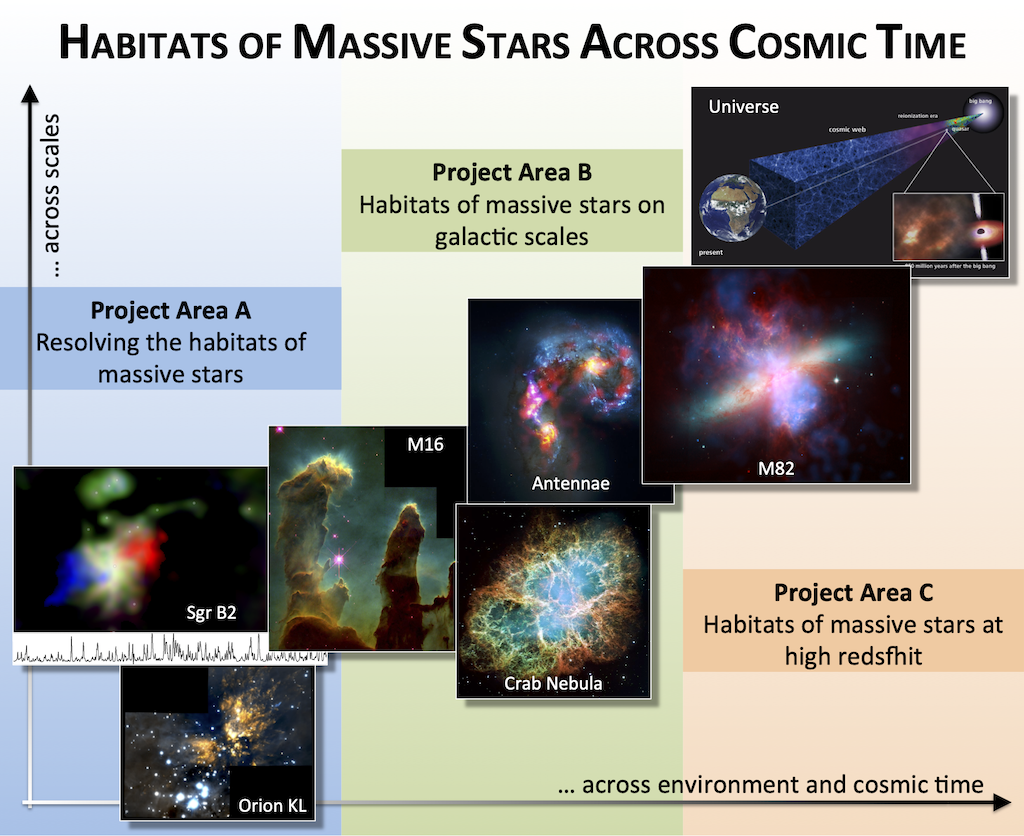
Massive stars, due to their short lifetime and high energy output, drive the evolution of galaxies across cosmic time. Hence, they substantially contribute to shaping the present-day Universe. The Collaborative Research Centre (CRC) will unravel the “habitats of massive stars across cosmic time”. “Habitats” are the gaseous environments within which massive stars are born and which they interact with via their feedback. Over the anticipated 12-year lifetime of this new CRC initiative, we aim to connect the physical processes that govern the habitats of massive stars across the full range of environments hosting massive stars – from sub-parsec to mega-parsec scales and from the Milky Way to the high-redshift Universe, where massive stars leave their cosmological fingerprint by driving cosmic reionisation.
Key Profile Area
“Dynamics of the Universe”
Our universe is full of fascinating, mysterious and often surprising phenomena. Understanding and explaining this in physical terms is the task of the new key profile area Dynamics of the Universe.
The Dynamics of the Universe key profile area establishes an excellent environment for training, early contact with current research, and exchange in international co-operations and competitions. In addition, the interdisciplinary collaboration between the fields of physics, computer science and applied mathematics will be strengthened in the long term. This is particularly important given the need to meet unprecedented challenges arising from the large amounts of observational data being generated by way of innovative ideas and algorithms, and to enable and efficiently advance complex simulations using new hardware technologies.
SFB 1601 News
Public Outreach
Symposium 2026
HRMS 2025
Colloquium
Child Care
Publications
Videos & Articles
SFB 1601 Projects
PhD Students
Family & Diversity
Sustainability
Science Highlight
-
C3/C6: Line intensity mapping (LIM) simulations using empirical galaxy catalogue data for observations from the Fred Young Submm Telescope (Jonathan Clarke)
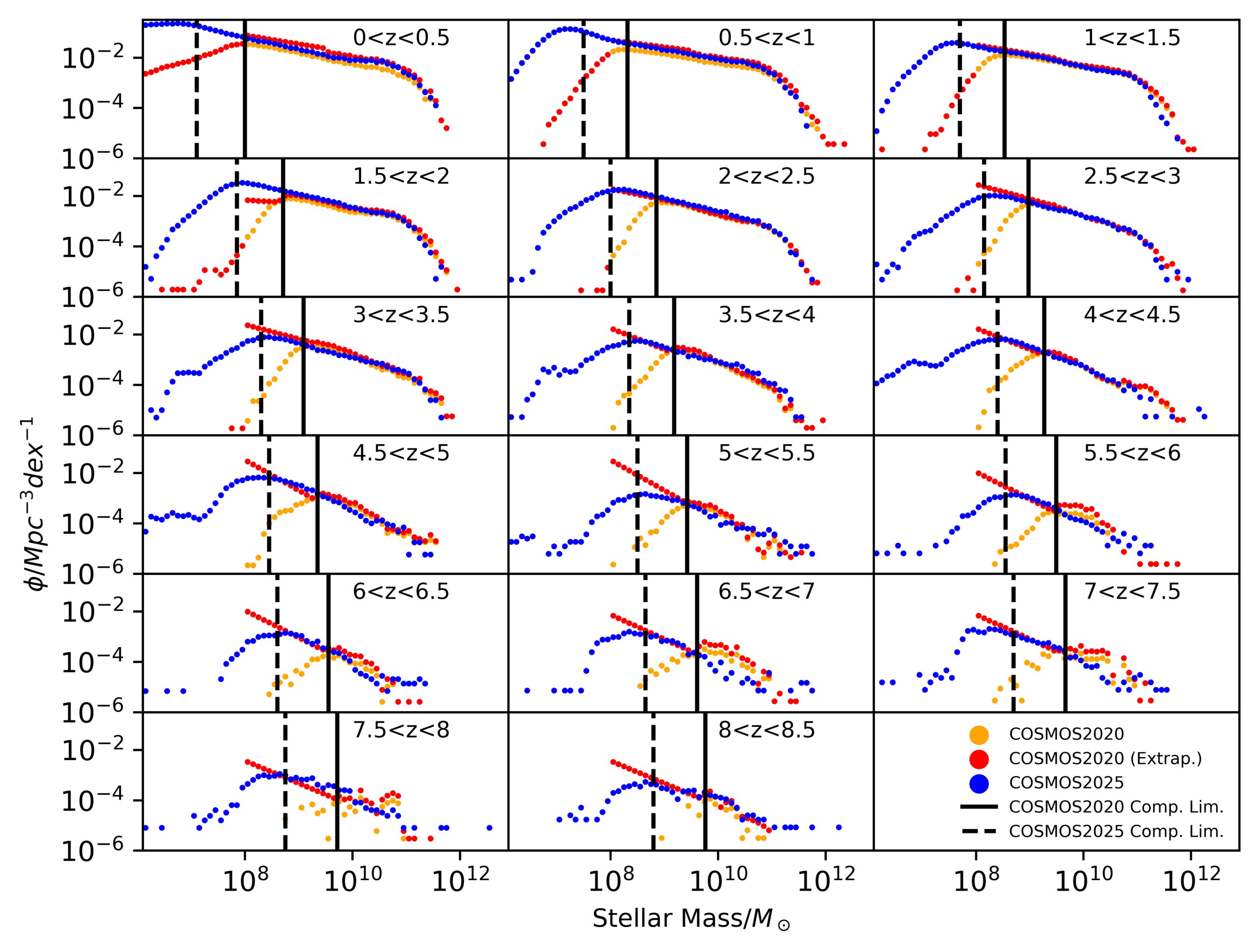
In our upcoming paper, we further develop techniques to make realistic line intensity mapping (LIM) simulations using empirical galaxy catalogue data for observations from the Fred Young Submm Telescope (FYST). LIM provides aggregate signal from a wide beam measured over an expansive sky map area, capturing information from dim galaxies which we cannot otherwise resolve at high redshift (the epoch of reionisation, EoR, 6 < z < 20, ~13 billion years ago). Our simulations must therefore accurately incorporate the primary target line emission, the star-formation tracer [CII] 158µm at the end of the epoch of reionisation (3.5 < z[CII] < 8.2 for FYST’s 210-420GHz range), as well as the foreground CO and [CI] contaminant signal (0 < z < 6). Correspondingly, it is imperative to ensure that the catalogues forming our mock tomographic maps have appropriate completeness across the entire redshift range.
Our simulation catalogues are primarily based on data from COSMOS2020, using HST, Subaru, VISTA and Spitzer data which covers a 1.44deg² range up to z = 10. However, this data has known incompleteness at the low and high redshift ranges, so we must account for it via multiple extrapolation techniques. By calibrating using the in-depth CANDELS subsample, and fitting to the stellar mass function of the sample, we can make samples comparable to the latest JWST data from the COSMOS-Web pencil survey (see figure). From this robust mock catalogue we can test LIM techniques such as masking (see Karoumpis et al 2024, the science highlight 10.25), thereby providing an empirical backing to other simulations and their contaminant removal techniques. This also provides a framework for upcoming cross-correlation work, including cross-instrument cross-correlations, which we will cover later this year.
This work will be submitted to A&A shortly, though it is based on earlier work focussing on [CII] signal (https://doi.org/10.1051/0004-6361/202450300)
We value our Planet:
1st funding period: 10/2023 – 06/2027