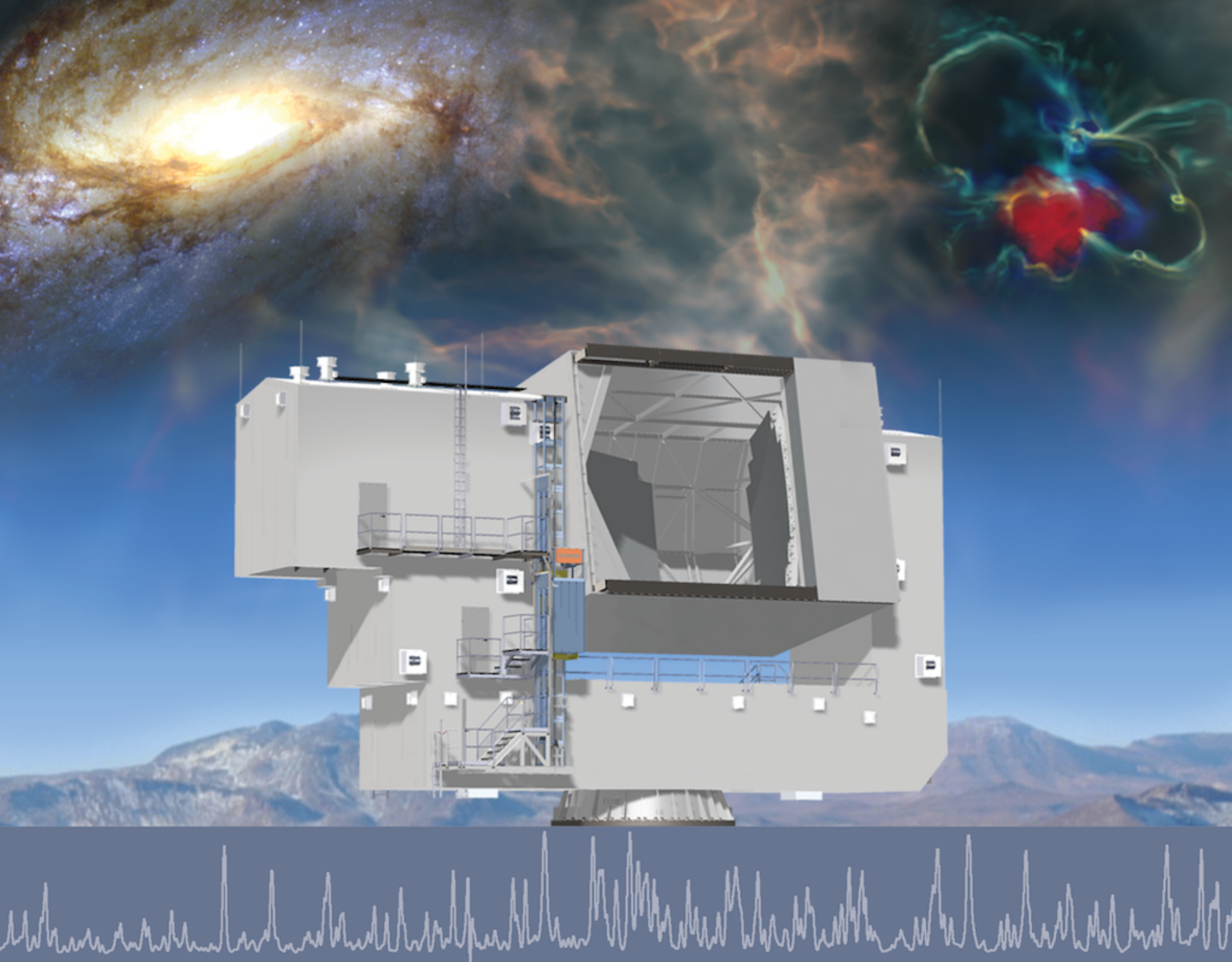
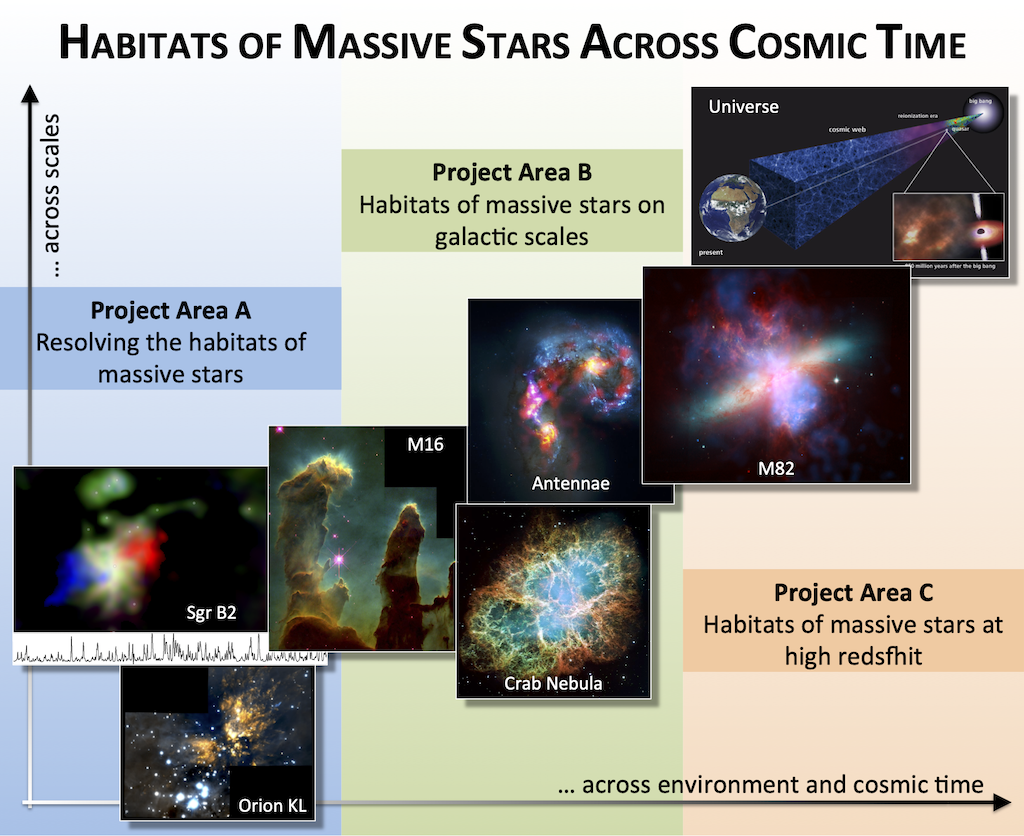
Massive stars, due to their short lifetime and high energy output, drive the evolution of galaxies across cosmic time. Hence, they substantially contribute to shaping the present-day Universe. The Collaborative Research Centre (CRC) will unravel the “habitats of massive stars across cosmic time”. “Habitats” are the gaseous environments within which massive stars are born and which they interact with via their feedback. Over the anticipated 12-year lifetime of this new CRC initiative, we aim to connect the physical processes that govern the habitats of massive stars across the full range of environments hosting massive stars – from sub-parsec to mega-parsec scales and from the Milky Way to the high-redshift Universe, where massive stars leave their cosmological fingerprint by driving cosmic reionisation.
Key Profile Area
“Dynamics of the Universe”
Our universe is full of fascinating, mysterious and often surprising phenomena. Understanding and explaining this in physical terms is the task of the new key profile area Dynamics of the Universe.
The Dynamics of the Universe key profile area establishes an excellent environment for training, early contact with current research, and exchange in international co-operations and competitions. In addition, the interdisciplinary collaboration between the fields of physics, computer science and applied mathematics will be strengthened in the long term. This is particularly important given the need to meet unprecedented challenges arising from the large amounts of observational data being generated by way of innovative ideas and algorithms, and to enable and efficiently advance complex simulations using new hardware technologies.
SFB 1601 News
Public Outreach
Symposium 2026
HRMS 2025
Colloquium
Child Care
Publications
Videos & Articles
SFB 1601 Projects
PhD Students
Family & Diversity
Sustainability
Science Highlight
-
C6: Constraining warm dark matter with intensity mapping of the [CII] fine-structure line (Elena Marcuzzo)
Line Intensity Mapping (LIM) is an emerging technique in radio-astronomy that scans vast fractions of the sky with a large beam and detects the integrated emission of all sources along the line of sight without resolving individual objects. This approach enables probing the high-redshift Universe including the contribution from intrinsically faint sources that traditional surveys miss due to their flux-limit thresholds. These peculiarities make LIM an ideal tool to probe the nature of dark matter (DM).
Most particle-physics candidates for DM fall into the class of thermal relics (i.e. particles that were once in thermal equilibrium with the rest of the Universe). In this case, the velocity dispersion of the particles at early times turns out to be inversely proportional to their mass. This implies that less massive particles can freely stream out of shallow potential wells and, de facto, inhibit the formation of low-mass structures. Therefore, cold DM (CDM, with negligible velocity dispersion) and warm DM (WDM, with a free-streaming length of the order of 0.1 Mpc) give rise to a different mass spectrum of DM halos within which galaxy formation takes place.
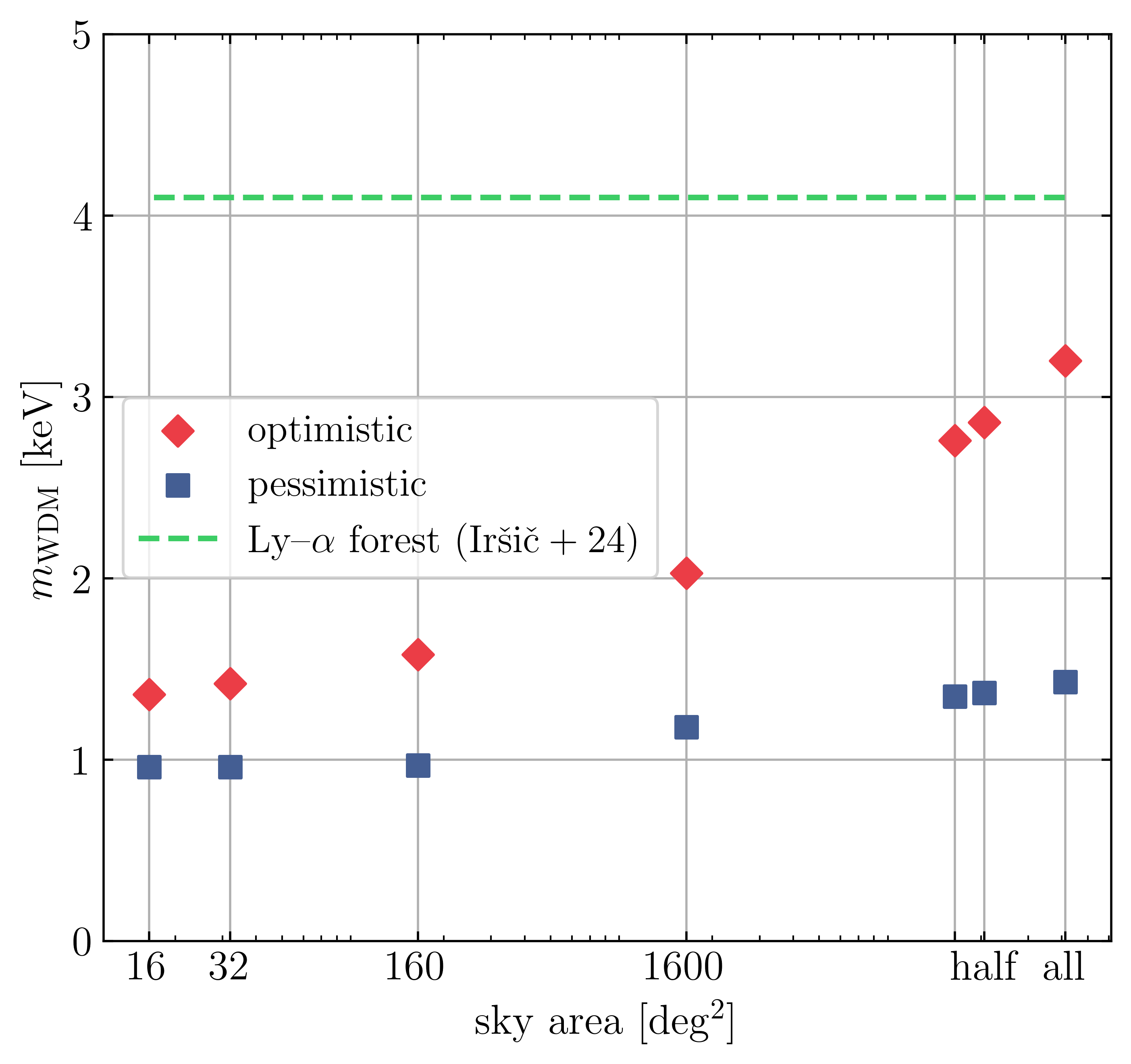
Using the halo-model approach, we make forecasts for the constraints that LIM of the 150 μm fine-structure transition of [Cii] can set on the mass of the DM particles. Ionised carbon is a promising tracer that should be present also in low-mass halos, contrary to neutral hydrogen that cannot be shielded from the UV background after cosmic reionisation. We compress the data into the isotropic power spectrum and use Bayesian inference marginalising over the uncertain faint-end slope of the [Cii] luminosity function (LF).
Our results are shown in the figure as a function of the survey area and for two different measurements of the bright-end of the [Cii] LF (optimistic/pessimistic). Assuming a CDM scenario, we find that LIM can rule out WDM particle masses up to 2–3 keV, which makes this technique competitive with other probes, such as the Ly-α forest. Our study demonstrates that, taking into account the current limits on the LF, the [Cii] power spectrum is dominated by sources hosted in relatively massive halos and this diminishes its constraining power on the WDM mass.
Paper: Marcuzzo et al. (2024)
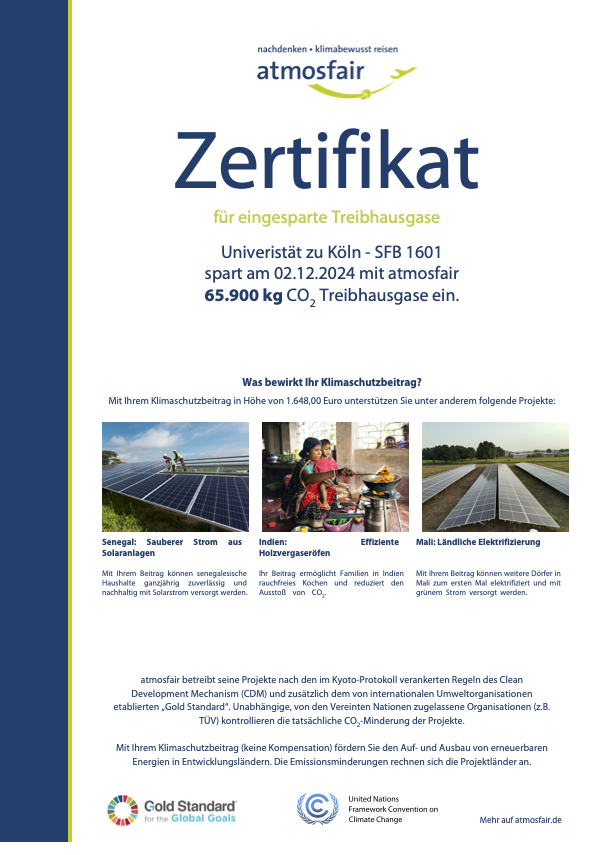
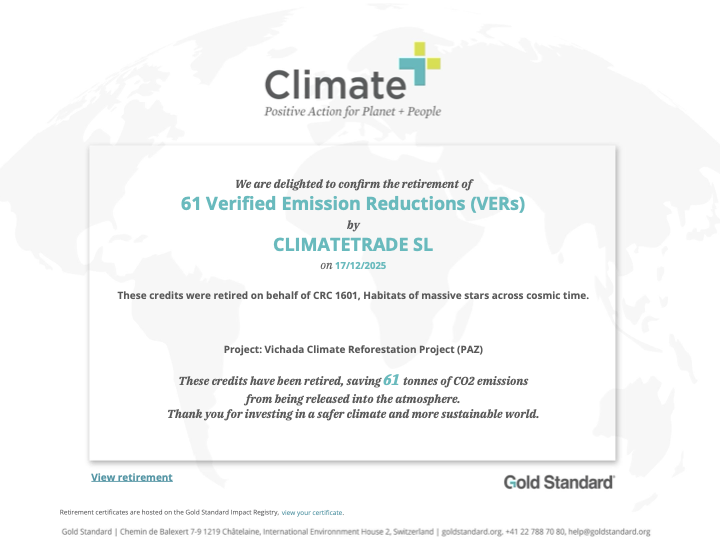
We value our Planet:
1st funding period: 10/2023 – 06/2027