
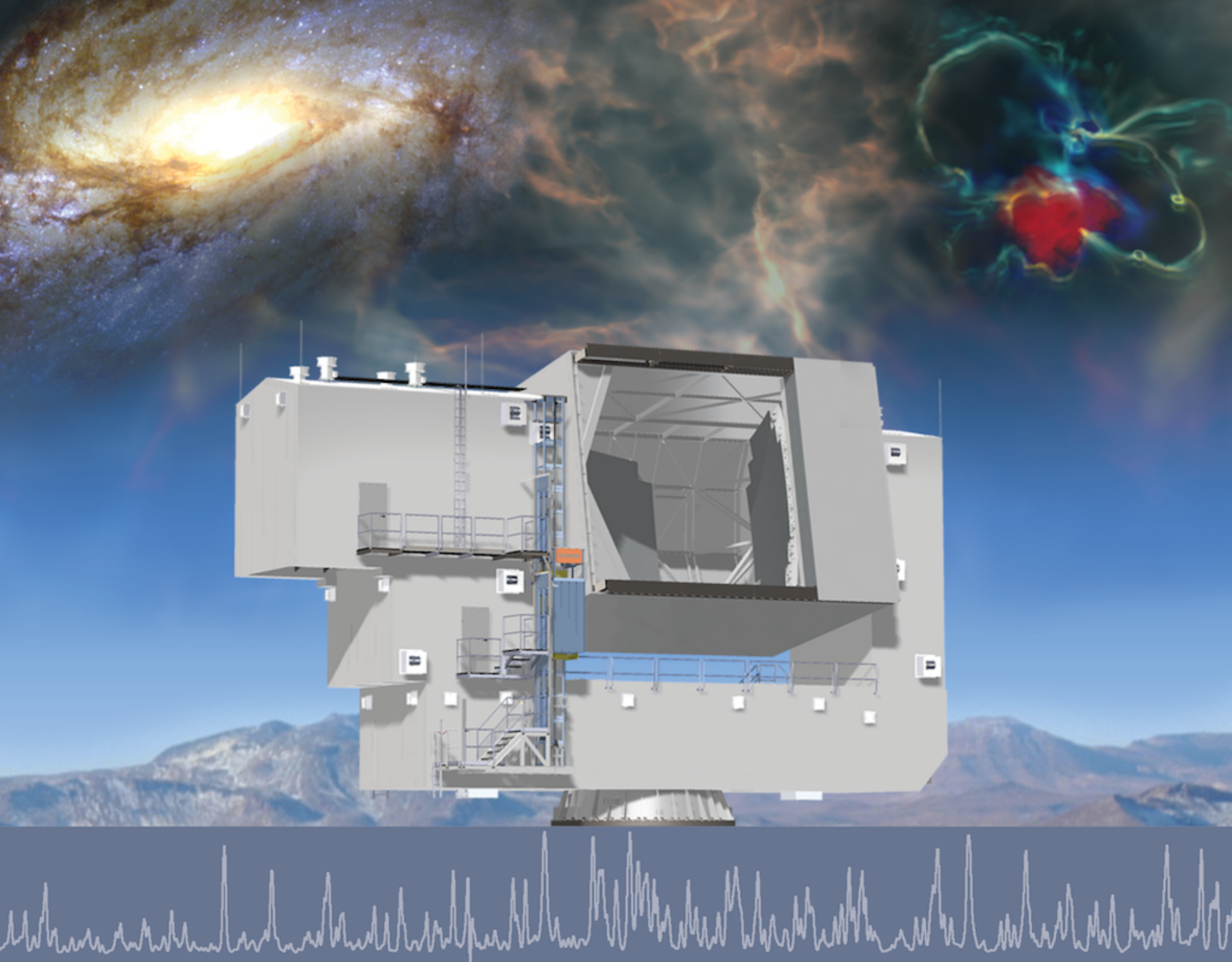
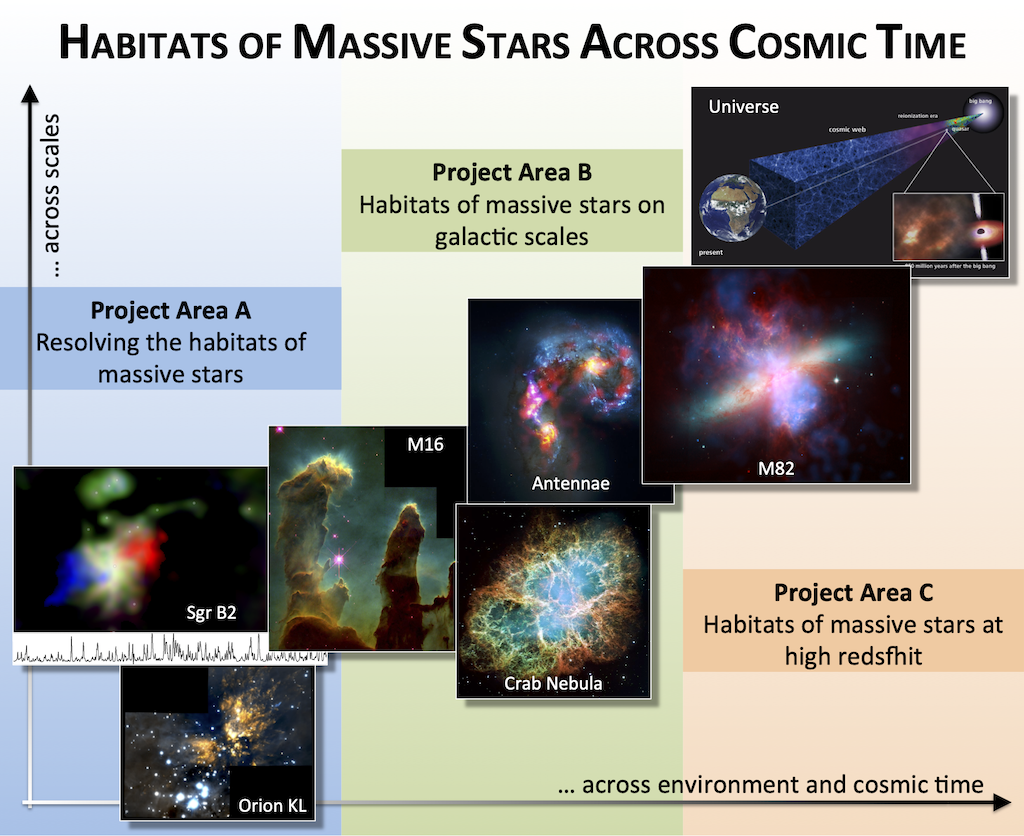
Massive stars, due to their short lifetime and high energy output, drive the evolution of galaxies across cosmic time. Hence, they substantially contribute to shaping the present-day Universe. The Collaborative Research Centre (CRC) will unravel the “habitats of massive stars across cosmic time”. “Habitats” are the gaseous environments within which massive stars are born and which they interact with via their feedback. Over the anticipated 12-year lifetime of this new CRC initiative, we aim to connect the physical processes that govern the habitats of massive stars across the full range of environments hosting massive stars – from sub-parsec to mega-parsec scales and from the Milky Way to the high-redshift Universe, where massive stars leave their cosmological fingerprint by driving cosmic reionisation.
Key Profile Area
“Dynamics of the Universe”
Our universe is full of fascinating, mysterious and often surprising phenomena. Understanding and explaining this in physical terms is the task of the new key profile area Dynamics of the Universe.
The Dynamics of the Universe key profile area establishes an excellent environment for training, early contact with current research, and exchange in international co-operations and competitions. In addition, the interdisciplinary collaboration between the fields of physics, computer science and applied mathematics will be strengthened in the long term. This is particularly important given the need to meet unprecedented challenges arising from the large amounts of observational data being generated by way of innovative ideas and algorithms, and to enable and efficiently advance complex simulations using new hardware technologies.
SFB 1601 News
Public Outreach
Symposium 2026
HRMS 2025
Colloquium
Child Care
Publications
Videos & Articles
SFB 1601 Projects
PhD Students
Family & Diversity
Sustainability
Science Highlight
-
B3: PHANGS-JWST: Molecular cloud identification using 7.7μm MIRI data (Z. Bazzi, D. Colombo, F. Bigiel)
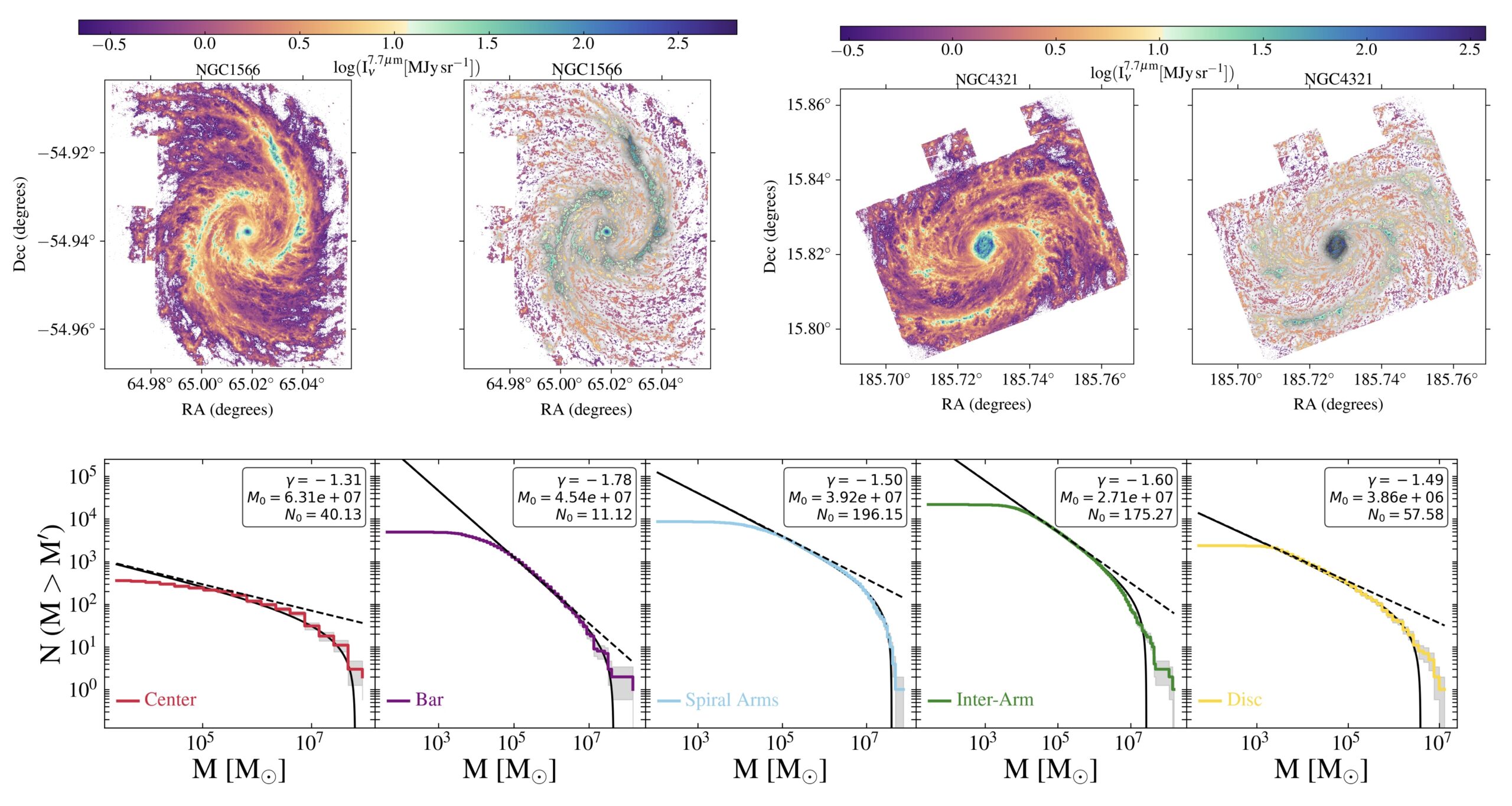
Stars form within molecular clouds, dense regions of cold gas primarily composed of molecular hydrogen. These clouds provide the necessary conditions for the formation of stars, including low temperatures and high densities, which allow gravitational forces to overcome thermal pressure and initiate the collapse of gas. To fully understand the process of star formation and therefore the evolution of galaxies, it is crucial to study the properties of molecular clouds—such as their mass, density, distribution, and relation to the galactic environment.
The Physics at High Angular resolution in Nearby GalaxieS (PHANGS) collaboration aims to create a comprehensive view of star formation and the lifecycle of gas and dust in nearby galaxies, using state-of-the-art facilities. In particular, by leveraging the James Webb Space Telescope (JWST)’s infrared capabilities, the PHANGS-JWST program has provided astonishing views of 19 galaxies in wavelengths that are typically obscured by dust in the optical range, reaching unprecedented resolutions and sensitivities.
We used observations of the emission from Polycyclic Aromatic Hydrocarbons (PAHs, e.g. complex organic molecules that emit strongly in the mid-infrared and are associated with photodissociation regions) from PHANGS-JWST to generate molecular gas maps of the 19 galaxies.
The application of the Spectral Clustering for Molecular Emission Segmentation (SCIMES) on the JWST data allowed the identification of more than 50,000 highly-resolved molecular clouds. SCIMES is a machine learning-based code that utilises graph theory concepts to segment out molecular clouds from the more diffuse medium by preserving their intrinsic morphology and internal structure.
Our preliminary results suggest that the molecular cloud mass spectra—specifically their steepness and truncation mass—are strongly influenced by the surrounding dynamical environment. This indicates that certain physical conditions may be more favourable to the formation of high-mass clouds than others.
Figure caption: Upper row: Left image shows the galaxy’s intensity map; right image displays dust structures identified by SCIMES with a greyscale intensity background and a colour bar indicating 7.7 μm intensity. Bottom row: Cumulative mass distributions of molecular clouds in different environments. Dotted black lines represent simple power-law fits; solid black curves are truncated power-law fits. Fit parameters—γ (spectral index), M0 (maximum mass), N0 (count in the distribution). The grey region represents the Poisson errors on the counts.
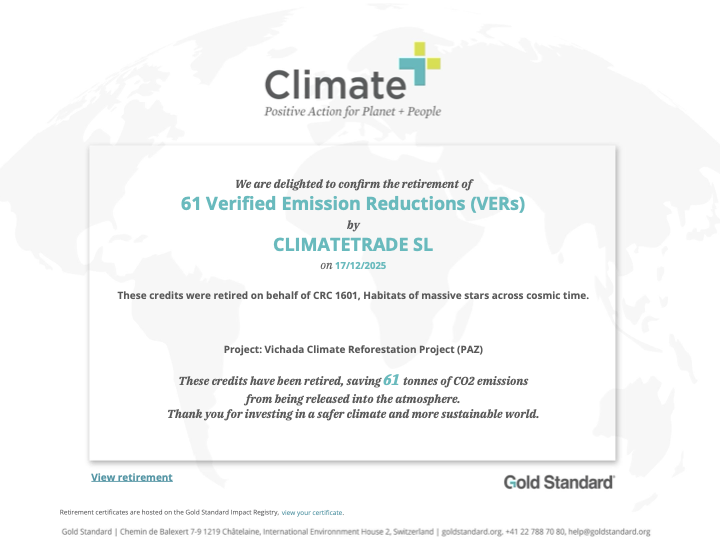
We value our Planet:
1st funding period: 10/2023 – 06/2027