
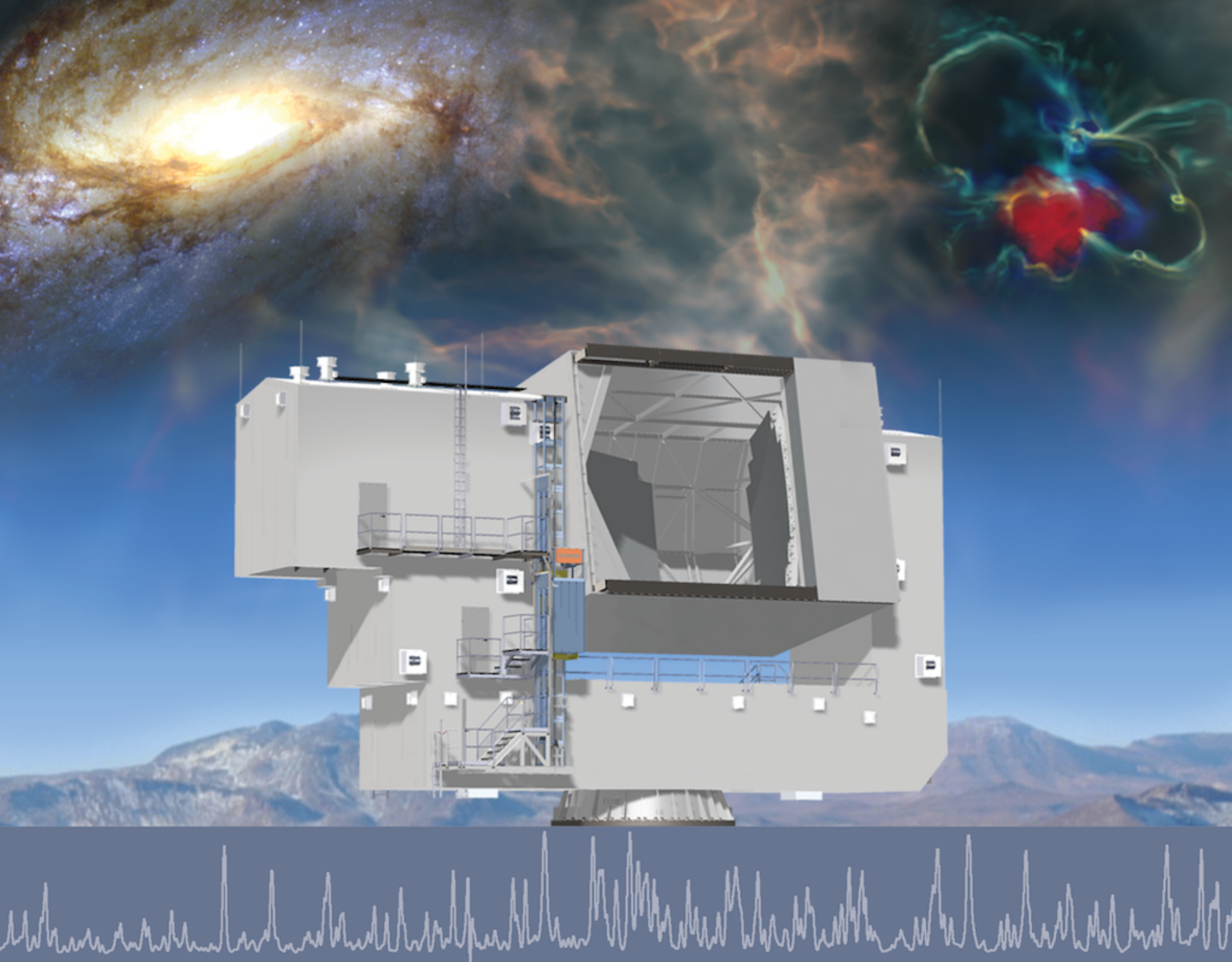
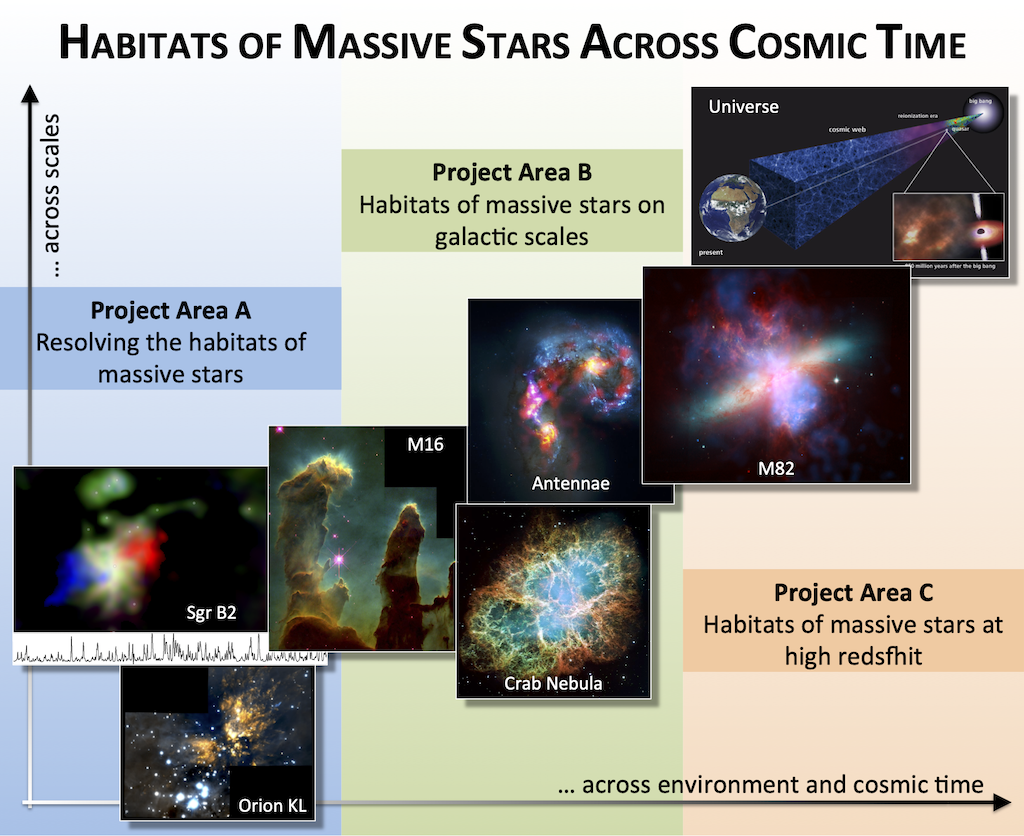
Massive stars, due to their short lifetime and high energy output, drive the evolution of galaxies across cosmic time. Hence, they substantially contribute to shaping the present-day Universe. The Collaborative Research Centre (CRC) will unravel the “habitats of massive stars across cosmic time”. “Habitats” are the gaseous environments within which massive stars are born and which they interact with via their feedback. Over the anticipated 12-year lifetime of this new CRC initiative, we aim to connect the physical processes that govern the habitats of massive stars across the full range of environments hosting massive stars – from sub-parsec to mega-parsec scales and from the Milky Way to the high-redshift Universe, where massive stars leave their cosmological fingerprint by driving cosmic reionisation.
Key Profile Area
“Dynamics of the Universe”
Our universe is full of fascinating, mysterious and often surprising phenomena. Understanding and explaining this in physical terms is the task of the new key profile area Dynamics of the Universe.
The Dynamics of the Universe key profile area establishes an excellent environment for training, early contact with current research, and exchange in international co-operations and competitions. In addition, the interdisciplinary collaboration between the fields of physics, computer science and applied mathematics will be strengthened in the long term. This is particularly important given the need to meet unprecedented challenges arising from the large amounts of observational data being generated by way of innovative ideas and algorithms, and to enable and efficiently advance complex simulations using new hardware technologies.
SFB 1601 News

Public Outreach
Symposium 2026
HRMS 2025

Colloquium
Child Care
Publications

Videos & Articles
SFB 1601 Projects
PhD Students
Family & Diversity
Sustainability
Science Highlight
-
A3: Exploring the Evolution of Stellar Multiplicity in Massive Star-Forming Clusters (Emma Bordier, Chinmaya Nagar)
Understanding how stars form and evolve is one of the most fascinating challenges in astronomy. A key piece of this puzzle is the stellar multiplicity—the frequency, separations, and mass ratios of stars that form in pairs or higher-order groups. Massive stars, which make up only 0.01% of all formed stars, play a pivotal role in shaping galaxies and the universe. Understanding their life cycle—90% of which unfolds alongside at least one companion—is therefore of paramount importance. Yet, they are particularly difficult to study since they are heavily bloated in their dusty envelopes and are born in distant, dense, and young star clusters. These observational challenges leave significant gaps in our understanding of how their multiplicity evolves over time.
To help fill this gap, our team conducted high-resolution observations to explore the properties of stars that have just formed or are still in the process of forming, within four massive, near-primordial clusters. We identify potential binary or multiple star systems, study how their properties—such as separation and mass ratios—vary within and between clusters. In this framework, multiplicity serves as a tool to trace the initial conditions that drive the formation of massive stars in multiple systems.
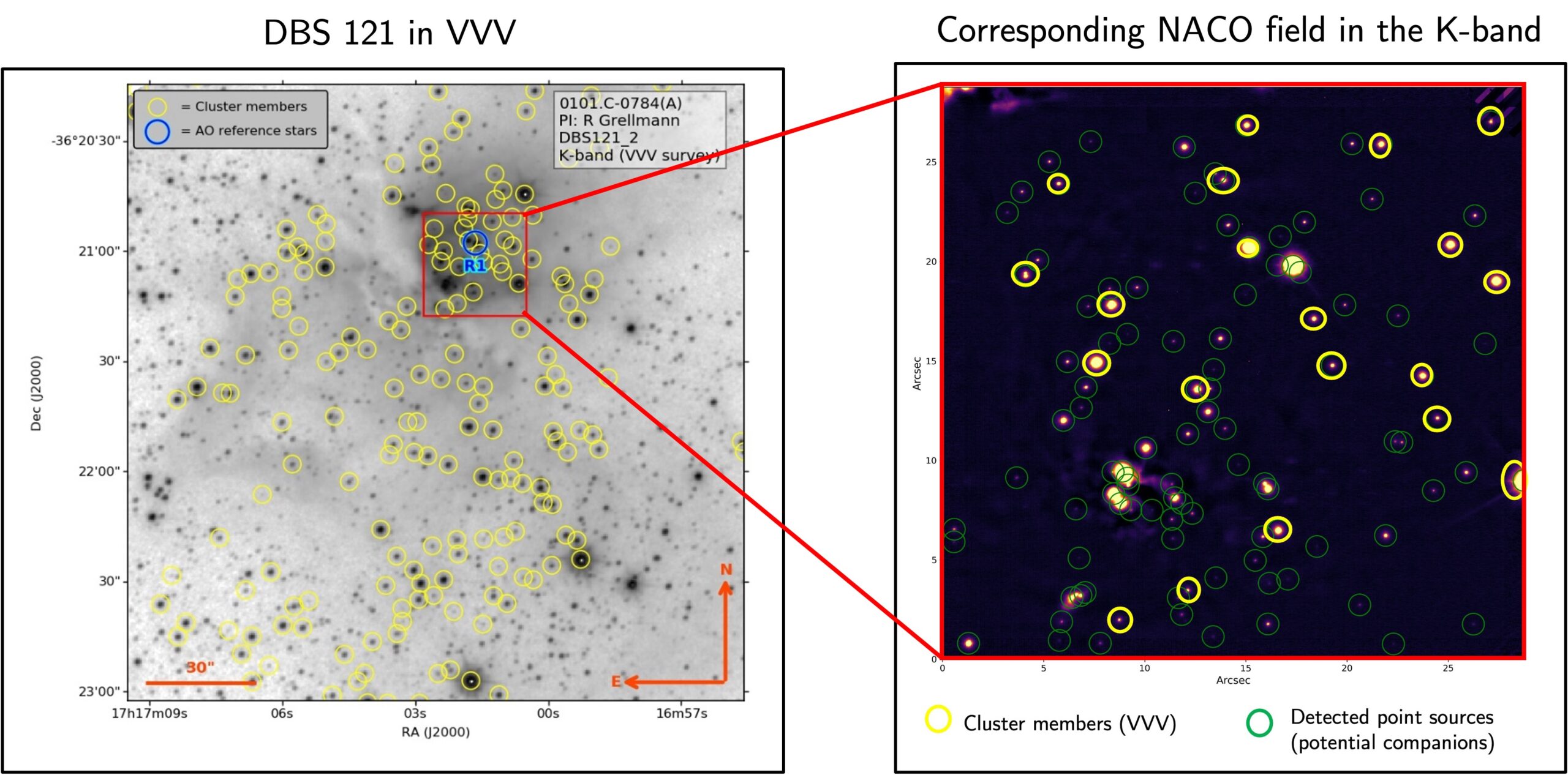
To study the primordial multiplicity properties, the clusters must have similar chronological ages with slight variations and be young enough to ensure that significant dynamical interactions have not yet occurred. This increases the likelihood of observing systems in a near-primordial multiplicity state. The selected clusters—Hourglass Nebula, RCW 108, DBS 113, and DBS 121—are observable in the near-infrared and submillimeter wavelengths due to their significant dust emission. These clusters are located at a distance of 1.5 ± 0.3 kpc on average and can be classified by age. Based on this cluster classification, we trace the evolution of multiplicity and companion fraction between 1.0 Myr and 2.8 Myr.
Our preliminary results are derived from NACO K-band data, with Chinmaya, a PhD student in our team, leading this aspect of the project. The figure shows one of the fields of DBS121 for which we show the identified sources, hence potential companions per bin of separation. We find that multiplicity properties evolve with cluster age, as the other clusters show a gradually increasing trend in the number of stars, thereby indicating a possible increase in companion fraction with cluster age. To extend this study, we recently included VVV CL100 (7.5 Myr) to determine whether this trend persists in older clusters.
Emma, a postdoc in our team, successfully led an ALMA proposal to enhance this analysis. Data acquisition is now underway, promising exciting new discoveries in the evolution of multiplicity properties in massive star-forming clusters. Stay tuned!
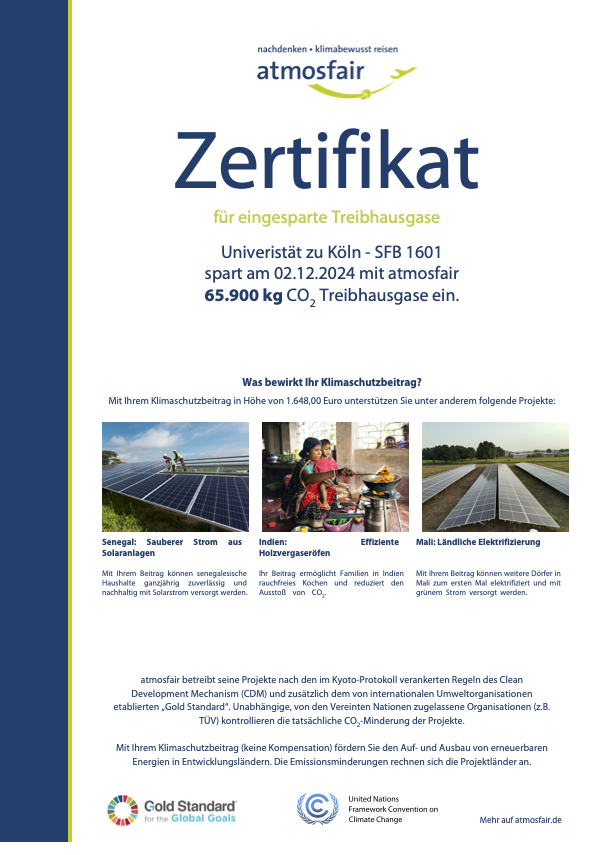
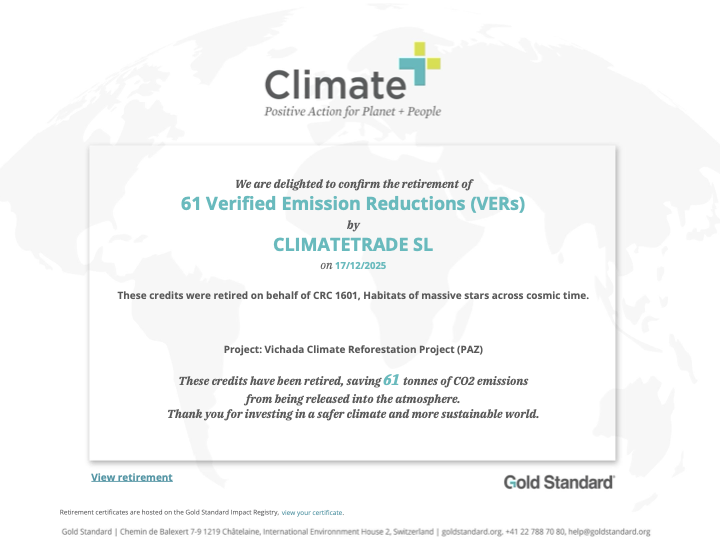
We value our Planet:
1st funding period: 10/2023 – 06/2027