
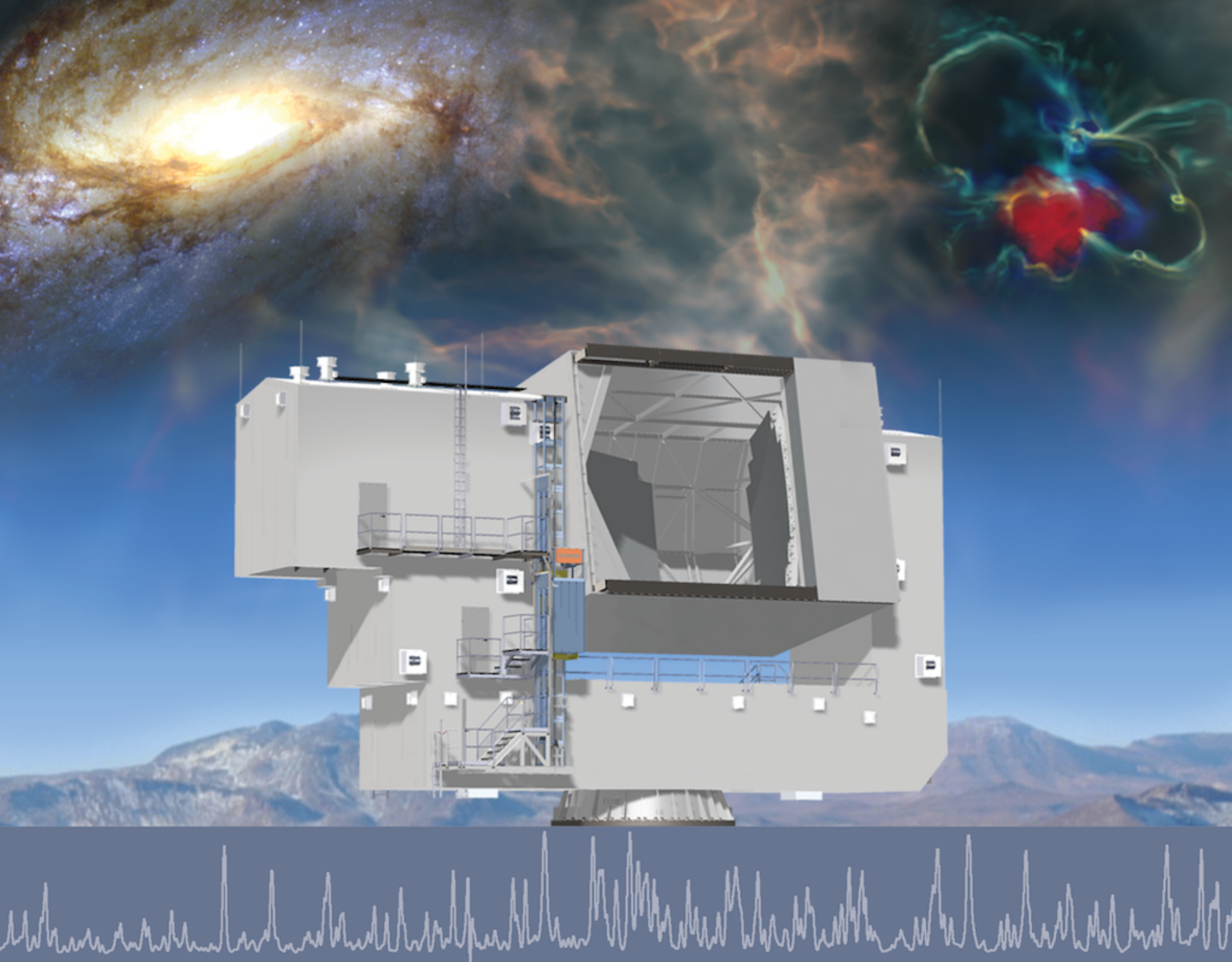
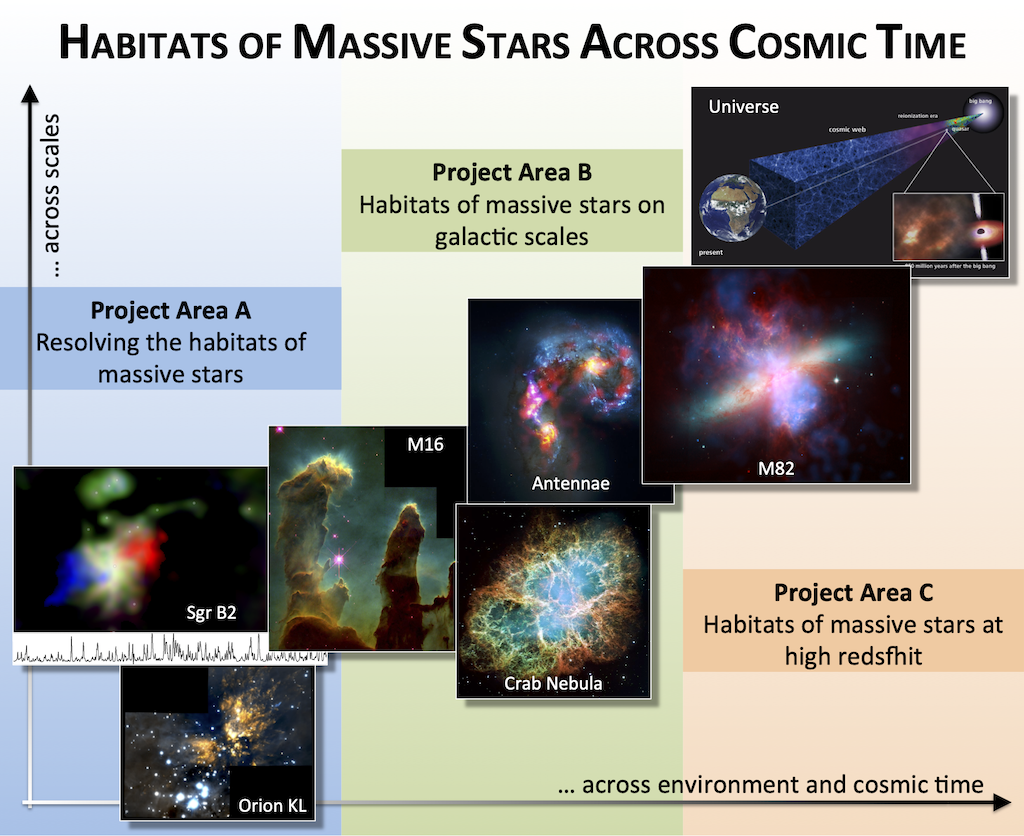
Massive stars, due to their short lifetime and high energy output, drive the evolution of galaxies across cosmic time. Hence, they substantially contribute to shaping the present-day Universe. The Collaborative Research Centre (CRC) will unravel the “habitats of massive stars across cosmic time”. “Habitats” are the gaseous environments within which massive stars are born and which they interact with via their feedback. Over the anticipated 12-year lifetime of this new CRC initiative, we aim to connect the physical processes that govern the habitats of massive stars across the full range of environments hosting massive stars – from sub-parsec to mega-parsec scales and from the Milky Way to the high-redshift Universe, where massive stars leave their cosmological fingerprint by driving cosmic reionisation.
Key Profile Area
“Dynamics of the Universe”
Our universe is full of fascinating, mysterious and often surprising phenomena. Understanding and explaining this in physical terms is the task of the new key profile area Dynamics of the Universe.
The Dynamics of the Universe key profile area establishes an excellent environment for training, early contact with current research, and exchange in international co-operations and competitions. In addition, the interdisciplinary collaboration between the fields of physics, computer science and applied mathematics will be strengthened in the long term. This is particularly important given the need to meet unprecedented challenges arising from the large amounts of observational data being generated by way of innovative ideas and algorithms, and to enable and efficiently advance complex simulations using new hardware technologies.
SFB 1601 News
Public Outreach
Symposium 2026
HRMS 2025
Colloquium
Child Care
Publications
Videos & Articles
SFB 1601 Projects
PhD Students
Family & Diversity
Sustainability
Science Highlight
-
B4: The first high frequency C-band RM Grid of the Galactic plane: A Faraday Rotation study using the GLObal view on STAR formation survey (Anahat Cheema, Ann Mao)
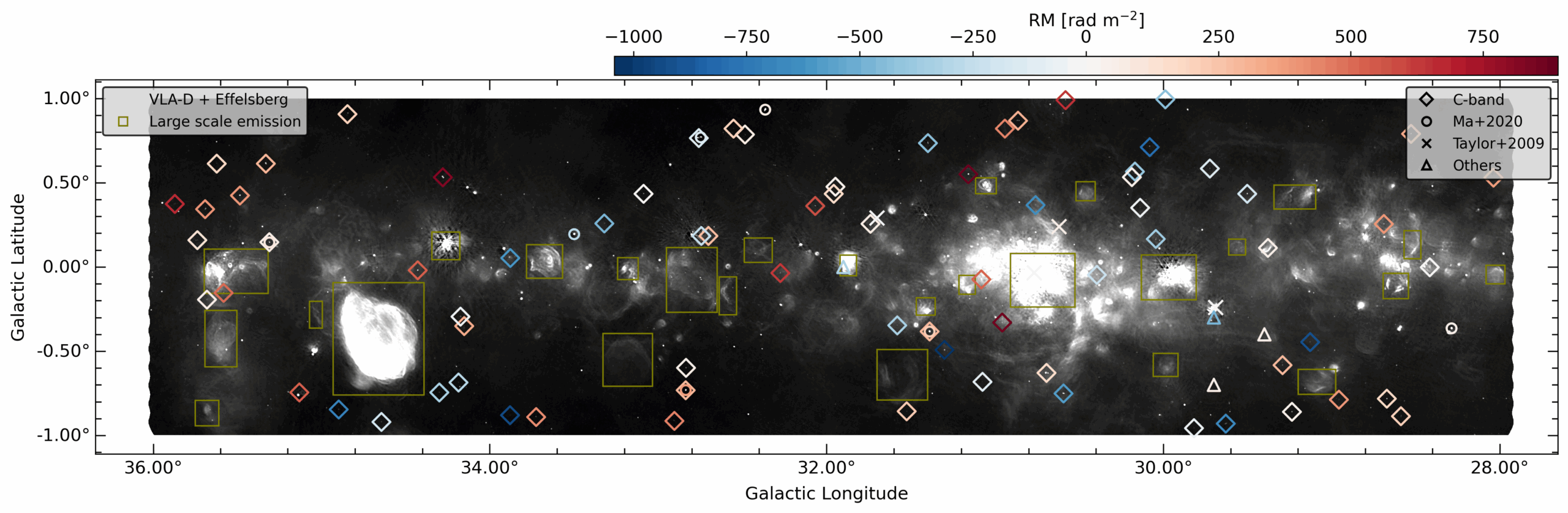
Magnetic fields are a key component of the interstellar medium, influencing star formation and galaxy evolution. To better understand their structure and strength, we use data from the GLObal view on STAR formation (GLOSTAR) survey to investigate magnetic fields in the plane of the Milky Way. Our study focuses on the Faraday effect – quantified by rotation measures (RM) towards background polarized radio sources to construct the first C-band RM grid. The small channel width in wavelength squared (~1.5 to 5 cm2) at C-band makes it well suited for identifying polarized sources with extreme RMs (~3000 rad m-2 at a channel width of 200 MHz), which would likely be completely bandwidth depolarized in lower-frequency surveys. GLOSTAR’s higher frequency coverage also significantly reduces depolarization effects from foreground Galactic turbulence, enabling us to probe previously obscured, dense regions of the Galaxy.
The GLOSTAR survey covers a significant portion of the Galactic plane (-2° < l < 60° and |b| < 1°), using the Karl G. Jansky Very Large Array (VLA) in D and B array configurations and the Effelsberg 100 m telescope within the 4-8 GHz C frequency band. The data products include Stokes IQU cubes covering mosaics of 16 square degrees from VLA-D and 2 square degrees from VLA-B configuration, observed at nine distinct frequency intervals across C-band.
We detected 74 polarized sources, out of which 71 are identified in polarization for the first time, within the pilot region of the survey (28° < l < 36° and |b| < 1°) having peak-pixel percent polarization of more than 5% and greater than 7-sigma detection in polarization. We determined the rotation measure values by performing a linear fit to the multi-frequency polarization angle measurements at 9 distinct GLOSTAR spectral windows as a function of λ2. The preliminary RM grid has a source density of approximately 5 RMs per square degree which is ~ 5 times denser than the current state-of-the-art RM grid on the Galactic plane. The maximum |RM| detected is 1042.37 rad m-2, the standard deviation of the 74 RMs is 437 rad m-2 with a typical RM uncertainty of ~ 40 rad m-2.
C-band observations reveal significantly higher |RM| values and source-to-source dispersion than those seen in low-frequency surveys, offering a much more complete view of the magnetic field structure in the Milky Way. After properly quantifying wide field instrumental polarization effects, we will be able to recover more reliably polarized sources below 5% in percent polarization, resulting in an even denser RM grid. We will next apply RM synthesis to determine RMs and to resolve possible complex Faraday structures, and subsequently extend this method to encompass the entire GLOSTAR footprint, providing brand new insights into the Galactic magnetic field in Galactic quadrant 1.
Figure: The Rotation Measures of the polarized sources in the GLOSTAR pilot region, overplotted on the VLA-D + Effelsberg image. The previously reported RMs in the Consolidated RMTable (Van Eck et al. 2023) are also shown with different markers shown in the legend.
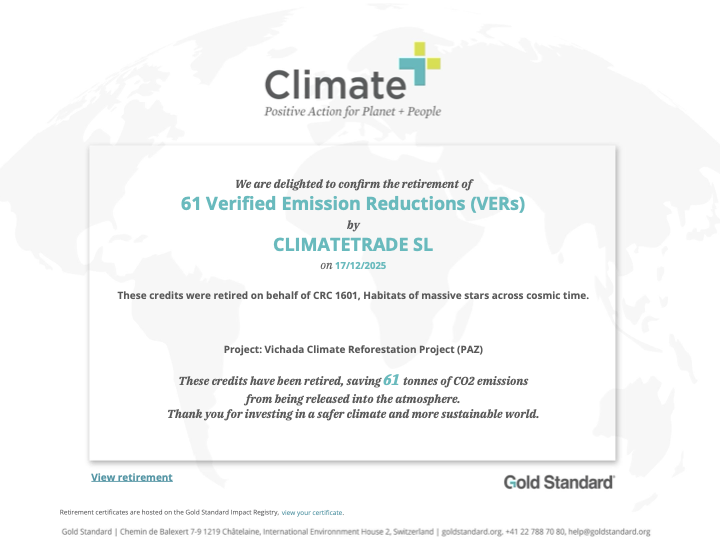
We value our Planet:

1st funding period: 10/2023 – 06/2027