
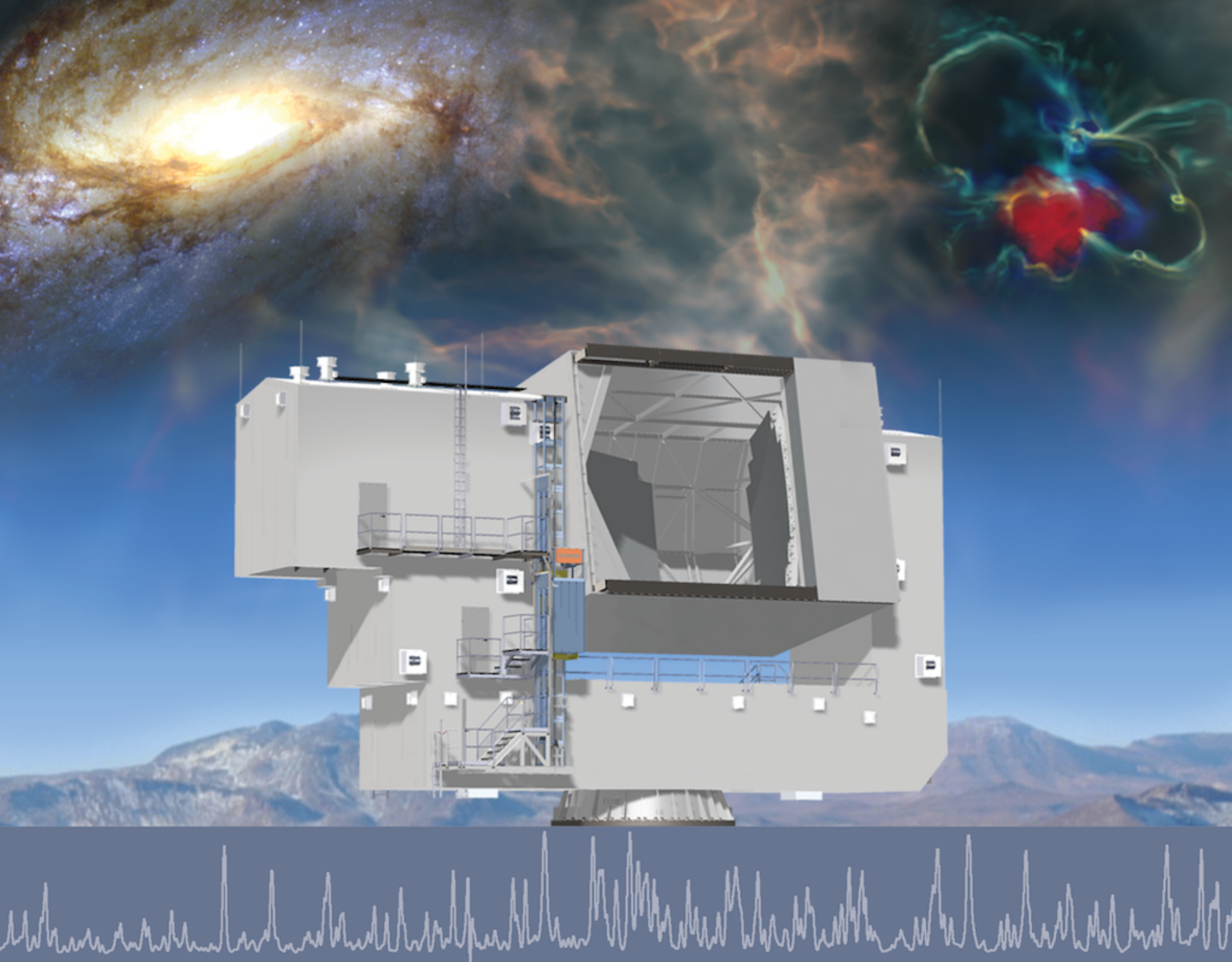
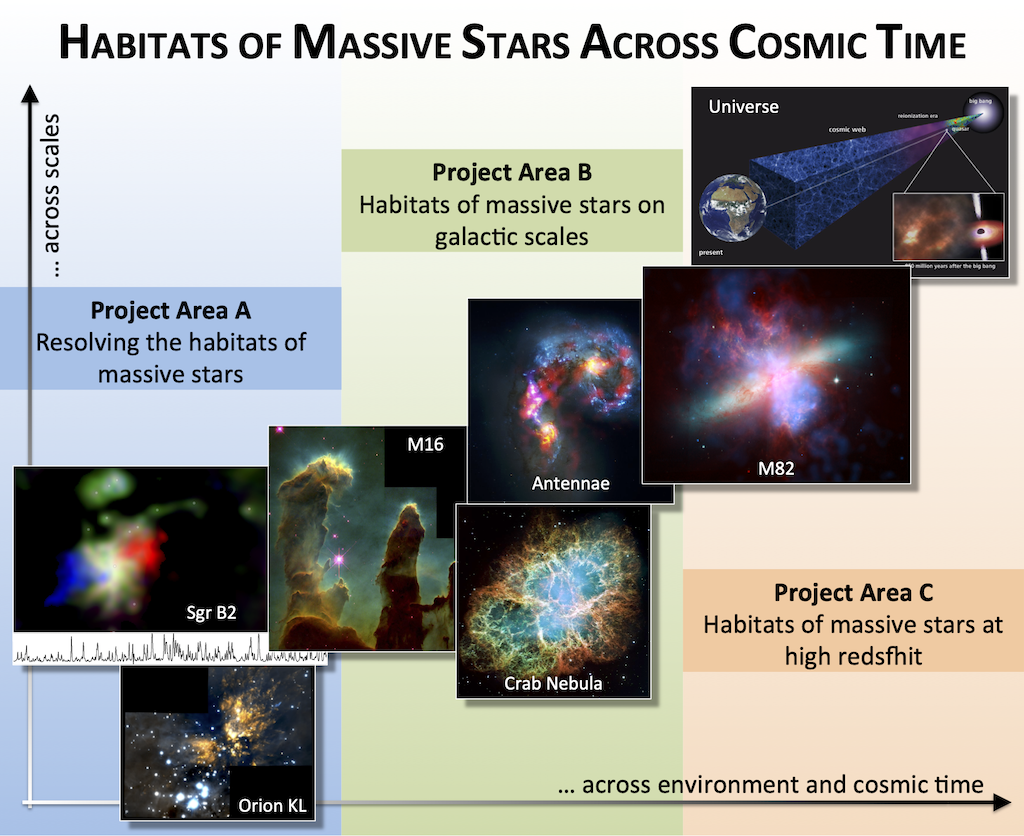
Massive stars, due to their short lifetime and high energy output, drive the evolution of galaxies across cosmic time. Hence, they substantially contribute to shaping the present-day Universe. The Collaborative Research Centre (CRC) will unravel the “habitats of massive stars across cosmic time”. “Habitats” are the gaseous environments within which massive stars are born and which they interact with via their feedback. Over the anticipated 12-year lifetime of this new CRC initiative, we aim to connect the physical processes that govern the habitats of massive stars across the full range of environments hosting massive stars – from sub-parsec to mega-parsec scales and from the Milky Way to the high-redshift Universe, where massive stars leave their cosmological fingerprint by driving cosmic reionisation.
Key Profile Area
“Dynamics of the Universe”
Our universe is full of fascinating, mysterious and often surprising phenomena. Understanding and explaining this in physical terms is the task of the new key profile area Dynamics of the Universe.
The Dynamics of the Universe key profile area establishes an excellent environment for training, early contact with current research, and exchange in international co-operations and competitions. In addition, the interdisciplinary collaboration between the fields of physics, computer science and applied mathematics will be strengthened in the long term. This is particularly important given the need to meet unprecedented challenges arising from the large amounts of observational data being generated by way of innovative ideas and algorithms, and to enable and efficiently advance complex simulations using new hardware technologies.
SFB 1601 News
Public Outreach
Symposium 2026
HRMS 2025
Colloquium
Child Care
Publications
Videos & Articles
SFB 1601 Projects
PhD Students
Family & Diversity
Sustainability
Science Highlight
-
C5: Does the [CII]-molecular gas relation evolve over time? (Prachi Khatri)
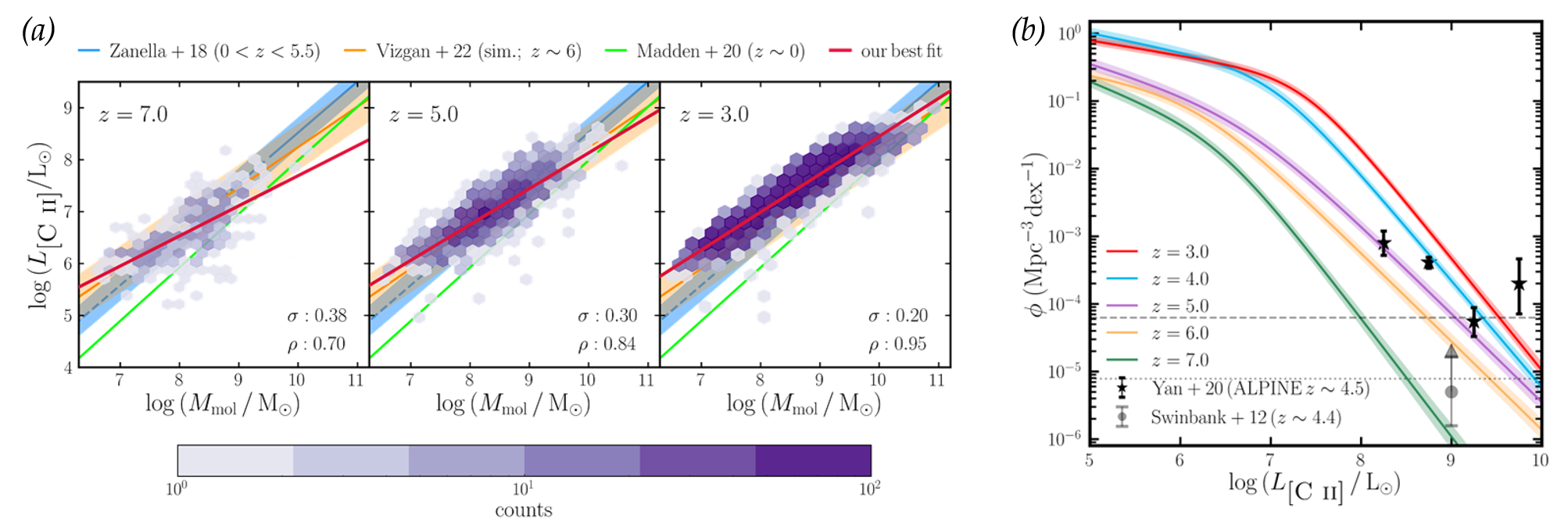
In recent years, the fine-structure line of C+ at 158 microns – the [CII] line – has gained significant attention as a molecular gas tracer, particularly at z ≳ 4. Being one of the brightest emission lines in galaxies, it offers a unique window into the molecular ISM of distant galaxies, where conventional tracers like CO become observationally expensive.
We have tested the reliability of this line as a tracer of the molecular gas mass (Mmol) using a statistical sample of galaxies at different cosmic epochs from high-resolution cosmological simulations – the Marigold simulations. Our analysis reveals that the [CII]- Mmol correlation is relatively weak at z ≳ 5, but becomes progressively stronger over time. We also identify a clear secondary dependence on the star formation rate (SFR), accounting for which, significantly improves Mₘₒₗ predictions by a factor of 2.3 at all redshifts.
We have further examined the time evolution of the [CII] luminosity function and the cosmic [CII] luminosity density (ρ[CII]) and found that faint (L[CII] < 107 L⊙) galaxies contribute nearly half of the cosmic ρ[CII] at z ≳ 7. Since these faint galaxies fall below the sensitivity limits of current instruments, detecting them would require alternative observational strategies.
The paper describing our findings has been published in A&A.
DOI: 10.1051/0004-6361/202453048Figure caption: a) Figure showing the redshift-evolution of the [CII]-Mmol relation in galaxies from the Marigoldsimulations. The purple bins show the distribution of simulated galaxies and the red line gives the ordinary least squares linear fit to these galaxies. The blue, lime, and orange lines show previous empirical and numerical estimates for specific redshifts. We note that the [CII]-Mmol correlation tightens and strengthens over time, as indicated by the decreasing scatter (σ) and increasing Spearman’s rank correlation coefficient (ρ) towards lower redshifts.
b) Figure showing the redshift-evolution of the simulated [CII] luminosity function (LF) and a comparison with observational estimates (in black). The coloured lines represent the best-fit double power-law to the simulated LF and the shaded area represents the central 68% credibility range obtained using MCMC chains.
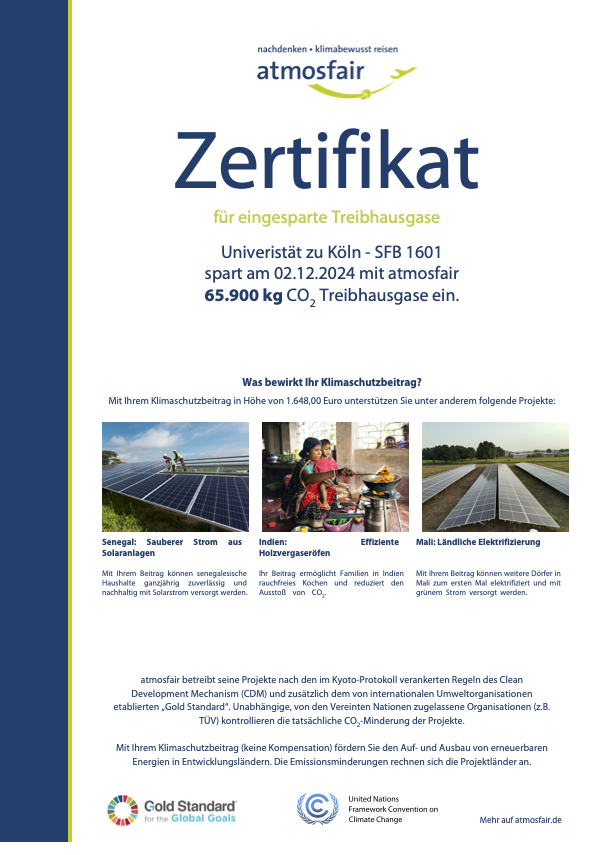
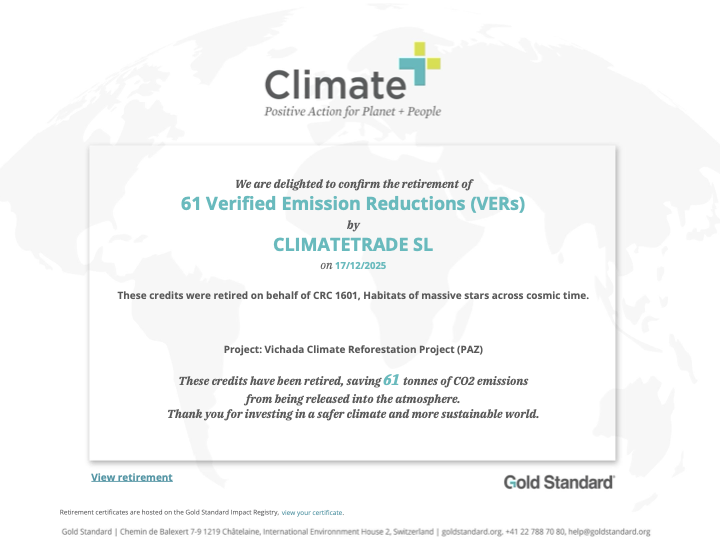
We value our Planet:
1st funding period: 10/2023 – 06/2027