
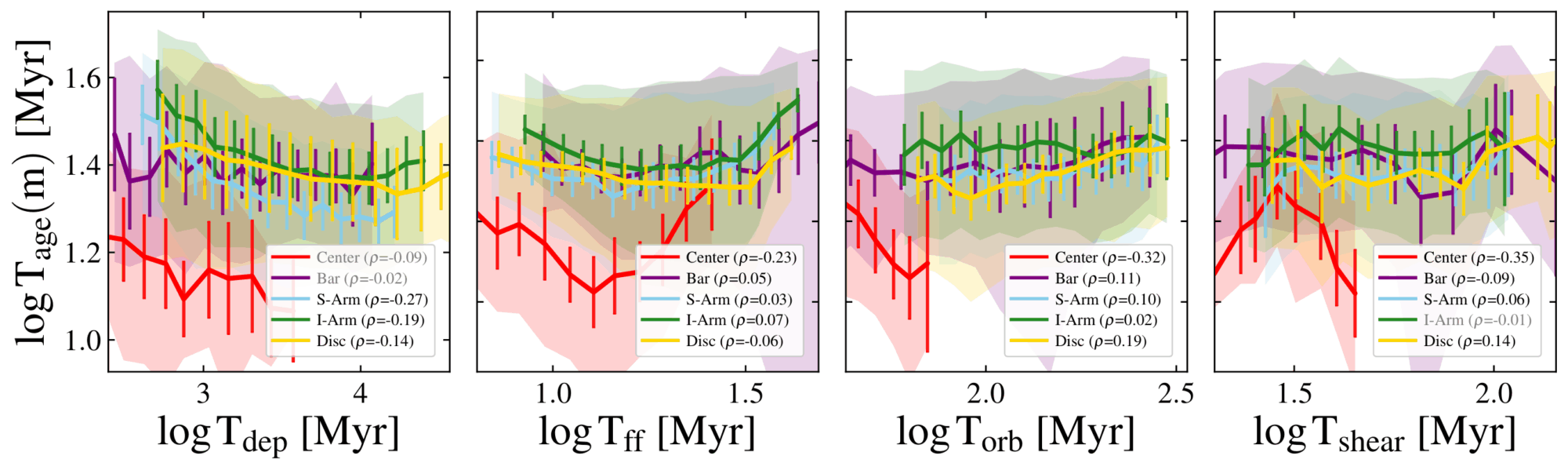
Multiple mechanisms are proposed for forming giant molecular clouds (GMCs), from gravitational free-fall driven by self-gravity to stellar feedback-driven gas compression. Both the galactic environment and galaxy conditions may also enhance formation through gas surface density and star-formation activity. In Bazzi et al. 2026a, we presented a catalog of 108,466 GMCs identified by F770W PHANGS-JWST imaging across 66 galaxies at a resolution of 5-30 pc. In Bazzi et al. 2026b, we use this catalog to measure the mass spectra in various galactic regions, whose power-law slopes vary from -1.2 to -2.0. We then estimate the formation time of each cloud using a model in which GMCs (e.g., Inutsuka et al. 2015; Kobayashi et al. 2017) form by multiple feedback compression, and find that clouds with masses ≤ 10^5 M☉ form in 20 Myr on average, and more massive clouds (~ 10^6-7 M☉) take up to 100 Myr. We also find that cloud formation proceeds most rapidly in the central regions of galaxies, with formation timescales typically shorter by ~ 5-10 Myr than in galactic disks. This highlights the role of intense massive star formation, high molecular gas surface densities, and strong supersonic compressions in accelerating cloud formation. However, star formation is generally inefficient, as shown in Figure 1, where the cloud lifetime is ~1% of the molecular depletion time. Also, cloud formation time is ~0.1 dex longer than the free-fall time. This suggests that magnetic fields, stellar feedback, or other mechanisms may prolong formation rather than allowing immediate free-fall collapse. This also indicates a longevity of massive GMCs. The GMC ages also show only limited variation with galactocentric radius in both spiral and disk galaxies, suggesting that cloud formation proceeds similarly in these galaxy types.
Paper Link: https://www.aanda.org/articles/aa/abs/2026/06/aa59653-26/aa59653-26.html (Bazzi et al. 2026b)