
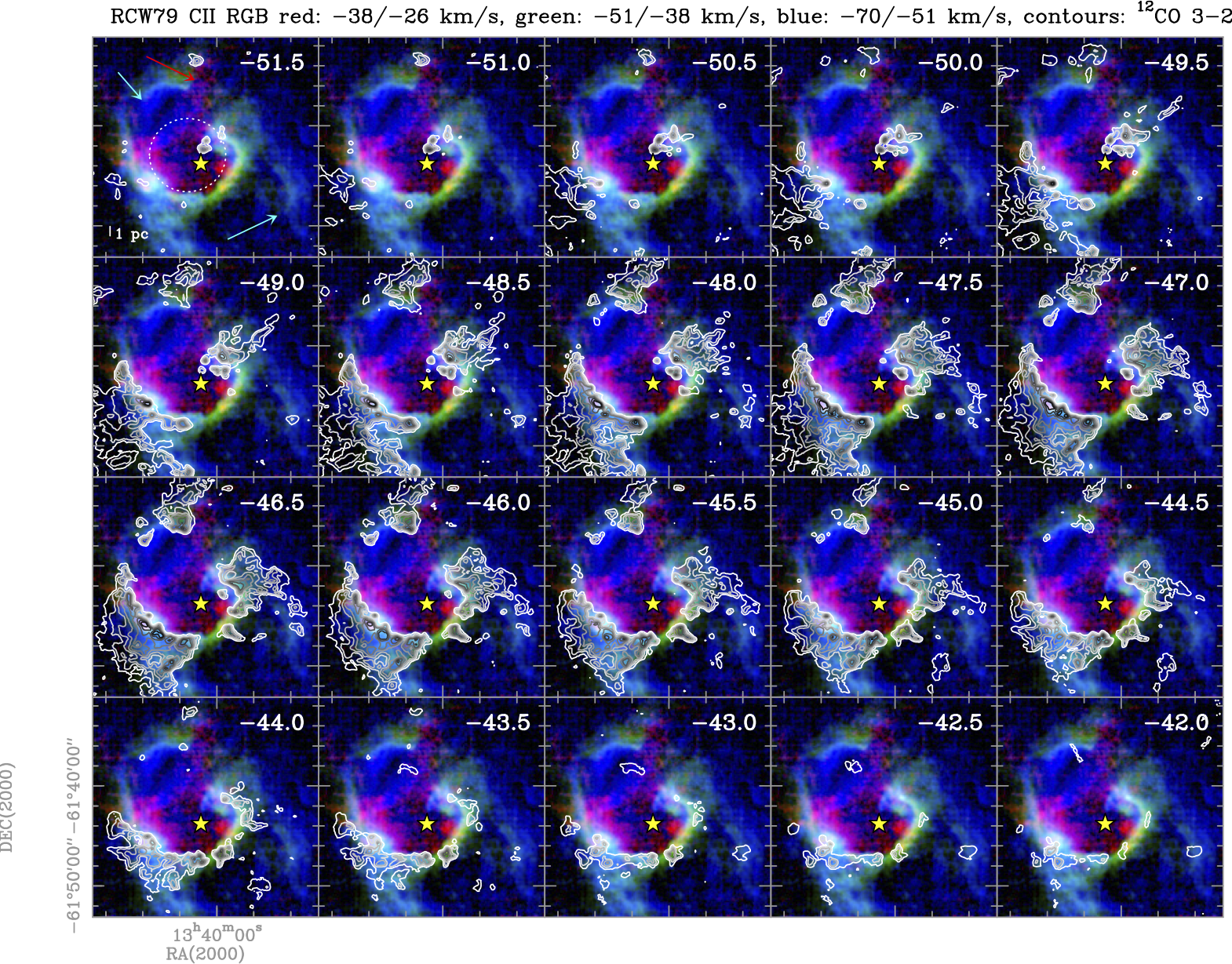
Massive stars are slowly but surely destroying the clouds that gave birth to them. This study by Bonne et al. uses observations of the ionized carbon line at 158 µm ([CII]) to systematically trace how radiation and winds from massive O-type stars erode their parent molecular clouds. Using the airborne observatory SOFIA, ten star-forming regions were mapped. All clouds show fast-moving gas, reaching velocities of 5–30 km/s above the cloud’s escape velocity, meaning this gas is permanently lost from the cloud.
The key finding is that this high-velocity gas cannot be explained by a simple, coherent expanding bubble,as was found in earlier studies of some HII regions. The dynamical timescales derived from the gas motions are always shorter than 0.75 million years, regardless of whether the stellar cluster is 0.5 or 2.5 million years old — a striking inconsistency. Instead, it is proposed, similar to
conclusions from observations and simulations of Dannhauer et al. (2025), that the initial bubble breaks open within about 0.1 million years. The gas continuously streams out of the cloud through holes and low-density channels carved into the irregular, fragmented cloud structure.
These erosion flows are efficient enough to ultimately disperse the entire molecular cloud within a few million years. Mass ejection rates range from roughly 0.001 to 0.02 solar masses per year, increasing systematically with the number and luminosity of the exciting O stars. This yields cloud lifetimes of 3–10 million years after the onset of massive star formation — consistent with independent estimates from other methods. Remarkably, these mass ejection rates are comparable in magnitude to the mass infall rates measured in actively collapsing star-forming clumps, suggesting that stellar feedback can balance gravitational infall and is a key mechanism keeping star formation rates in galaxies as low as observed.
available at: