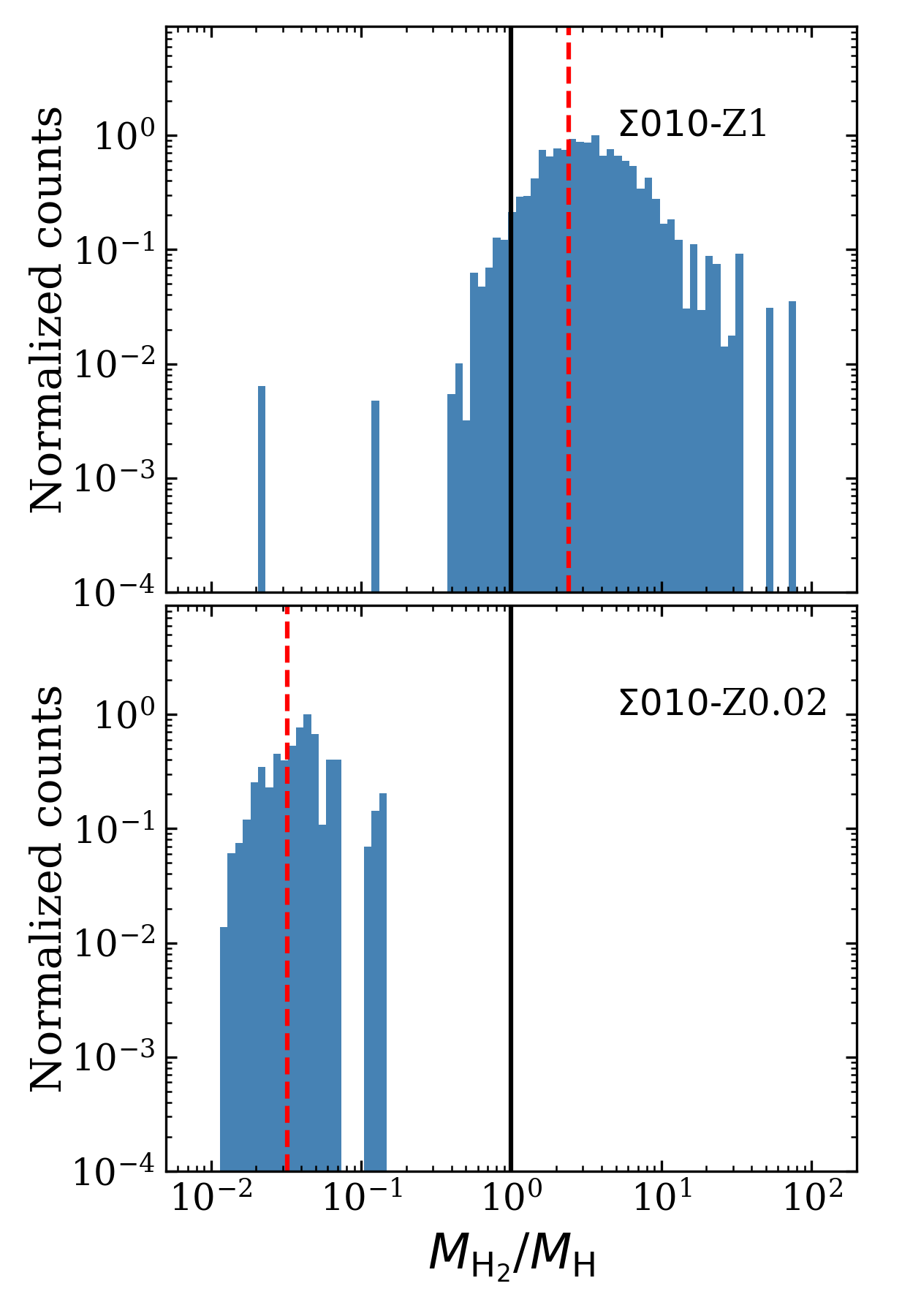
In our latest SILCC paper, we perform magneto-hydrodynamic simulations to investigate the impact of metallicity on the interstellar medium (ISM). In fact, gas-phase metallicity affects heating and cooling processes in the star-forming ISM as well as ionising luminosities, wind strengths, and lifetimes of massive stars. Our simulations include non-equilibrium chemistry, a space- and time-variable far-UV background and cosmic ray ionisation rate, metal-dependent stellar tracks, the formation of HII regions, stellar winds, type II supernovae, and cosmic ray injection and transport. The simulations assume a gas surface density of 10 M_sun pc−2 and span metallicities from 1/50 Z_sun to 1 Zsun. Among our results, we find that for decreasing metallicity, the star formation rate decreases by more than a factor of ten, the mass fraction of cold gas decreases from 60% to 2.3%, while the volume filling fraction of the warm gas increases from 20% to 80%. In particular, we analyze the conditions in which our stars form, computing the ratio of the H2 mass to the H mass in star-forming regions, and we find that this ratio depends on the metallicity. In fact, we find that at solar metallicity (upper panel), massive stars form in an almost fully molecular gas, whereas at extremely low metallicity (bottom panel), they form in almost fully atomic gas. Including the major processes that regulate ISM properties, this study highlights the strong impact of gas phase metallicity on the star-forming ISM.