
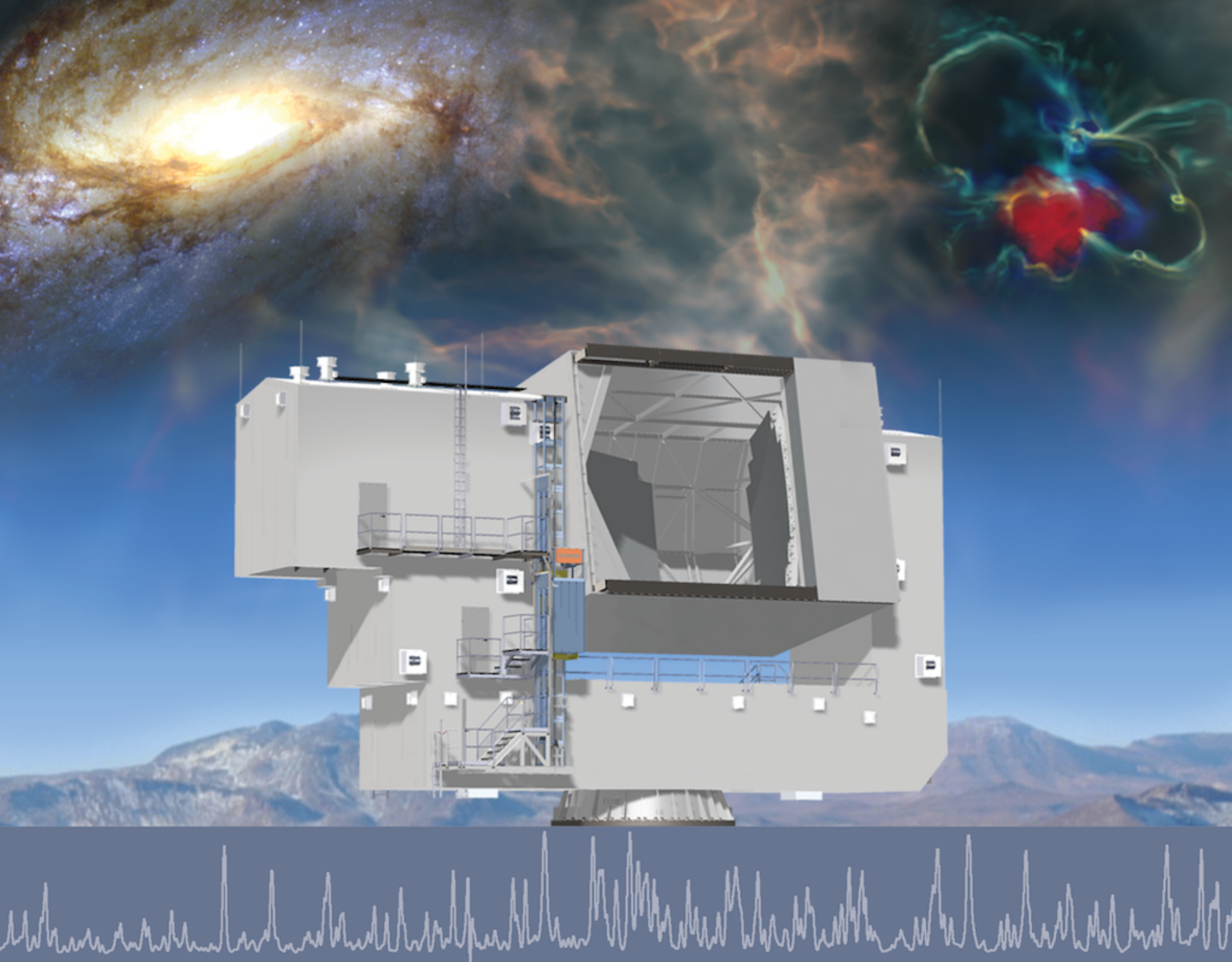
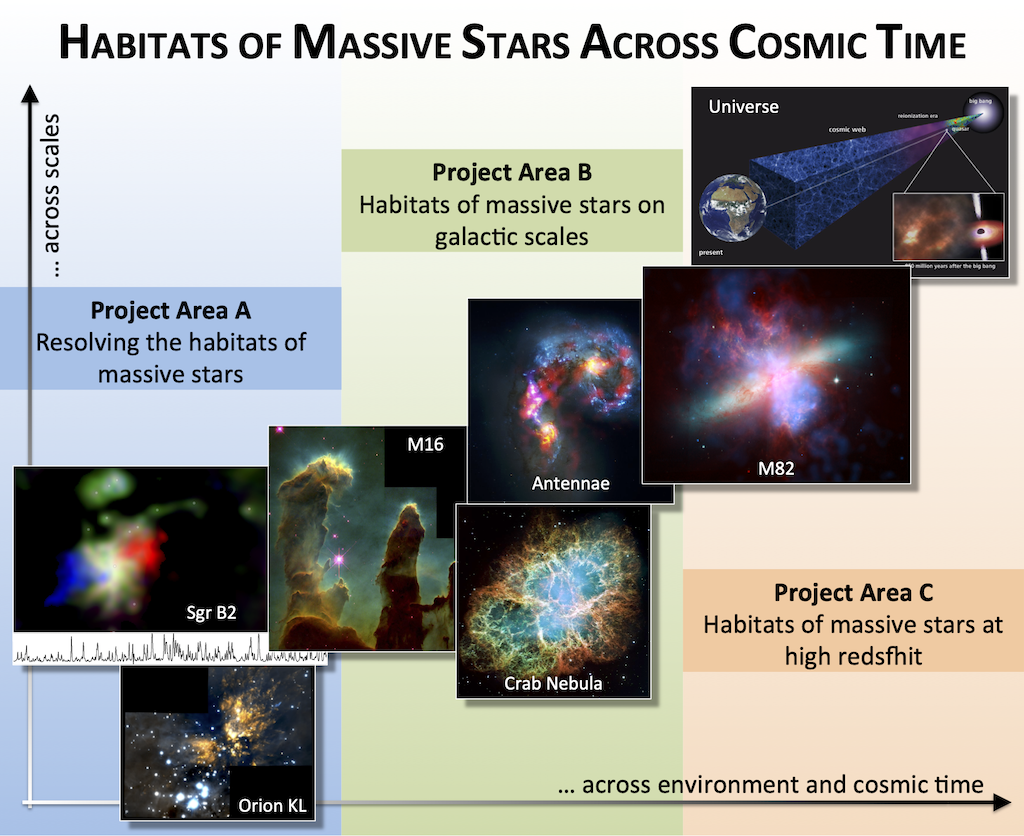
Massive stars, due to their short lifetime and high energy output, drive the evolution of galaxies across cosmic time. Hence, they substantially contribute to shaping the present-day Universe. The Collaborative Research Centre (CRC) will unravel the “habitats of massive stars across cosmic time”. “Habitats” are the gaseous environments within which massive stars are born and which they interact with via their feedback. Over the anticipated 12-year lifetime of this new CRC initiative, we aim to connect the physical processes that govern the habitats of massive stars across the full range of environments hosting massive stars – from sub-parsec to mega-parsec scales and from the Milky Way to the high-redshift Universe, where massive stars leave their cosmological fingerprint by driving cosmic reionisation.
Key Profile Area
“Dynamics of the Universe”
Our universe is full of fascinating, mysterious and often surprising phenomena. Understanding and explaining this in physical terms is the task of the new key profile area Dynamics of the Universe.
The Dynamics of the Universe key profile area establishes an excellent environment for training, early contact with current research, and exchange in international co-operations and competitions. In addition, the interdisciplinary collaboration between the fields of physics, computer science and applied mathematics will be strengthened in the long term. This is particularly important given the need to meet unprecedented challenges arising from the large amounts of observational data being generated by way of innovative ideas and algorithms, and to enable and efficiently advance complex simulations using new hardware technologies.
SFB 1601 News
Public Outreach
Symposium 2026
HRMS 2025

Colloquium
Child Care
Publications
Videos & Articles
SFB 1601 Projects
PhD Students
Family & Diversity
Sustainability
Science Highlight
-
B2: The Diamond Ring in Cygnus X – Environment shapes evolution (Simon Dannhauer, Nicola Schneider, Robert Simon, Sebastian Vider)
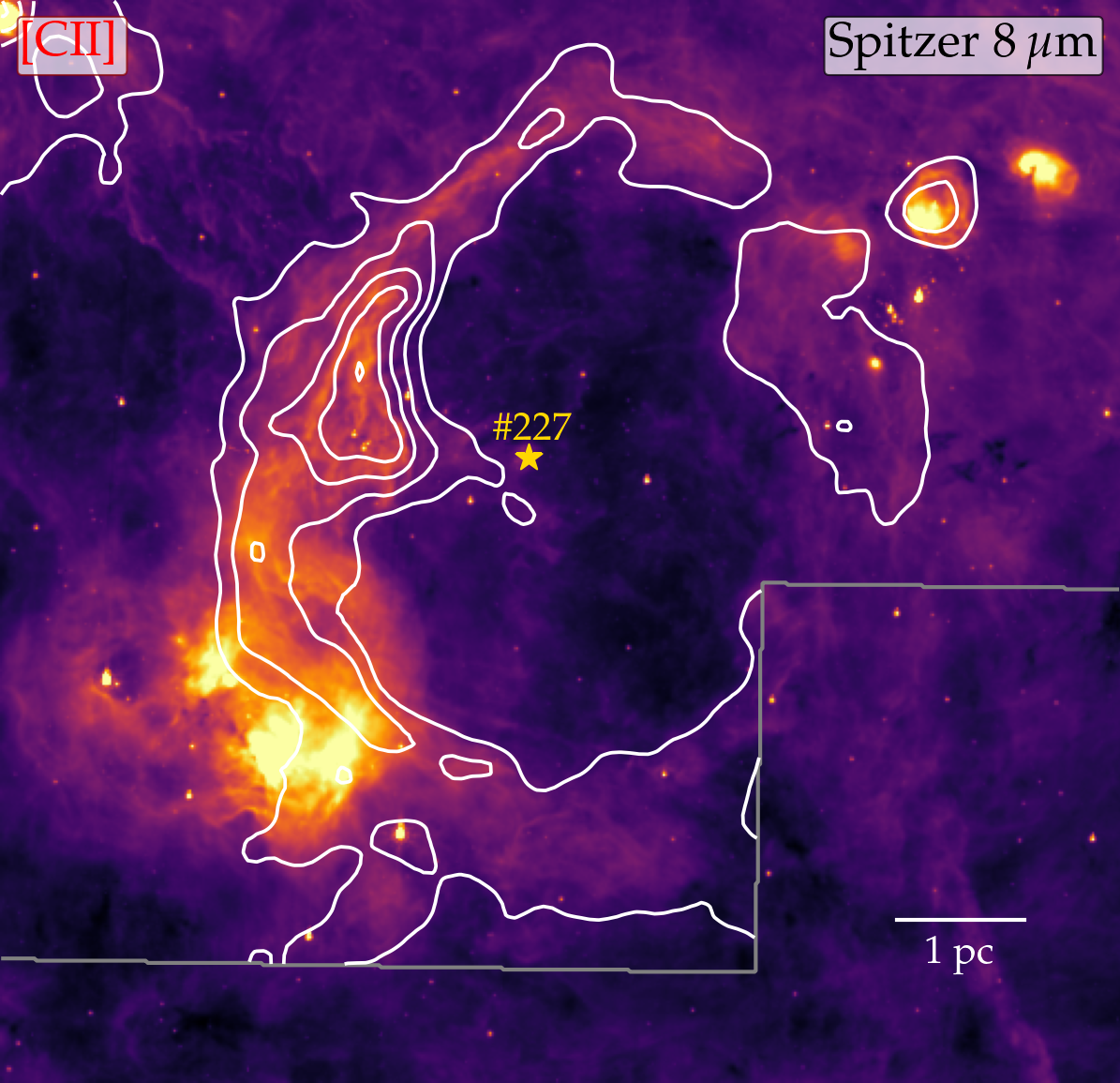
In our recent A&A paper (Dannhauer et al., subm.), we investigated the “Diamond Ring” in Cygnus X, a striking 6 pc wide ring-like structure seen in [C II] 158 μm and dust emission. Unlike the three-dimensional [C II] shells discovered in recent years, the Diamond Ring reveals itself as the first pure ring, slowly expanding at only ~1.3 km/s.
The [C II] data stem from velocity-resolved SOFIA/upGREAT maps from the FEEDBACK legacy program. Combined with archival molecular line data, dust continuum, radio observations, and new spectroscopy of the central star, we establish a picture of the nature of this object. The ring is powered by a B0.5e star located near its center which also creates an HII region in the ring cavity. Interestingly, the bright “Diamond” to the southeast of the ring is not part of the same structure, but an unrelated clump of dense gas and young stars at a completely different velocity along the line of sight.
We carried out dedicated 3D simulations of stellar feedback in a flat molecular slab, in order to follow the evolution of a ring-like structure. These simulations demonstrate that the Diamond Ring represents the terminal phase of a [C II] bubble evolving inside such a slab. In its early life, the bubble expanded in three dimensions. However, gas moving perpendicular to the plane of the slab quickly dispersed into the surrounding lower-density medium dropping below our detection limit, while the parts confined to the slab persisted as a coherent, slowly expanding ring.
From the observations and simulations, we derive an age of only ~400–500 kyr, much younger than classical estimates assuming spherical expansion, with cloud dispersal taking over after 100 kyr as also suggested by previous studies. The Diamond Ring highlights how the geometry of molecular clouds, especially flat clouds which might be common, fundamentally shapes stellar feedback.
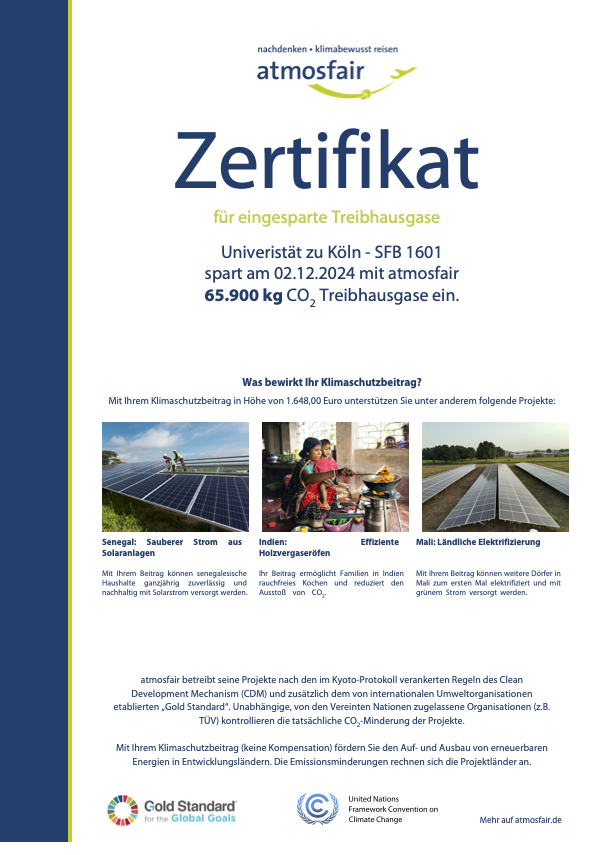
We value our Planet:

1st funding period: 10/2023 – 06/2027