
Astronomers identify more than four hundred individual rings in the jet of the binary star system SVS 13 / publication in ‘Nature Astronomy’
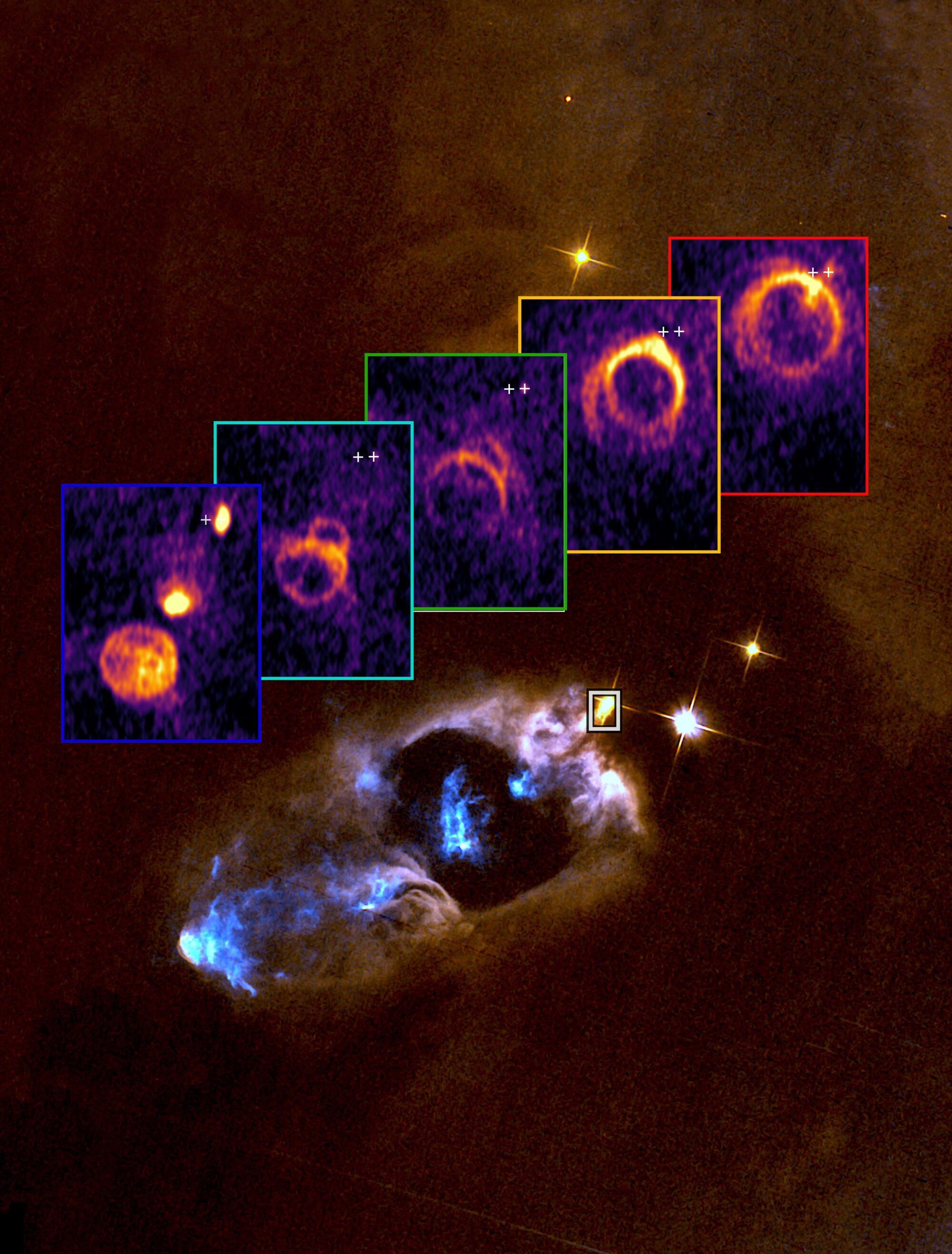
A team of astronomers including a researcher from Cologne has captured the most detailed images ever taken of a jet launched by a young star. In astronomy, a jet is a narrow, rapid stream of particles and energy that is hurled into space by celestial objects ranging from black holes to young stars. The latest images show a series of delicate, ring-like structures that record violent outbursts of energy during the star’s early life. With these findings, the researchers have confirmed a theoretical model that has prevailed for decades. The study ‘Bowshocks driven by the pole-on molecular jet of outbursting protostar SVS 13’ was published in the scientific journal Nature Astronomy.
The team used the Atacama Large Millimeter/submillimeter Array (ALMA) for its measurements and focused on a fast-moving jet emerging from SVS 13, a binary system approximately 1,000 light years from Earth. The researchers captured high-resolution images that show hundreds of nested molecular rings. Each group of rings traces the aftermath of an energetic burst during the star’s infancy.
The results provide the first direct confirmation of a three-decade-old model of these jets and – like the annual rings of trees – allow the reconstruction of the chronological processes of star formation. They show how stars ‘feed’ on surrounding material during their formation, before expelling some of it explosively.
Gary Fuller, Professor of Astrophysics at the University of Manchester and, a member of the Global Faculty of the University of Cologne, also a project leader in the new Dynaverse Cluster of Excellence, is a co-author of the paper. He says: “ALMA has provided a level of precision we’ve never been able to achieve before. These images give us a completely new way of reading a young star’s history. Each group of rings is effectively a time-stamp of a past eruption. It gives us an important new insight into how young stars grow and how their developing planetary systems are shaped.”
Stars like the Sun form deep within dense clouds of gas and dust. In their earliest stages, they undergo energetic outbursts that heat and disturb the material around them. At the same time, they launch rapid, tightly collimated jets of gas, that play a crucial role in regulating how the star accumulates matter and how its surrounding disc – where future planets will eventually form – develops.
The team identified more than 400 individual rings in the jet from SVS 13, showing how its shape and speed change over time. Using this data, the researchers reconstructed the jet’s 3D structure in unprecedented detail – a technique they refer to as ‘cosmic tomography’.
They found that the youngest ring matches a bright outburst observed in the SVS 13 system in the early 1990s. This is the first time astronomers have been able to directly connect a specific burst of activity in a forming star with a change in the speed of its jet.
The project involved researchers from 16 institutions across eight countries. It was led by the Institute of Astrophysics of Andalusia (IAA-CSIC) in Spain. The new ALMA observations form part of a long-running project to understand how stars and planets form, building on earlier work from the US National Science Foundation’s Very Large Array (VLA), which first revealed the jets from SVS 13.
Media Contact:
Professor Dr Gary Fuller
Institute for Astrophysics
+44 161 306 3653
fuller@ph1.uni-koeln.de
Press and Communications Team:
Jan Voelkel
+49 221 470 2356
j.voelkel@verw.uni-koeln.de
For publication:
www.nature.com/articles/s41550-025-02716-2
Figure: “Tomographic” view obtained by ALMA that reveals how the supersonic
protostellar jet from SVS 13 interacts with the surrounding environment. In the
background, an image taken by the Hubble Space Telescope (HST) shows the cavity
carved out by the jet, together with the bluish glow of the Herbig–Haro objects 7–11,
especially striking at optical wavelengths. Credits: Guillermo Blázquez-Calero, Mayra
Osorio, Guillem Anglada. Background image credits: ESA/Hubble & NASA, Karl
Stapelfeldt.
Article: https://www.nature.com/articles/s41550-025-02716-2#Ack1